

Check if There Is a Valid Parentheses String Path
Hard
A parentheses string is a non-empty string consisting only of '(' and ')'. It is valid if any of the following conditions is true:
- It is
(). - It can be written as
AB(Aconcatenated withB), whereAandBare valid parentheses strings. - It can be written as
(A), whereAis a valid parentheses string.
You are given an m x n matrix of parentheses grid. A valid parentheses string path in the grid is a path satisfying all of the following conditions:
- The path starts from the upper left cell
(0, 0). - The path ends at the bottom-right cell
(m - 1, n - 1). - The path only ever moves down or right.
- The resulting parentheses string formed by the path is valid.
Return true if there exists a valid parentheses string path in the grid. Otherwise, return false.
Example 1:

Input: grid = [["(","(","("],[")","(",")"],["(","(",")"],["(","(",")"]]
Output: true
Explanation: The above diagram shows two possible paths that form valid parentheses strings.
The first path shown results in the valid parentheses string "()(())".
The second path shown results in the valid parentheses string "((()))".
Note that there may be other valid parentheses string paths.
Example 2:
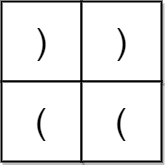
Input: grid = [[")",")"],["(","("]]
Output: false
Explanation: The two possible paths form the parentheses strings "))(" and ")((". Since neither of them are valid parentheses strings, we return false.
Constraints:
m == grid.lengthn == grid[i].length1 <= m, n <= 100grid[i][j]is either'('or')'.

Solution
Clarifying Questions
When you get asked this question in a real-life environment, it will often be ambiguous (especially at FAANG). Make sure to ask these questions in that case:
- What are the dimensions of the matrix, and what are the upper bounds for the number of rows and columns?
- Can the matrix be empty (0x0)? What should I return in that case?
- Besides '(' and ')', can the matrix contain any other characters?
- What constitutes a 'valid parentheses string path'? Is it simply a path from the top-left to the bottom-right where at each step, the resulting string formed by concatenating the characters along the path is a valid parentheses string, and how do I define what a 'valid parentheses string' is?
- If there are multiple valid paths, should I return true as soon as I find one, or do I need to find all of them (or return a specific one)?
- Is diagonal movement allowed?
Brute Force Solution
Approach
The brute force way to solve this is to try every single possible path through the grid. We'll check if each of these paths creates a valid string of parentheses.
Here's how the algorithm would work step-by-step:
- Start at the top-left corner of the grid.
- Explore every possible path from the starting point to the bottom-right corner.
- At each step, we can only move down or to the right.
- As we follow each path, build a string by adding the parenthesis we encounter at each cell.
- Once we reach the bottom-right corner, check if the string we built has balanced parentheses (meaning every open parenthesis has a matching close parenthesis in the correct order).
- If we find at least one path that leads to a valid balanced string, then the answer is yes.
- If we have explored every possible path and found no valid string, the answer is no.
Code Implementation
def check_if_there_is_a_valid_parentheses_string_path(grid):
    number_of_rows = len(grid)
    number_of_columns = len(grid[0])

    def is_valid_parentheses_string(parentheses_string):
        balance = 0
        for character in parentheses_string:
            if character == '(':
                balance += 1
            else:
                balance -= 1
            if balance < 0:
                return False
        return balance == 0

    def find_path(row, column, current_string):
        # If we are out of bounds, this is not a valid path
        if row >= number_of_rows or column >= number_of_columns:
            return False

        current_string += grid[row][column]

        # We have reached the destination
        if row == number_of_rows - 1 and column == number_of_columns - 1:
            return is_valid_parentheses_string(current_string)

        # Explore going down
        if find_path(row + 1, column, current_string):
            return True

        # Explore going right
        if find_path(row, column + 1, current_string):
            return True

        return False

    # Initiate search from top-left
return find_path(0, 0, '')Big(O) Analysis
Optimal Solution
Approach
The core idea is to use a technique to efficiently explore all possible paths in the grid, keeping track of the balance between open and closed parentheses. If we reach the destination with a balanced state (equal number of open and closed parentheses), it means we have found a valid path. We avoid recomputing paths by remembering previously visited locations and their parenthesis balance.
Here's how the algorithm would work step-by-step:
- Begin at the starting point of the grid and maintain a count to represent the running balance of open and closed parentheses as you move along a path.
- At each position in the grid, update the parenthesis count. Add one for an open parenthesis and subtract one for a closed parenthesis.
- To prevent re-exploration of the same paths and avoid exceeding limits of the environment, store information about each grid position and the parenthesis count at that position to remember the state.
- If at any point the parenthesis count goes below zero, this indicates an invalid path because there are more closed parentheses than open ones. Discard this path immediately.
- Continue exploring paths recursively or iteratively. When a path reaches the end point, verify if the parenthesis count is zero. If it is, a valid path exists and the process may stop (if we need just one valid path).
- If all paths are explored and no valid path with a final parenthesis count of zero is discovered, then no valid path exists.
Code Implementation
def check_if_there_is_a_valid_parentheses_string_path(grid):
    number_of_rows = len(grid)
    number_of_columns = len(grid[0])

    # Use a set to store visited states (row, col, balance).
    visited = set()

    def depth_first_search(row, col, parenthesis_balance):
        # If out of bounds, return False
        if row < 0 or row >= number_of_rows or col < 0 or col >= number_of_columns:
            return False

        # Update the parenthesis balance.
        if grid[row][col] == '(':
            parenthesis_balance += 1
        else:
            parenthesis_balance -= 1

        # If balance is negative, it's invalid.
        if parenthesis_balance < 0:
            return False

        # If we reached the destination.
        if row == number_of_rows - 1 and col == number_of_columns - 1:
            # Valid path if the parenthesis are balanced
            return parenthesis_balance == 0

        # Check if the state has been visited before
        if (row, col, parenthesis_balance) in visited:
            return False

        # Mark the current state as visited.
        visited.add((row, col, parenthesis_balance))

        # Explore the path downwards and to the right
        down = depth_first_search(row + 1, col, parenthesis_balance)
        right = depth_first_search(row, col + 1, parenthesis_balance)

        return down or right

    # Initiate dfs with the top-left cell
return depth_first_search(0, 0, 0)Big(O) Analysis
Edge Cases
| Case | How to Handle |
|---|---|
| Null or empty grid | Return false immediately, as there's no path to traverse. |
| Grid with only one cell | Return true if the single cell contains a parenthesis, otherwise false. |
| Grid with mismatched starting/ending parentheses | If the starting cell is ')' or the ending cell is '(', a valid path is impossible, so return false. |
| Long path exceeding maximum recursion depth (if using recursion) | Use dynamic programming (memoization) or iterative approach to avoid stack overflow errors. |
| Grid containing non-parenthesis characters | Treat non-parenthesis characters as invalid input and return false. |
| No valid path exists despite balanced parentheses in the grid | The algorithm should explore all possible paths and correctly return false if no valid path exists. |
| Large grid dimensions impacting memory usage | Optimize memory usage by using techniques like bitmasking to represent the parenthesis balance, or using an in-place modification approach if allowed and feasible. |
| Grid with only opening or only closing parentheses preventing balance | The path will never become balanced, leading to no valid path and return false. |






