

Design an Ordered Stream
Easy

There is a stream of n (idKey, value) pairs arriving in an arbitrary order, where idKey is an integer between 1 and n and value is a string. No two pairs have the same id.
Design a stream that returns the values in increasing order of their IDs by returning a chunk (list) of values after each insertion. The concatenation of all the chunks should result in a list of the sorted values.
Implement the OrderedStream class:
OrderedStream(int n)Constructs the stream to takenvalues.String[] insert(int idKey, String value)Inserts the pair(idKey, value)into the stream, then returns the largest possible chunk of currently inserted values that appear next in the order.
Example:
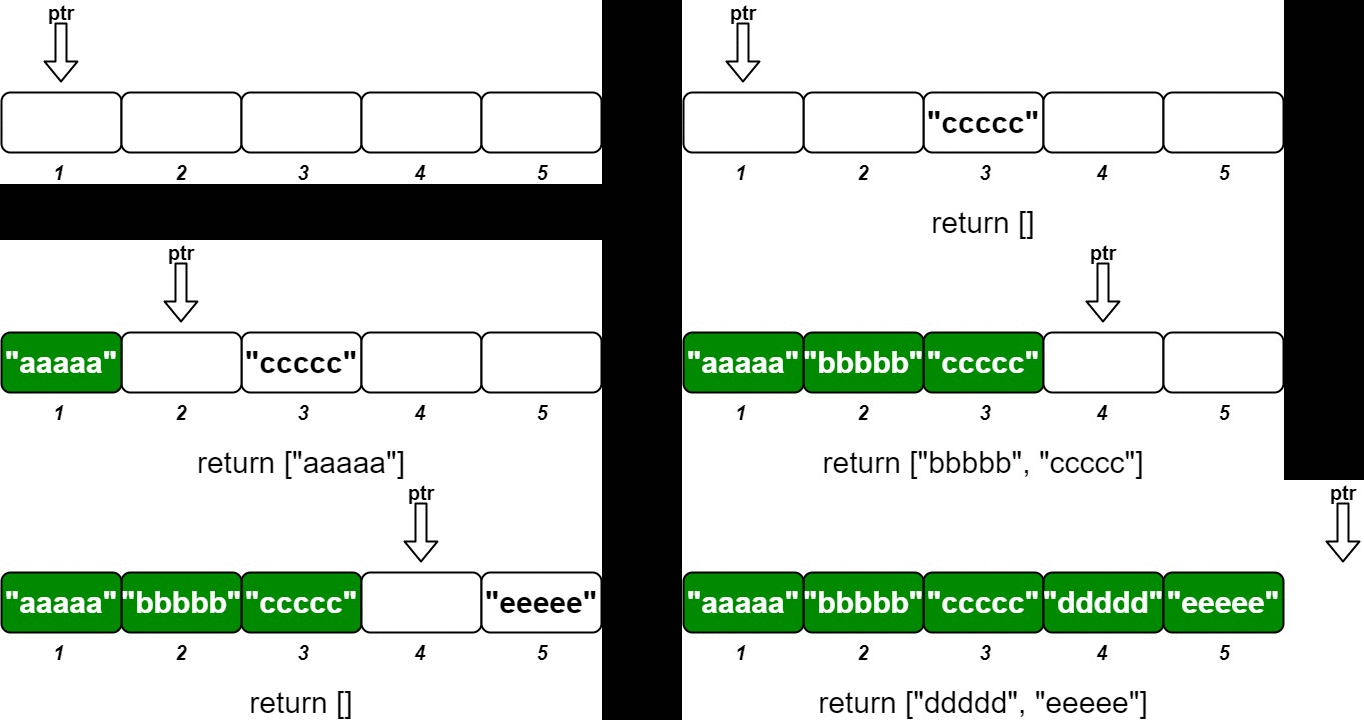
Input
["OrderedStream", "insert", "insert", "insert", "insert", "insert"]
[[5], [3, "ccccc"], [1, "aaaaa"], [2, "bbbbb"], [5, "eeeee"], [4, "ddddd"]]
Output
[null, [], ["aaaaa"], ["bbbbb", "ccccc"], [], ["ddddd", "eeeee"]]

Explanation
// Note that the values ordered by ID is ["aaaaa", "bbbbb", "ccccc", "ddddd", "eeeee"].
OrderedStream os = new OrderedStream(5);
os.insert(3, "ccccc"); // Inserts (3, "ccccc"), returns [].
os.insert(1, "aaaaa"); // Inserts (1, "aaaaa"), returns ["aaaaa"].
os.insert(2, "bbbbb"); // Inserts (2, "bbbbb"), returns ["bbbbb", "ccccc"].
os.insert(5, "eeeee"); // Inserts (5, "eeeee"), returns [].
os.insert(4, "ddddd"); // Inserts (4, "ddddd"), returns ["ddddd", "eeeee"].
// Concatentating all the chunks returned:
// [] + ["aaaaa"] + ["bbbbb", "ccccc"] + [] + ["ddddd", "eeeee"] = ["aaaaa", "bbbbb", "ccccc", "ddddd", "eeeee"]
// The resulting order is the same as the order above.
Constraints:
1 <= n <= 10001 <= id <= nvalue.length == 5valueconsists only of lowercase letters.- Each call to
insertwill have a uniqueid. - Exactly
ncalls will be made toinsert.

Solution
Clarifying Questions
When you get asked this question in a real-life environment, it will often be ambiguous (especially at FAANG). Make sure to ask these questions in that case:
- What is the range of possible values for the `idKey`?
- Is the input stream guaranteed to contain all IDs from 1 to n, or could there be gaps?
- If an `idKey` is received out of order but would eventually complete a chunk (e.g., chunk starts at 3, but we first receive 5, then 3, then 4), should we buffer those until the chunk is complete?
- What should be returned if no new chunk can be formed with the current data in the stream?
- If the input contains duplicate `idKey` values, what should the behaviour be?
Brute Force Solution
Approach
The Ordered Stream problem requires us to assemble a sequence of values in the correct order based on their positions. A brute-force approach involves repeatedly checking for the next expected value in the stream and adding it to our result if it's available.
Here's how the algorithm would work step-by-step:
- We receive pieces of the stream one at a time.
- We keep track of the next position we expect to see.
- When a new piece arrives, we see if it's the piece we were expecting.
- If it is, we add it to our ordered sequence.
- Then, we check if the next several pieces after that are also in the correct order.
- We continue adding pieces as long as they are in the correct sequence following the last added piece.
- If we receive a piece that is not the next expected piece, we simply store it for later.
- When asked to provide the output, we return the sequence we've built so far.
Code Implementation
class OrderedStream:

    def __init__(self, stream_size: int):
        self.stream_array = [None] * (stream_size + 1)
        self.pointer = 1

    def insert(self, id_key: int, value: str) -> list[str]:
        self.stream_array[id_key] = value
        result = []

        # Keep adding values to result while in order
        while self.pointer < len(self.stream_array) and self.stream_array[self.pointer] is not None:
            result.append(self.stream_array[self.pointer])
            self.pointer += 1

return resultBig(O) Analysis
Optimal Solution
Approach
The goal is to process a stream of data in order. Instead of immediately returning data as it arrives, we hold onto it until we have a continuous sequence starting from the expected position. This allows us to efficiently output the ordered stream.
Here's how the algorithm would work step-by-step:
- Keep track of the next expected position in the ordered stream.
- As data chunks arrive, store them in a temporary holding place.
- Check if the current chunk's position matches the next expected position.
- If it matches, extract this chunk and any immediately following chunks from the holding place that form a continuous sequence.
- Output the extracted continuous sequence.
- Update the next expected position to reflect the end of the outputted sequence.
- If the current chunk's position doesn't match the next expected position, do nothing and keep storing the chunk until it is needed.
Code Implementation
class OrderedStream:
    def __init__(self, number_of_values):
        self.data_store = {}
        self.current_position = 1

    def insert(self, id_key, value):
        self.data_store[id_key] = value
        output = []

        # Check if the current id matches expected position
        if id_key == self.current_position:

            # Extract and append continuous sequence
            while self.current_position in self.data_store:
                output.append(self.data_store[self.current_position])
                self.current_position += 1

        # We increment the position only when a continuous sequence is extracted
return outputBig(O) Analysis
Edge Cases
| Case | How to Handle |
|---|---|
| Empty input stream | Initialize the internal data structure to an appropriate empty state and return an empty list for any `insert` call. |
| Input `idKey` less than 1 | Throw an IllegalArgumentException or return an empty list as invalid idKey leads to out-of-bounds access if used as index. |
| Input `idKey` greater than stream length | Throw an IllegalArgumentException or return an empty list because this is an invalid insertion location beyond the stream's capacity. |
| Maximum stream length reached (consider memory constraints) | Check if the stream has reached its maximum capacity before inserting; if so, either resize (if allowed) or throw an exception to prevent memory overflow. |
| Inserting out-of-order, but contiguous elements | Store the value at the given index; when the pointer reaches the stored index, start returning the contiguous chunk. |
| Inserting out-of-order and non-contiguous elements (gaps in the ordered stream) | Store the inserted values and only return a chunk when the current pointer finds the start of a contiguous block of non-null values. |
| Null value being inserted | Store the null value in the array and skip it when returning chunks as per expected behavior (depending on requirements, it might be better to throw an exception). |
| Large number of inserts that don't release any data. | The solution should handle a continuous stream of inserts where `ptr` never advances, potentially indicating a problem with the input order; this can lead to memory buildup and the solution should scale efficiently by managing memory appropriately. |






