

All Elements in Two Binary Search Trees
Medium

Given two binary search trees root1 and root2, return a list containing all the integers from both trees sorted in ascending order.
Example 1:

Input: root1 = [2,1,4], root2 = [1,0,3]
Output: [0,1,1,2,3,4]
Example 2:
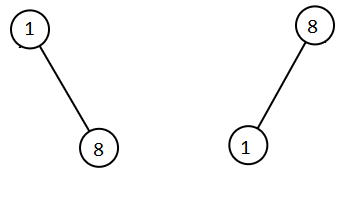
Input: root1 = [1,null,8], root2 = [8,1]
Output: [1,1,8,8]
Constraints:
- The number of nodes in each tree is in the range
[0, 5000]. -105 <= Node.val <= 105

Solution
Clarifying Questions
When you get asked this question in a real-life environment, it will often be ambiguous (especially at FAANG). Make sure to ask these questions in that case:
- What is the range of values that the nodes in the trees can have? Can they be negative, zero, or floating-point numbers?
- Can the trees be empty? What should I return if either or both trees are empty?
- Are duplicate values allowed within either of the binary search trees, and if so, how should they be handled in the final sorted list?
- Do I need to maintain the relative order of elements that come from the same tree in the final sorted list?
- Can I modify the given binary search trees, or should I treat them as immutable?
Brute Force Solution
Approach
The brute force method for combining elements from two sorted trees is straightforward. We extract all the numbers from both trees first. Then, we simply sort all the extracted numbers together to get the final result.
Here's how the algorithm would work step-by-step:
- First, take all the numbers out of the first tree and put them into a list.
- Next, do the same thing for the second tree; put all its numbers into another list.
- Now, combine the two lists into one big list.
- Finally, sort the big list so the numbers are in increasing order.
Code Implementation
class TreeNode:
    def __init__(self, val=0, left=None, right=None):
        self.val = val
        self.left = left
        self.right = right

def getAllElementsBruteForce(root1, root2):
    first_tree_elements = []
    second_tree_elements = []

    def inorderTraversal(root, elements_list):
        if root:
            inorderTraversal(root.left, elements_list)
            elements_list.append(root.val)
            inorderTraversal(root.right, elements_list)

    # Extract elements from the first BST
    inorderTraversal(root1, first_tree_elements)

    # Extract elements from the second BST
    inorderTraversal(root2, second_tree_elements)

    combined_elements = first_tree_elements + second_tree_elements

    # Sorting to combine the elements
    combined_elements.sort()

return combined_elementsBig(O) Analysis
Optimal Solution
Approach
The best way to merge two sorted binary search trees is to first extract their elements into sorted lists. Then, we can efficiently merge these two sorted lists into a single sorted list, which represents all elements in ascending order.
Here's how the algorithm would work step-by-step:
- Go through the first binary search tree and create a sorted list of all its numbers. Because it is a search tree, we can do this efficiently.
- Do the same thing for the second binary search tree: make another sorted list of its numbers.
- Now you have two sorted lists. Merge these two lists together into one big sorted list. The merging process should maintain the sorted order.
- The final sorted list contains all the elements from both trees in the correct order.
Code Implementation
class TreeNode:
    def __init__(self, val=0, left=None, right=None):
        self.val = val
        self.left = left
        self.right = right

class Solution:
    def getAllElements(self, root1: TreeNode, root2: TreeNode) -> list[int]:
        first_tree_elements = []
        second_tree_elements = []

        def inorder_traversal(root: TreeNode, element_list: list[int]) -> None:
            if root:
                inorder_traversal(root.left, element_list)
                element_list.append(root.val)
                inorder_traversal(root.right, element_list)

        # Traverse the first tree and store elements in sorted order.
        inorder_traversal(root1, first_tree_elements)

        # Traverse the second tree and store elements in sorted order.
        inorder_traversal(root2, second_tree_elements)

        merged_elements = []
        first_index = 0
        second_index = 0

        # Merge the two sorted lists into a single sorted list.
        while first_index < len(first_tree_elements) and second_index < len(second_tree_elements):
            if first_tree_elements[first_index] <= second_tree_elements[second_index]:
                merged_elements.append(first_tree_elements[first_index])
                first_index += 1
            else:
                merged_elements.append(second_tree_elements[second_index])
                second_index += 1

        # Add any remaining elements from the first list.
        while first_index < len(first_tree_elements):
            merged_elements.append(first_tree_elements[first_index])
            first_index += 1

        # Add any remaining elements from the second list.
        while second_index < len(second_tree_elements):
            merged_elements.append(second_tree_elements[second_index])
            second_index += 1

return merged_elementsBig(O) Analysis
Edge Cases
| Case | How to Handle |
|---|---|
| Both trees are empty (null) | Return an empty list as there are no elements to merge. |
| One tree is empty (null), the other is not | Return the sorted list of elements from the non-empty tree. |
| Both trees contain only one node | Merge the two single-element lists into a single sorted list. |
| One tree is extremely large, the other is small | Ensure the merge algorithm avoids excessive recursion or stack overflow issues and considers iterative merging approaches for scalability. |
| Trees contain duplicate values | The merging process should correctly handle duplicates, preserving all occurrences in the final sorted list. |
| Trees contain negative, zero, and positive values | The comparison and merging process should correctly order all elements including negative and zero values. |
| Trees are highly unbalanced or skewed | Inorder traversal should still be efficient, and the merge process should not degrade to quadratic time based on skewness. |
| Integer overflow during element comparison | Utilize a safe comparison method that avoids direct subtraction or addition to prevent potential overflow errors. |






