

Binary Tree Maximum Path Sum
Hard




























A path in a binary tree is a sequence of nodes where each pair of adjacent nodes in the sequence has an edge connecting them. A node can only appear in the sequence at most once. Note that the path does not need to pass through the root.
The path sum of a path is the sum of the node's values in the path.
Given the root of a binary tree, return the maximum path sum of any non-empty path.
Example 1:
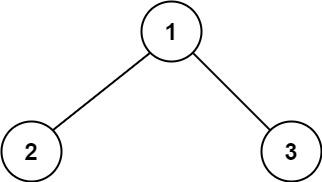
Input: root = [1,2,3]
Output: 6
Explanation: The optimal path is 2 -> 1 -> 3 with a path sum of 2 + 1 + 3 = 6.
Example 2:
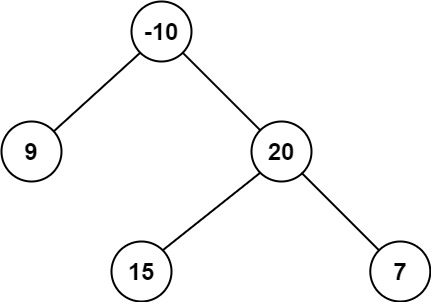
Input: root = [-10,9,20,null,null,15,7]
Output: 42
Explanation: The optimal path is 15 -> 20 -> 7 with a path sum of 15 + 20 + 7 = 42.
Constraints:
- The number of nodes in the tree is in the range
[1, 3 * 104]. -1000 <= Node.val <= 1000

Solution
Clarifying Questions
When you get asked this question in a real-life environment, it will often be ambiguous (especially at FAANG). Make sure to ask these questions in that case:
- Can the tree node values be negative, and can the maximum path sum itself be negative if all nodes in the tree are negative?
- Does a 'path' have to start and end at different nodes, or can a valid path consist of a single node?
- Are there any structural guarantees on the binary tree, such as it being balanced, a complete binary tree, or skewed?
- What is the expected data type and range for the node values (e.g., standard 32-bit integers)?
- Is the input tree guaranteed to be non-empty, or do I need to handle a null root edge case?
Brute Force Solution
Approach
To find the maximum path sum in a tree using the brute force approach, you systematically examine every single possible path that connects any two nodes. By checking every combination of connected nodes, you calculate their total sum and keep track of the highest one found.
Here's how the algorithm would work step-by-step:
- Begin by identifying every possible path in the tree, remembering that a path is any unbroken sequence of connected nodes where you never visit the same node twice.
- Pick one of these paths to start your exploration.
- Add up all the values contained within the nodes of this chosen path.
- Compare this path sum against the highest sum you have found so far, and update your record if this new sum is larger.
- Repeat this process for every other possible path in the entire tree.
- Once you have checked every single path, your recorded highest sum will be your final answer.
Code Implementation
class TreeNode:
    def __init__(self, value=0, left=None, right=None):
        self.val = value
        self.left = left
        self.right = right


def max_path_sum_brute_force(root):
    if not root:
        return 0

    def collect_all_nodes(current_node, node_list):
        if not current_node:
            return
        node_list.append(current_node)
        collect_all_nodes(current_node.left, node_list)
        collect_all_nodes(current_node.right, node_list)

    def find_all_paths(current_node, adjacency_list, current_path, all_paths):
        current_path.append(current_node)
        all_paths.append(list(current_path))
        for neighbor in adjacency_list[current_node]:
            if neighbor not in current_path:
                find_all_paths(neighbor, adjacency_list, current_path, all_paths)
        current_path.pop()

    tree_nodes = []
    collect_all_nodes(root, tree_nodes)

    adjacency_list = {node: [] for node in tree_nodes}

    def build_graph(current_node):
        if not current_node:
            return
        if current_node.left:
            adjacency_list[current_node].append(current_node.left)
            adjacency_list[current_node.left].append(current_node)
            build_graph(current_node.left)
        if current_node.right:
            adjacency_list[current_node].append(current_node.right)
            adjacency_list[current_node.right].append(current_node)
            build_graph(current_node.right)

    build_graph(root)

    # Generate every single valid sequence of connected nodes because brute force requires checking all
    all_possible_paths = []
    for start_node in tree_nodes:
        find_all_paths(start_node, adjacency_list, [], all_possible_paths)

    maximum_sum_found = float('-inf')

    # Iterate through every path to compute its total sum and track the highest value encountered
    for path_sequence in all_possible_paths:
        current_path_sum = sum(node.val for node in path_sequence)
        if current_path_sum > maximum_sum_found:
            maximum_sum_found = current_path_sum

    # Return the highest sum discovered across all exhaustive path combinations
return maximum_sum_foundBig(O) Analysis
Optimal Solution
Approach
To find the most valuable continuous path through a branching tree of numbers, we can visit every junction and calculate the best possible score that can be made by combining the left and right paths. By passing the best single-side score upward while simultaneously checking if a complete peak path is formed at every point, we can find the absolute maximum score in a single pass.
Here's how the algorithm would work step-by-step:
- Imagine standing at the bottom-most parts of the tree and looking upward toward the main root.
- For any junction you visit, ask your left branch and your right branch for the maximum scoring path they can provide from their respective sides.
- Ignore any path from a branch that has a negative score, because adding a negative score would only drag down your total value.
- Calculate the total score of a potential mountain-shaped path that goes up through your left branch, passes through you as the peak, and goes down through your right branch.
- Compare this mountain-shaped path score against the highest score you have recorded so far across the entire tree, and update your record if this new one is higher.
- To help the junction directly above you, figure out which single side (either your left or your right, plus your own value) is better, and pass that single best score upward.
- Continue this process all the way up to the very top of the tree, ensuring every junction acts as a potential peak, until you are left with the highest recorded score overall.
Code Implementation
class Solution:
    def maxPathSum(self, root_node) -> int:
        maximum_path_sum = float('-inf')

        def calculate_gain(current_node):
            nonlocal maximum_path_sum
            if not current_node:
                return 0

            # Negative paths are ignored since they reduce the overall sum.
            left_branch_gain = max(calculate_gain(current_node.left), 0)
            right_branch_gain = max(calculate_gain(current_node.right), 0)

            # A peak path uses both left and right branches through current node.
            current_peak_path = current_node.val + left_branch_gain + right_branch_gain
            maximum_path_sum = max(maximum_path_sum, current_peak_path)

            # Only the best single side can be passed up to the parent junction.
            return current_node.val + max(left_branch_gain, right_branch_gain)

        calculate_gain(root_node)
return maximum_path_sumBig(O) Analysis
Edge Cases
| Case | How to Handle |
|---|---|
| Null root pointer representing an empty tree | Return zero or a special null sentinel value, though the problem states the tree is non-empty. |
| Binary tree with a single node containing a negative value | The recursive DFS will return the negative value itself as the maximum path sum without adding child contributions. |
| Binary tree with all negative node values | Initializing the global maximum to negative infinity ensures we correctly track the single least negative node. |
| Deeply skewed or degenerate binary tree resembling a linked list | Recursion depth reaches N which may cause a stack overflow in languages without tail-call optimization. |
| Path that does not pass through the root node | Computing the local maximum at every node allows any subtree to act as the turning point for a valid path. |
| Node values near the integer minimum or maximum boundaries | Using standard integer types might cause arithmetic overflow when summing large paths, requiring careful constraint handling. |
| Paths where extending to a child yields a negative sum | Taking the maximum of zero and the child path sum effectively discards unprofitable subtrees. |






