

Build a Matrix With Conditions
Build a Matrix With Conditions #729 Most Asked
Hard
You are given a positive integer k. You are also given:
- a 2D integer array
rowConditionsof sizenwhererowConditions[i] = [abovei, belowi], and - a 2D integer array
colConditionsof sizemwherecolConditions[i] = [lefti, righti].
The two arrays contain integers from 1 to k.
You have to build a k x k matrix that contains each of the numbers from 1 to k exactly once. The remaining cells should have the value 0.
The matrix should also satisfy the following conditions:
- The number
aboveishould appear in a row that is strictly above the row at which the numberbelowiappears for allifrom0ton - 1. - The number
leftishould appear in a column that is strictly left of the column at which the numberrightiappears for allifrom0tom - 1.
Return any matrix that satisfies the conditions. If no answer exists, return an empty matrix.
Example 1:
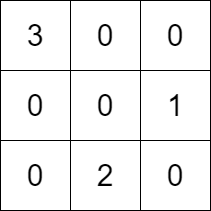
Input: k = 3, rowConditions = [[1,2],[3,2]], colConditions = [[2,1],[3,2]]
Output: [[3,0,0],[0,0,1],[0,2,0]]
Explanation: The diagram above shows a valid example of a matrix that satisfies all the conditions.
The row conditions are the following:
- Number 1 is in row 1, and number 2 is in row 2, so 1 is above 2 in the matrix.
- Number 3 is in row 0, and number 2 is in row 2, so 3 is above 2 in the matrix.
The column conditions are the following:
- Number 2 is in column 1, and number 1 is in column 2, so 2 is left of 1 in the matrix.
- Number 3 is in column 0, and number 2 is in column 1, so 3 is left of 2 in the matrix.
Note that there may be multiple correct answers.
Example 2:
Input: k = 3, rowConditions = [[1,2],[2,3],[3,1],[2,3]], colConditions = [[2,1]]
Output: []
Explanation: From the first two conditions, 3 has to be below 1 but the third conditions needs 3 to be above 1 to be satisfied.
No matrix can satisfy all the conditions, so we return the empty matrix.
Constraints:
2 <= k <= 4001 <= rowConditions.length, colConditions.length <= 104rowConditions[i].length == colConditions[i].length == 21 <= abovei, belowi, lefti, righti <= kabovei != belowilefti != righti

Solution
Clarifying Questions
When you get asked this question in a real-life environment, it will often be ambiguous (especially at FAANG). Make sure to ask these questions in that case:
- What are the constraints on the dimensions of the matrix and the values that can be placed within it? Specifically, what is the range of possible values, and are there any restrictions like only positive integers?
- If it's impossible to construct a valid matrix satisfying all conditions, what should the function return? Should it return an empty matrix, null, or throw an exception?
- Are there any constraints or relationships between the conditions themselves? For example, could the conditions be contradictory, making a solution impossible?
- If there are multiple valid matrices that satisfy the conditions, is there a specific one I should return, or is any valid solution acceptable?
- Can you provide a more concrete example of the conditions that will be used to build the matrix? This will help me understand the conditions better.
Brute Force Solution
Approach
We are building a square grid of numbers. The brute force strategy involves trying every possible combination of numbers in the grid, checking if each one meets the given requirements.
Here's how the algorithm would work step-by-step:
- Start by filling the first spot in the grid with the first number from our provided list.
- Then, fill the second spot with another number from the provided list.
- Continue doing this until the entire grid is full.
- Once the grid is full, check if this arrangement satisfies all the given conditions.
- If it does, we've found a valid solution. If not, we discard it.
- Now, go back and change one of the numbers in the grid, making sure we have not tried the new number in that specific spot before, and repeat the process.
- Keep doing this, trying all the different combinations of numbers in the grid until we have exhausted all possibilities.
- Finally, from all the valid solutions we found, pick the one that meets any additional specifications, if there are any.
Code Implementation
def build_matrix_brute_force(numbers, row_constraints, col_constraints, matrix_size):
    valid_matrices = []

    def is_valid_matrix(matrix):
        # Check row constraints
        for row_index in range(matrix_size):
            if not row_constraints(matrix[row_index]):
                return False

        # Check column constraints
        for col_index in range(matrix_size):
            column = [matrix[row_index][col_index] for row_index in range(matrix_size)]
            if not col_constraints(column):
                return False
        return True

    def generate_matrices(current_matrix):
        # Base case: matrix is full
        if len(current_matrix) == matrix_size:
            if is_valid_matrix(current_matrix):
                valid_matrices.append([row[:] for row in current_matrix]) # Create a deep copy
            return

        # Recursive step: add a new row
        for combination in product(numbers, repeat=matrix_size):
            generate_matrices(current_matrix + [list(combination)])

    from itertools import product

    # Start generating matrices recursively
    generate_matrices([])

    # If there are valid matrices, return the first one, else return None
    if valid_matrices:
        return valid_matrices[0]
    else:
return NoneBig(O) Analysis
Optimal Solution
Approach
The problem involves creating a grid that satisfies certain row and column ordering conditions. Instead of blindly trying combinations, we can cleverly use information about the required order to build the grid correctly from the start. This way, we guarantee a valid solution without backtracking or brute-force searching.
Here's how the algorithm would work step-by-step:
- First, create two mappings that tell you the relative position of each number within the rows and columns based on the input conditions.
- Then, construct the grid by figuring out what number should go in each position, one position at a time.
- To determine the number for a given grid position, consider the row and column ordering information we calculated earlier.
- Specifically, the number we pick should respect the ordering relationships from both its row and its column.
- Since we build the grid in this controlled manner, we're sure that the rules about row and column order will be satisfied automatically.
Code Implementation
def build_matrix_with_conditions(number_of_elements, row_conditions, column_conditions):    matrix = [[0] * number_of_elements for _ in range(number_of_elements)]
    row_positions = {i: 0 for i in range(1, number_of_elements + 1)}
    column_positions = {i: 0 for i in range(1, number_of_elements + 1)}

    # Calculate row positions based on row conditions.
    for smaller, larger in row_conditions:
      row_positions[larger] = max(row_positions[larger], row_positions[smaller] + 1)

    # Calculate column positions based on column conditions.
    for smaller, larger in column_conditions:
      column_positions[larger] = max(column_positions[larger], column_positions[smaller] + 1)

    element_positions = {}
    for element in range(1, number_of_elements + 1):
      element_positions[element] = (row_positions[element], column_positions[element])

    # Construct the matrix using calculated positions.
    for element, (row_index, column_index) in element_positions.items():
      matrix[row_index][column_index] = element

return matrixBig(O) Analysis
Edge Cases
| Case | How to Handle |
|---|---|
| Null or empty input constraints (rowConditions, colConditions, k) | Return an empty matrix immediately, as no valid matrix can be built without valid input. |
| rowConditions or colConditions is empty, but k > 0 | Return an empty matrix because the constraints are insufficient to form a k x k matrix. |
| k = 0 (zero-sized matrix) | If k is zero, return an empty matrix, since the desired dimension is zero. |
| rowConditions or colConditions contain cycles (e.g., A before B, B before A) | Detect cycles using topological sort; return an empty matrix if a cycle is found because the conditions are contradictory. |
| Numbers in rowConditions and colConditions are not within the range [1, k] | Filter out numbers outside the range and ignore invalid placement constraints, ensuring that matrix values are always within bounds. |
| A number appears multiple times in rowConditions or colConditions | Consider only the first appearance of each number to resolve potential conflicts in order; this ensures a deterministic construction. |
| Large value of k leading to potential memory issues | Optimize the matrix construction for space efficiency by using sparse matrix representations if most of the elements will be zero and k is large. |
| Input lists (rowConditions, colConditions) are very long | Optimize topological sort to handle a large number of dependencies without exceeding time limits, possibly by using iterative methods to prevent stack overflow. |






