

Cat and Mouse II
Cat and Mouse II #351 Most Asked
Hard
A game is played by a cat and a mouse named Cat and Mouse.
The environment is represented by a grid of size rows x cols, where each element is a wall, floor, player (Cat, Mouse), or food.
- Players are represented by the characters
'C'(Cat),'M'(Mouse). - Floors are represented by the character
'.'and can be walked on. - Walls are represented by the character
'#'and cannot be walked on. - Food is represented by the character
'F'and can be walked on. - There is only one of each character
'C','M', and'F'ingrid.
Mouse and Cat play according to the following rules:
- Mouse moves first, then they take turns to move.
- During each turn, Cat and Mouse can jump in one of the four directions (left, right, up, down). They cannot jump over the wall nor outside of the
grid. catJump, mouseJumpare the maximum lengths Cat and Mouse can jump at a time, respectively. Cat and Mouse can jump less than the maximum length.- Staying in the same position is allowed.
- Mouse can jump over Cat.
The game can end in 4 ways:
- If Cat occupies the same position as Mouse, Cat wins.
- If Cat reaches the food first, Cat wins.
- If Mouse reaches the food first, Mouse wins.
- If Mouse cannot get to the food within 1000 turns, Cat wins.
Given a rows x cols matrix grid and two integers catJump and mouseJump, return true if Mouse can win the game if both Cat and Mouse play optimally, otherwise return false.
Example 1:

Input: grid = ["####F","#C...","M...."], catJump = 1, mouseJump = 2
Output: true
Explanation: Cat cannot catch Mouse on its turn nor can it get the food before Mouse.
Example 2:
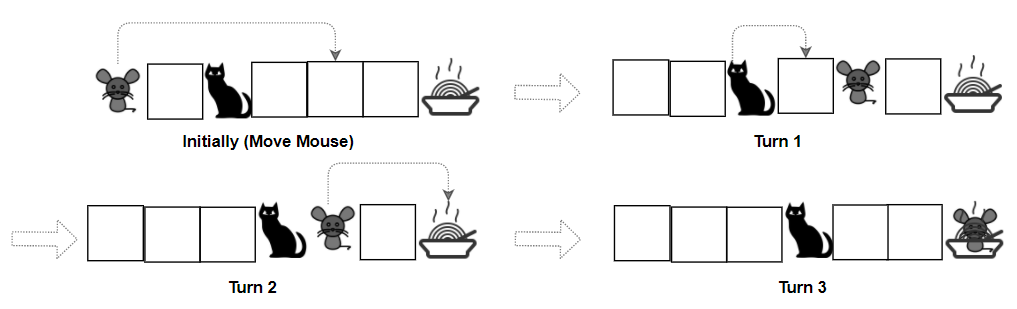
Input: grid = ["M.C...F"], catJump = 1, mouseJump = 4
Output: true
Example 3:
Input: grid = ["M.C...F"], catJump = 1, mouseJump = 3
Output: false
Constraints:
rows == grid.lengthcols = grid[i].length1 <= rows, cols <= 8grid[i][j]consist only of characters'C','M','F','.', and'#'.- There is only one of each character
'C','M', and'F'ingrid. 1 <= catJump, mouseJump <= 8

Solution
Clarifying Questions
When you get asked this question in a real-life environment, it will often be ambiguous (especially at FAANG). Make sure to ask these questions in that case:
- What are the dimensions of the grid and the maximum value of 'jump'? Are there any constraints on these values?
- Can the initial positions of the cat and mouse, and the food, be the same? Can the cat, mouse, or food positions be outside the grid?
- If the mouse can never reach the food, what should I return?
- If both the cat and the mouse reach the food in the same number of moves, who wins (or is it a draw)?
- Can the grid contain any obstacles or other elements besides the empty space?
Brute Force Solution
Approach
The brute force approach to the Cat and Mouse II game involves trying every possible sequence of moves for both the cat and the mouse. We explore all combinations of movements until we find a scenario where the mouse wins or we've exhausted all possibilities.
Here's how the algorithm would work step-by-step:
- Imagine the game board and the current positions of the cat and mouse.
- Enumerate all possible moves the mouse can make from its current position.
- For each of the mouse's possible moves, enumerate all possible moves the cat can make in response.
- For each of these cat-mouse move combinations, check if the mouse has won (reached the food) or if the cat has won (caught the mouse).
- If neither player has won, consider this new board state and recursively repeat the process, exploring all possible mouse moves followed by all possible cat moves from *this* new state.
- Continue exploring these possibilities until we find a sequence of moves where the mouse wins, the cat wins, or we reach a point where we've exceeded a move limit or visited a state too many times.
- If the mouse can eventually win through at least one path of moves, we determine that the mouse wins overall. Otherwise, the cat wins.
Code Implementation
def cat_and_mouse_ii_brute_force(grid, cat_jump, mouse_jump, food):
    rows = len(grid)
    cols = len(grid[0])

    mouse_start = None
    cat_start = None

    for row_index in range(rows):
        for col_index in range(cols):
            if grid[row_index][col_index] == 'M':
                mouse_start = (row_index, col_index)
            elif grid[row_index][col_index] == 'C':
                cat_start = (row_index, col_index)

    def get_possible_moves(position, jump_distance):
        possible_moves = []
        row, col = position

        # Stay in place
        possible_moves.append((row, col))

        # Move in all four directions
        for move_row in range(row - jump_distance, row + jump_distance + 1):
            for move_col in range(col - jump_distance, col + jump_distance + 1):
                if abs(move_row - row) + abs(move_col - col) <= jump_distance:
                    if 0 <= move_row < rows and 0 <= move_col < cols and grid[move_row][move_col] != '#':
                        possible_moves.append((move_row, move_col))

        return possible_moves

    def mouse_wins(mouse_position, food_position):
        return mouse_position == food_position

    def cat_wins(mouse_position, cat_position):
        return mouse_position == cat_position

    def solve(mouse_position, cat_position, move_count):
        # Limit the number of moves to prevent infinite recursion
        if move_count > 100:
            return False

        # Check if the mouse wins
        if mouse_wins(mouse_position, food):
            return True

        # Check if the cat wins
        if cat_wins(mouse_position, cat_position):
            return False

        # Iterate through all possible mouse moves
        mouse_moves = get_possible_moves(mouse_position, mouse_jump)

        for next_mouse_position in mouse_moves:
            # Iterate through all possible cat moves
            cat_moves = get_possible_moves(cat_position, cat_jump)

            all_cat_wins = True
            for next_cat_position in cat_moves:

                # Recursively call the solve function after cat makes move
                if solve(next_mouse_position, next_cat_position, move_count + 1):
                    all_cat_wins = False
                    break

            # If the cat loses in ALL possibilities, mouse wins.
            if all_cat_wins:
                return True

        # If the mouse can't win in any possible scenario, cat wins.
        return False

return solve(mouse_start, cat_start, 0)Big(O) Analysis
Optimal Solution
Approach
This is a game of cat and mouse, but it takes place on a grid. We need to figure out if the cat can catch the mouse before the mouse escapes, considering both can only move a certain distance each turn.
Here's how the algorithm would work step-by-step:
- The core idea is to see if we can reach a point in the game where we already know the answer. This happens when one of them wins or if we've been in the same position too many times, signaling a draw.
- Let's start by thinking about what it means for the mouse to win. The mouse wins if it can reach the food before the cat catches it or reach the edge of the board to escape.
- Now, what if the cat catches the mouse? That means the cat is close enough to the mouse (on the same spot or within its jump distance).
- We'll explore all possible moves by both the cat and mouse, one turn at a time. We can use something like a method that looks at the possible positions they can move to at each turn.
- To avoid infinite loops, we remember the game states we have already visited. A 'game state' is just the positions of the cat and mouse and the number of turns taken.
- If a game state repeats, it's a draw because neither player can force a win, and we stop exploring from that point.
- After checking all the possible moves within a limited number of turns, we can decide whether the cat catches the mouse, the mouse escapes, or it's a draw.
Code Implementation
def cat_and_mouse(grid, cat_jump, mouse_jump, food):
    rows = len(grid)
    cols = len(grid[0])
    mouse_start = None
    cat_start = None
    for row_index in range(rows):
        for col_index in range(cols):
            if grid[row_index][col_index] == 'M':
                mouse_start = (row_index, col_index)
            elif grid[row_index][col_index] == 'C':
                cat_start = (row_index, col_index)

    def get_neighbors(row, col, jump):
        neighbors = []
        for delta_row in range(-jump, jump + 1):
            for delta_col in range(-jump, jump + 1):
                if abs(delta_row) + abs(delta_col) <= jump:
                    new_row = row + delta_row
                    new_col = col + delta_col
                    if 0 <= new_row < rows and 0 <= new_col < cols and grid[new_row][new_col] != '#':
                        neighbors.append((new_row, new_col))
        return neighbors

    def can_win(mouse_row, mouse_col, cat_row, cat_col, turn, visited):
        # Early exit for repeated states.
        if turn > 1000:
            return False
        if (mouse_row, mouse_col, cat_row, cat_col, turn) in visited:
            return False

        visited.add((mouse_row, mouse_col, cat_row, cat_col, turn))

        # Mouse's turn
        if turn % 2 == 0:
            neighbors = get_neighbors(mouse_row, mouse_col, mouse_jump)
            for next_mouse_row, next_mouse_col in neighbors:

                # Check if the mouse reaches food
                if next_mouse_row == food[0] and next_mouse_col == food[1]:
                    return True

                # Recursive call for the cat's turn
                if not can_win(next_mouse_row, next_mouse_col, cat_row, cat_col, turn + 1, visited):
                    return True
            return False
        else:
            # Cat's turn
            neighbors = get_neighbors(cat_row, cat_col, cat_jump)
            for next_cat_row, next_cat_col in neighbors:
                # Cat catches mouse
                if next_cat_row == mouse_row and next_cat_col == mouse_col:
                    return False

                # If cat can't catch mouse, keep recursing
                if not can_win(mouse_row, mouse_col, next_cat_row, next_cat_col, turn + 1, visited):
                    return True
            return False

    visited = set()

    # Starts game from the beginning
return can_win(mouse_start[0], mouse_start[1], cat_start[0], cat_start[1], 0, visited)Big(O) Analysis
Edge Cases
| Case | How to Handle |
|---|---|
| maze is null or empty (0x0) | Return false immediately as there is no maze. |
| mouse or cat start position is outside the maze boundaries | Return false since they start outside the grid. |
| jump is zero | If jump is zero, the cat and mouse cannot move, so return whether the mouse and cat start at the same position. |
| cat and mouse start at the same position | If the cat and mouse start at the same location and the cat's move range is greater or equal than the mouse's move range, the cat will immediately win; return true. |
| maze is a single cell | Check whether the cat and mouse positions are the same, returning true only if they are. |
| mouse reaches food before cat can reach it | Use BFS to check if food is reachable by the mouse before the cat. |
| cat and mouse can move infinitely without reaching the food or each other | Employ a visited state check (memoization) to avoid infinite loops and determine if a win/lose state has already been reached. |
| Integer overflow in jump calculation or state representation | Ensure all jump calculations are within integer limits, and if memoization is used, consider carefully how the state is represented to avoid overflow issues. |






