

Cat and Mouse
Hard


A game on an undirected graph is played by two players, Mouse and Cat, who alternate turns.
The graph is given as follows: graph[a] is a list of all nodes b such that ab is an edge of the graph.
The mouse starts at node 1 and goes first, the cat starts at node 2 and goes second, and there is a hole at node 0.
During each player's turn, they must travel along one edge of the graph that meets where they are. For example, if the Mouse is at node 1, it must travel to any node in graph[1].
Additionally, it is not allowed for the Cat to travel to the Hole (node 0).
Then, the game can end in three ways:
- If ever the Cat occupies the same node as the Mouse, the Cat wins.
- If ever the Mouse reaches the Hole, the Mouse wins.
- If ever a position is repeated (i.e., the players are in the same position as a previous turn, and it is the same player's turn to move), the game is a draw.
Given a graph, and assuming both players play optimally, return
1if the mouse wins the game,2if the cat wins the game, or0if the game is a draw.
Example 1:

Input: graph = [[2,5],[3],[0,4,5],[1,4,5],[2,3],[0,2,3]]
Output: 0
Example 2:
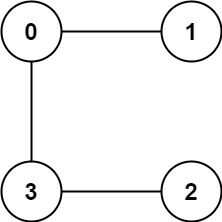
Input: graph = [[1,3],[0],[3],[0,2]]
Output: 1
Constraints:
3 <= graph.length <= 501 <= graph[i].length < graph.length0 <= graph[i][j] < graph.lengthgraph[i][j] != igraph[i]is unique.- The mouse and the cat can always move.

Solution
Clarifying Questions
When you get asked this question in a real-life environment, it will often be ambiguous (especially at FAANG). Make sure to ask these questions in that case:
- What are the constraints on the coordinates for the cat and mouse? Are they positive integers, and is there a maximum value?
- If the cat can't catch the mouse, what should the function return? Should it return -1, or some other indicator?
- Can the cat and mouse occupy the same starting position?
- Is the graph represented as an adjacency list, adjacency matrix, or some other data structure? And if the graph is empty, should I return -1?
- Is the movement simultaneous, or does the cat move first, and then the mouse?
Brute Force Solution
Approach
The brute force approach to the cat and mouse problem involves exploring every possible sequence of moves for both the cat and the mouse. We simulate all possible games to determine the outcome. By exhaustively searching all possible game states, we guarantee finding the solution if one exists.
Here's how the algorithm would work step-by-step:
- Consider all possible moves the cat could make from its starting location.
- For each of these cat moves, consider all possible moves the mouse could then make.
- Continue this process, alternating between cat and mouse moves, exploring all possible sequences of moves up to a reasonable limit.
- For each sequence of moves, check if the cat catches the mouse or if the mouse escapes within the move limit.
- If the cat catches the mouse in a sequence, the cat wins. If the mouse escapes within the move limit, the mouse wins. If all possible moves lead to a draw, the game results in a draw.
- Repeat this process for every possible initial set of moves by the cat to find the winner or the draw outcome.
Code Implementation
def cat_and_mouse_brute_force(graph, cat_start, mouse_start, max_moves):
    number_of_nodes = len(graph)

    def get_result(cat_position, mouse_position, moves_remaining):
        # Cat wins if it catches the mouse
        if cat_position == mouse_position:
            return 1

        # Mouse wins if it reaches 0 before cat catches
        if moves_remaining == 0:
            return 2

        # Mouse wins if it reaches hole (node 0) before cat catches
        if mouse_position == 0:
            return 2

        # Iterate through all the possible mouse moves.
        mouse_wins = False
        for next_mouse_position in graph[mouse_position]:
            # Assume the cat will now try to minimize the chance mouse wins.
            cat_loses = True
            for next_cat_position in graph[cat_position]:
                if next_cat_position == 0:
                    continue

                result = get_result(next_cat_position, next_mouse_position, moves_remaining - 1)

                # If there's a path where cat can win, cat doesn't lose
                if result != 2:
                    cat_loses = False

            # If cat loses, then the mouse wins
            if cat_loses:
                mouse_wins = True
                break

        # Mouse can't win, therefore cat must win
        if not mouse_wins:
            return 1
        else:
            return 2

return get_result(cat_start, mouse_start, 2 * max_moves)Big(O) Analysis
Optimal Solution
Approach
This problem involves figuring out who wins a game of cat and mouse on a graph. The clever approach recognizes that certain positions are traps, leading to predictable outcomes, and avoids unnecessary searching.
Here's how the algorithm would work step-by-step:
- Understand that if either the cat or the mouse reaches the location '0', the cat wins.
- Consider positions where the mouse can't move because the cat has blocked all adjacent spots; the cat wins in those scenarios too.
- Start identifying winning and losing positions for both the cat and the mouse, beginning with the end-game scenarios (reaching location '0' or the mouse being trapped).
- Work backward from these end-game positions. If the mouse can move to a position where the cat always loses, that's a winning position for the mouse. Conversely, if the cat can move to a position where the mouse always loses, it's a winning position for the cat.
- Keep repeating this process, marking positions as winning or losing for either the cat or the mouse based on whether they can force the other player into a losing position.
- If you reach a point where you can't determine whether a position is winning or losing for either player within a certain number of turns, it's a draw.
- The outcome starting from the initial positions of the cat and mouse on the graph determines the winner.
Code Implementation
def cat_and_mouse(graph):    number_of_nodes = len(graph)
    MOUSE_WIN = 1
    CAT_WIN = 2
    DRAW = 0
    cache = {}    def get_result(mouse_position, cat_position, turns):      if turns > 2 * number_of_nodes:        return DRAW
      if (mouse_position, cat_position, turns) in cache:        return cache[(mouse_position, cat_position, turns)]
      # Mouse wins if it reaches hole.      if mouse_position == 0:        return MOUSE_WIN
      # Cat wins if it reaches the mouse or hole first.      if cat_position == 0 or cat_position == mouse_position:        return CAT_WIN
      if turns % 2 == 0:  # Mouse's turn        # Mouse tries to move to a losing position for the cat.        mouse_can_win = False
        for next_mouse_position in graph[mouse_position]:          result = get_result(next_mouse_position, cat_position, turns + 1)
          if result == MOUSE_WIN:            mouse_can_win = True            break        if mouse_can_win:          cache[(mouse_position, cat_position, turns)] = MOUSE_WIN          return MOUSE_WIN        else:          # If no move leads to mouse win, it's a loss or draw.          cache[(mouse_position, cat_position, turns)] = CAT_WIN          return CAT_WIN      else:  # Cat's turn        # Cat tries to move to a losing position for the mouse.        cat_can_win = False
        for next_cat_position in graph[cat_position]:          if next_cat_position != 0: #Cat cannot move to 0 on its turn.            result = get_result(mouse_position, next_cat_position, turns + 1)
if result == CAT_WIN: cat_can_win = True break if cat_can_win: cache[(mouse_position, cat_position, turns)] = CAT_WIN return CAT_WIN else: #If no move leads to cat win, it's a loss or draw. cache[(mouse_position, cat_position, turns)] = DRAW return DRAW # Start the game from position 1,2, and 0 turns. return get_result(1, 2, 0)Big(O) Analysis
Edge Cases
| Case | How to Handle |
|---|---|
| Null or empty input arrays for cat and mouse positions | Return an appropriate error value, such as -1, or throw an exception if the input is invalid. |
| Cat and mouse start at the same position | If the cat and mouse positions are identical, the game is immediately over and return 0. |
| Cat's speed is zero | If the cat's speed is zero, the mouse automatically wins unless they start at the same point. |
| Mouse's speed is zero | If the mouse's speed is zero, the cat automatically wins unless they start at the same point. |
| Integer overflow when calculating distances | Use appropriate data types or modular arithmetic to prevent integer overflow when computing large distances or time steps. |
| Large speed values potentially resulting in very small time steps | Use double or long data type for speed and time step calculations to avoid precision issues. |
| The finish point is the same as the start position of the cat | If the finish point is the start position of the cat, the cat immediately wins, and return 1. |
| Negative speeds or distances provided as input | Return an appropriate error value, such as -1, or throw an IllegalArgumentException if the inputs are invalid. |






