

Cells with Odd Values in a Matrix
Easy



There is an m x n matrix that is initialized to all 0's. There is also a 2D array indices where each indices[i] = [ri, ci] represents a 0-indexed location to perform some increment operations on the matrix.
For each location indices[i], do both of the following:
- Increment all the cells on row
ri. - Increment all the cells on column
ci.
Given m, n, and indices, return the number of odd-valued cells in the matrix after applying the increment to all locations in indices.
Example 1:

Input: m = 2, n = 3, indices = [[0,1],[1,1]]
Output: 6
Explanation: Initial matrix = [[0,0,0],[0,0,0]].
After applying first increment it becomes [[1,2,1],[0,1,0]].
The final matrix is [[1,3,1],[1,3,1]], which contains 6 odd numbers.
Example 2:
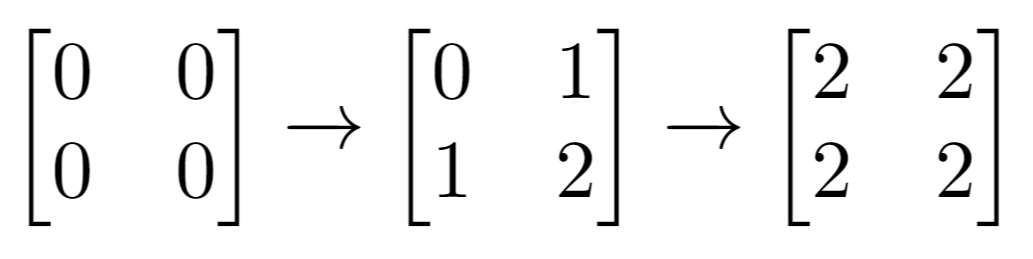
Input: m = 2, n = 2, indices = [[1,1],[0,0]]
Output: 0
Explanation: Final matrix = [[2,2],[2,2]]. There are no odd numbers in the final matrix.
Constraints:
1 <= m, n <= 501 <= indices.length <= 1000 <= ri < m0 <= ci < n
Follow up: Could you solve this in O(n + m + indices.length) time with only O(n + m) extra space?

Solution
Clarifying Questions
When you get asked this question in a real-life environment, it will often be ambiguous (especially at FAANG). Make sure to ask these questions in that case:
- What are the constraints on the dimensions 'm' and 'n' of the matrix? Are they guaranteed to be positive?
- What are the possible values of the elements within the 'indices' array? Are the row and column indices within the bounds of the matrix dimensions?
- Can the 'indices' array be empty or null?
- Is the initial matrix guaranteed to be initialized with all zeros, or could there be other initial values?
- Are there any memory constraints I should be aware of, given the potential size of the matrix?
Brute Force Solution
Approach
We're given instructions to increase values in a grid. The brute force method is like physically going through each instruction, one at a time, and updating the grid accordingly. After doing all the updates, we simply count how many cells have odd values.
Here's how the algorithm would work step-by-step:
- Start with the initial grid, which is filled with zeros.
- Take the first instruction, which tells you to increase certain row and column values.
- Go to the specified row and increase the value of every cell in that row by one.
- Go to the specified column and increase the value of every cell in that column by one.
- Repeat steps 2-4 for every instruction you are given.
- Once all instructions have been processed and all values are updated, go through each cell in the grid.
- For each cell, check if the value is an odd number.
- Count the number of cells that have odd values.
- The final count represents the answer.
Code Implementation
def cells_with_odd_values(number_of_rows, number_of_columns, indices):
    matrix = [[0] * number_of_columns for _ in range(number_of_rows)]

    for row_index, column_index in indices:
        # Increment all cells in the specified row

        for column in range(number_of_columns):
            matrix[row_index][column] += 1

        # Increment all cells in the specified column

        for row in range(number_of_rows):
            matrix[row][column_index] += 1

    odd_count = 0

    # Iterate through matrix to count odd values

    for row in range(number_of_rows):
        for column in range(number_of_columns):
            if matrix[row][column] % 2 != 0:
                # Count if the value is odd

                odd_count += 1

return odd_countBig(O) Analysis
Optimal Solution
Approach
The most efficient way to find the odd values is to track how many times each row and column is affected. Instead of updating every cell individually, we focus on just the rows and columns that are changed, then use that information to determine the odd numbers.
Here's how the algorithm would work step-by-step:
- First, keep separate counts for how many times each row is incremented and how many times each column is incremented.
- Go through the list of row and column operations. For each operation, increase the corresponding row count or column count.
- After processing all operations, go through each cell in the matrix. Determine its final value by adding the row count for its row to the column count for its column.
- If the sum of the row and column counts for a particular cell is an odd number, then count that cell.
- Finally, report the total count of cells whose final value is odd.
Code Implementation
def odd_cells(matrix_row_count, matrix_column_count, indices):
    row_counts = [0] * matrix_row_count
    column_counts = [0] * matrix_column_count

    # Increment row and column counts based on indices
    for row_index, column_index in indices:
        row_counts[row_index] += 1
        column_counts[column_index] += 1

    odd_count = 0

    # Determine odd cells based on row and column counts
    for row_index in range(matrix_row_count):

        # Iterate through each column in the matrix
        for column_index in range(matrix_column_count):
            # Sum row and column counts to simulate matrix increment
            if (row_counts[row_index] + column_counts[column_index]) % 2 != 0:

                odd_count += 1

    # Return the total count of odd cells
return odd_countBig(O) Analysis
Edge Cases
| Case | How to Handle |
|---|---|
| m or n is zero | Return 0 since a matrix with zero rows or columns has no cells. |
| m and n are both very large (e.g., close to limits of integer type) | Ensure the solution uses efficient data structures to avoid memory issues and potentially integer overflows when calculating counts. |
| Indices array is empty. | Return 0 as no updates will be performed, so all cells remain 0 (even). |
| Indices contain invalid row or column indices (out of bounds). | Check indices are valid and throw an exception or skip the invalid operations. |
| Indices array is very large (many updates). | Ensure the solution's time complexity is efficient to handle a large number of updates without exceeding time limits. |
| All values in indices reference the same row or column | The solution should correctly handle extreme skew in row/column update distributions. |
| m and n are 1. | If the indices array is empty, the matrix will contain the value 0 and return 0; otherwise update it and return 0 or 1. |
| Integer overflow possible when incrementing matrix cells. | Consider using a larger integer type (e.g., long) or modulo operations to prevent integer overflow. |






