

Check if DFS Strings Are Palindromes
Hard
You are given a tree rooted at node 0, consisting of n nodes numbered from 0 to n - 1. The tree is represented by an array parent of size n, where parent[i] is the parent of node i. Since node 0 is the root, parent[0] == -1.
You are also given a string s of length n, where s[i] is the character assigned to node i.
Consider an empty string dfsStr, and define a recursive function dfs(int x) that takes a node x as a parameter and performs the following steps in order:
- Iterate over each child
yofxin increasing order of their numbers, and calldfs(y). - Add the character
s[x]to the end of the stringdfsStr.
Note that dfsStr is shared across all recursive calls of dfs.
You need to find a boolean array answer of size n, where for each index i from 0 to n - 1, you do the following:
- Empty the string
dfsStrand calldfs(i). - If the resulting string
dfsStris a palindrome, then setanswer[i]totrue. Otherwise, setanswer[i]tofalse.
Return the array answer.
Example 1:

Input: parent = [-1,0,0,1,1,2], s = "aababa"
Output: [true,true,false,true,true,true]
Explanation:
- Calling
dfs(0)results in the stringdfsStr = "abaaba", which is a palindrome. - Calling
dfs(1)results in the stringdfsStr = "aba", which is a palindrome. - Calling
dfs(2)results in the stringdfsStr = "ab", which is not a palindrome. - Calling
dfs(3)results in the stringdfsStr = "a", which is a palindrome. - Calling
dfs(4)results in the stringdfsStr = "b", which is a palindrome. - Calling
dfs(5)results in the stringdfsStr = "a", which is a palindrome.
Example 2:
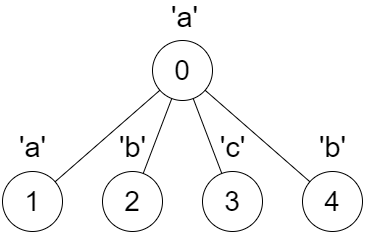
Input: parent = [-1,0,0,0,0], s = "aabcb"
Output: [true,true,true,true,true]
Explanation:
Every call on dfs(x) results in a palindrome string.
Constraints:
n == parent.length == s.length1 <= n <= 1050 <= parent[i] <= n - 1for alli >= 1.parent[0] == -1parentrepresents a valid tree.sconsists only of lowercase English letters.

Solution
Clarifying Questions
When you get asked this question in a real-life environment, it will often be ambiguous (especially at FAANG). Make sure to ask these questions in that case:
- What is the structure representing the graph? Is it an adjacency list or an adjacency matrix, and what data types do the nodes and edges use?
- What constitutes a "DFS string" exactly? Is it the sequence of node values visited during a standard depth-first search traversal, and is the starting node pre-defined?
- Can the graph be disconnected or contain cycles? If so, how should the DFS handle these cases, and how does that affect the creation of the DFS string?
- If multiple DFS traversals result in palindromes, should I return `true` if any DFS string is a palindrome, or do I need to check all possible DFS strings?
- What is the maximum possible number of nodes in the graph, and what is the maximum length of a single node's value when converted to a string?
Brute Force Solution
Approach
We're given a tree-like structure and we want to see if paths from the top to the bottom create palindrome strings. The brute force way is to explore every single possible path and then individually check if the string formed by that path is a palindrome.
Here's how the algorithm would work step-by-step:
- Start at the very top of the tree.
- Explore one path all the way down to the bottom.
- As you go down that path, remember all the letters you encounter.
- Once you reach the bottom, you have a string of letters.
- Check if that string is a palindrome. Does it read the same forwards and backward?
- Now, go back to where you had a choice of paths and try a different path.
- Again, remember the letters, form a string, and check if it's a palindrome.
- Keep doing this until you've explored every single possible path from the top to a bottom.
- If at least one of the strings formed by these paths is a palindrome, then we have our answer.
Code Implementation
def check_dfs_strings_are_palindromes(tree):    def is_palindrome(string):        return string == string[::-1]
    def depth_first_search(node, current_path):        current_path += node['value']        # If we've reached a leaf node, check if the path is a palindrome
        if not node['children']:            if is_palindrome(current_path):                return True            else:                return False        # Recursively explore each child of the current node
        for child in node['children']:            if depth_first_search(child, current_path):                return True        return False
    # Start DFS from the root node with an empty path
if not tree: return False return depth_first_search(tree, '')Big(O) Analysis
Optimal Solution
Approach
The core idea is to explore all possible strings created during a Depth First Search (DFS) traversal and efficiently check if each string is a palindrome. We use recursion to explore the possible strings and a simple palindrome check.
Here's how the algorithm would work step-by-step:
- Start a recursive function that takes the current node being visited and the current string built so far as input.
- Add the current node's value to the current string.
- Check if the updated string is a palindrome.
- If the current node has any children, call the recursive function on each of them, passing the updated string along. This explores each path in the implied tree.
- The recursion stops when you reach a node without children. The final string will be tested if it is a palindrome. If you determine that the string is a palindrome return true. Otherwise, return false.
- Combine the results: if at least one of the strings made by following a path is a palindrome, the answer is true; otherwise, it is false.
Code Implementation
def check_dfs_strings_are_palindromes(root):
    def is_palindrome(input_string):
        return input_string == input_string[::-1]

    def dfs(node, current_string):
        current_string += node.value

        # Check for palindrome after adding node value
        if is_palindrome(current_string):
            is_current_string_palindrome = True
        else:
            is_current_string_palindrome = False

        # If the node has no children.
        if not node.children:
            return is_current_string_palindrome

        # This boolean will store the combined result.
        at_least_one_palindrome = False

        # Explore all children.
        for child in node.children:
            at_least_one_palindrome = at_least_one_palindrome or dfs(child, current_string)

        return at_least_one_palindrome

    # Handle the case where the tree is empty.
    if not root:
        return False

    # Initiate DFS with an empty string.
    return dfs(root, "")

class Node:
    def __init__(self, value):
        self.value = value
self.children = []Big(O) Analysis
Edge Cases
| Case | How to Handle |
|---|---|
| Null or empty input string | Return true (or an empty list) as an empty string is considered a palindrome. |
| String with a single character | Return true as a single character string is a palindrome. |
| Maximum string length exceeding memory limitations | Check and handle potential stack overflow issues during recursion by limiting string length or using iterative DFS. |
| DFS yields no strings | If DFS produces no strings, return an empty list or a boolean indicating no palindromes were found. |
| All DFS strings are identical | The palindrome check should still correctly identify if this identical string is a palindrome or not. |
| DFS leads to cyclical paths creating infinite recursion | Implement cycle detection in the DFS to avoid infinite loops, potentially using a 'visited' set. |
| String contains non-alphanumeric characters | Filter out non-alphanumeric characters or specify the palindrome check to only consider alphanumeric characters. |
| Stack Overflow with deep recursion | Consider iterative DFS using a stack data structure if recursive DFS risks stack overflow for large trees. |






