

Check if Word Can Be Placed In Crossword
Medium
You are given an m x n matrix board, representing the current state of a crossword puzzle. The crossword contains lowercase English letters (from solved words), ' ' to represent any empty cells, and '#' to represent any blocked cells.
A word can be placed horizontally (left to right or right to left) or vertically (top to bottom or bottom to top) in the board if:
- It does not occupy a cell containing the character
'#'. - The cell each letter is placed in must either be
' '(empty) or match the letter already on theboard. - There must not be any empty cells
' 'or other lowercase letters directly left or right of the word if the word was placed horizontally. - There must not be any empty cells
' 'or other lowercase letters directly above or below the word if the word was placed vertically.
Given a string word, return true if word can be placed in board, or false otherwise.
Example 1:
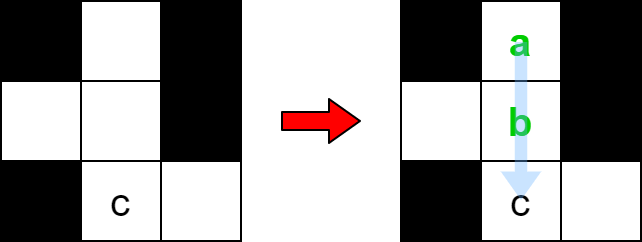
Input: board = [["#", " ", "#"], [" ", " ", "#"], ["#", "c", " "]], word = "abc"
Output: true
Explanation: The word "abc" can be placed as shown above (top to bottom).
Example 2:

Input: board = [[" ", "#", "a"], [" ", "#", "c"], [" ", "#", "a"]], word = "ac"
Output: false
Explanation: It is impossible to place the word because there will always be a space/letter above or below it.
Example 3:

Input: board = [["#", " ", "#"], [" ", " ", "#"], ["#", " ", "c"]], word = "ca"
Output: true
Explanation: The word "ca" can be placed as shown above (right to left).
Constraints:
m == board.lengthn == board[i].length1 <= m * n <= 2 * 105board[i][j]will be' ','#', or a lowercase English letter.1 <= word.length <= max(m, n)wordwill contain only lowercase English letters.

Solution
Clarifying Questions
When you get asked this question in a real-life environment, it will often be ambiguous (especially at FAANG). Make sure to ask these questions in that case:
- What are the dimensions of the crossword board (rows and columns), and what is the maximum length of the word?
- What characters can appear in the crossword board? Is it limited to lowercase letters, or are other characters (e.g., uppercase, numbers, special symbols) possible?
- If the word can be placed in multiple locations or orientations, should I return `true` as soon as I find one, or do I need to find all possible placements?
- Is the crossword board guaranteed to be rectangular (all rows have the same length), and is the word guaranteed to be non-empty?
- What should I return if the board or the word are null or empty strings?
Brute Force Solution
Approach
The brute force approach for this problem is all about trying every possible placement of the word in the crossword. We will explore every location and orientation to see if the word fits and matches existing letters.
Here's how the algorithm would work step-by-step:
- First, consider placing the word horizontally, starting from the very top-left corner of the crossword.
- Check if the word fits within the bounds of the crossword when placed horizontally at that location.
- Also, check if each letter of the word matches the existing letters in the crossword at that location, or if the crossword square is empty.
- If the word fits and all letters match or the squares are empty, we have found a valid placement, so we can stop. If it doesn't fit or there's a mismatch, try the next horizontal location to the right.
- Keep shifting the starting position one square at a time to the right, checking the fit and letter matches for each new position on the top row.
- Once you reach the end of the first row, move to the second row and repeat the process of trying every horizontal position on that row.
- Continue this process for every row in the crossword, until you've tried every possible horizontal position.
- Now, repeat the entire process but this time consider placing the word vertically instead of horizontally.
- Check the fit, letter matches, and try every possible vertical starting position in the crossword.
- If, after trying all horizontal and vertical positions, you still haven't found a valid placement, the word cannot be placed in the crossword.
Code Implementation
def can_place_word_in_crossword(board, word):
    rows = len(board)
    cols = len(board[0])
    word_length = len(word)

    # Check horizontal placement
    for row_index in range(rows):
        for col_index in range(cols - word_length + 1):
            valid = True

            # Check if word fits and matches
            for word_index in range(word_length):
                if board[row_index][col_index + word_index] != ' ' and \
                   board[row_index][col_index + word_index] != word[word_index]:
                    valid = False
                    break

            if valid:
                return True

    # Check vertical placement
    for row_index in range(rows - word_length + 1):
        for col_index in range(cols):
            valid = True

            # Check if word fits and matches
            for word_index in range(word_length):
                if board[row_index + word_index][col_index] != ' ' and \
                   board[row_index + word_index][col_index] != word[word_index]:
                    valid = False
                    break

            if valid:
                return True

    # No valid placement found
return FalseBig(O) Analysis
Optimal Solution
Approach
The task is to check if a given word can be placed into a crossword puzzle. The optimal strategy involves checking possible locations and directions for the word, ensuring it fits within the crossword's boundaries and matches existing letters where applicable. We'll focus on quickly eliminating invalid placements to find a valid one efficiently.
Here's how the algorithm would work step-by-step:
- First, find all possible starting positions for the word within the crossword grid. A starting position is valid if it is within the bounds of the grid.
- For each starting position, consider both horizontal and vertical directions for placing the word.
- For each starting position and direction, check if the word fits entirely within the crossword's boundaries in that direction.
- Next, verify if the word can be placed without conflicting with existing letters. If the crossword already has a letter in a position where you want to place the word, make sure the letters match. If they don't match, that position and direction are invalid.
- If all checks pass (fits within boundaries and matches existing letters), then the word can be placed in the crossword. Return true.
- If you've checked all possible starting positions and directions and haven't found a valid placement, the word cannot be placed. Return false.
Code Implementation
def can_place_word_in_crossword(crossword, word):
    rows = len(crossword)
    cols = len(crossword[0])
    word_length = len(word)

    for start_row in range(rows):
        for start_col in range(cols):
            # Check horizontal placement
            if can_place_horizontally(crossword, word, start_row, start_col):
                return True

            # Check vertical placement
            if can_place_vertically(crossword, word, start_row, start_col):
                return True

    return False

def can_place_horizontally(crossword, word, start_row, start_col):
    cols = len(crossword[0])
    word_length = len(word)

    # Check if the word fits within bounds
    if start_col + word_length > cols:
        return False

    for i in range(word_length):
        # Check if letters match or space is empty
        cell = crossword[start_row][start_col + i]
        if cell != ' ' and cell != word[i]:
            return False

    return True

def can_place_vertically(crossword, word, start_row, start_col):
    rows = len(crossword)
    word_length = len(word)

    # Check if the word fits within bounds
    if start_row + word_length > rows:
        return False

    for i in range(word_length):
        # Check if letters match or space is empty
        cell = crossword[start_row + i][start_col]
        if cell != ' ' and cell != word[i]:
            return False

return TrueBig(O) Analysis
Edge Cases
| Case | How to Handle |
|---|---|
| Null or empty crossword or word input | Return false immediately as a valid placement is impossible. |
| Word length is greater than any dimension of the crossword | Return false, as the word cannot fit in either direction. |
| Crossword contains invalid characters (not ' ' or letter) | Throw an IllegalArgumentException or return false after validation. |
| Word contains invalid characters (not letters) | Throw an IllegalArgumentException or return false after validation. |
| Crossword is a single row or column | The algorithm should still correctly check if the word can be placed horizontally or vertically, respectively. |
| Multiple possible placements exist | The problem only asks to check if *a* valid placement exists, so return true as soon as one is found. |
| Word contains consecutive repeating characters | The algorithm should correctly handle consecutive identical letters in both the word and the crossword. |
| Crossword is very large, causing potential performance issues | Optimize the search by immediately returning when a valid placement is found, avoiding unnecessary iterations. |






