

Checking Existence of Edge Length Limited Paths
Hard
An undirected graph of n nodes is defined by edgeList, where edgeList[i] = [ui, vi, disi] denotes an edge between nodes ui and vi with distance disi. Note that there may be multiple edges between two nodes.
Given an array queries, where queries[j] = [pj, qj, limitj], your task is to determine for each queries[j] whether there is a path between pj and qj such that each edge on the path has a distance strictly less than limitj .
Return a boolean array answer, where answer.length == queries.length and the jth value of answer is true if there is a path for queries[j] is true, and false otherwise.
Example 1:
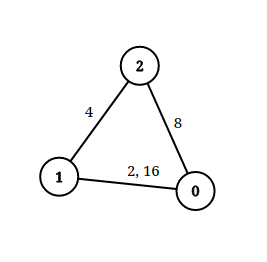
Input: n = 3, edgeList = [[0,1,2],[1,2,4],[2,0,8],[1,0,16]], queries = [[0,1,2],[0,2,5]]
Output: [false,true]
Explanation: The above figure shows the given graph. Note that there are two overlapping edges between 0 and 1 with distances 2 and 16.
For the first query, between 0 and 1 there is no path where each distance is less than 2, thus we return false for this query.
For the second query, there is a path (0 -> 1 -> 2) of two edges with distances less than 5, thus we return true for this query.
Example 2:

Input: n = 5, edgeList = [[0,1,10],[1,2,5],[2,3,9],[3,4,13]], queries = [[0,4,14],[1,4,13]]
Output: [true,false]
Explanation: The above figure shows the given graph.
Constraints:
2 <= n <= 1051 <= edgeList.length, queries.length <= 105edgeList[i].length == 3queries[j].length == 30 <= ui, vi, pj, qj <= n - 1ui != vipj != qj1 <= disi, limitj <= 109- There may be multiple edges between two nodes.

Solution
Clarifying Questions
When you get asked this question in a real-life environment, it will often be ambiguous (especially at FAANG). Make sure to ask these questions in that case:
- What are the constraints on the number of nodes `n` and edges `edgeList`? What is the maximum value for any node?
- Can the `edgeList` contain duplicate edges, and if so, how should they be handled?
- For each query in `queries`, can the start and end nodes `p` and `q` be the same, and what should be the return value in that case?
- Can edge lengths (`distance` in `queries`) be zero or negative?
- If there are multiple paths between two nodes with different maximum edge lengths, should I return true if *any* path satisfies the length limit?
Brute Force Solution
Approach
The problem asks whether there is a path between two locations with all the roads on the path being shorter than some given limit. The brute force method simply tries every possible path between the locations to see if any of them satisfy the limit.
Here's how the algorithm would work step-by-step:
- For each request, consider all possible paths between the starting and ending locations.
- For each path, check the length of the longest road on that path.
- If the longest road on the path is shorter than the length limit provided in the request, then a valid path exists, and the answer for that request is 'yes'.
- If all possible paths have been checked and none of them have a longest road shorter than the limit, then a valid path does not exist, and the answer for that request is 'no'.
Code Implementation
def check_existence_edge_length_limited_paths_brute_force(number_of_nodes, edge_list, queries):    adjacency_list = [[] for _ in range(number_of_nodes)]
    for node_a, node_b, edge_length in edge_list:
        adjacency_list[node_a].append((node_b, edge_length))
        adjacency_list[node_b].append((node_a, edge_length))

    results = []
    for start_node, end_node, length_limit in queries:
        found_path = False

        def depth_first_search(current_node, destination_node, current_path, max_edge_length):
            nonlocal found_path
            if current_node == destination_node:
                found_path = True
                return

            for neighbor_node, edge_length in adjacency_list[current_node]:
                if neighbor_node not in current_path:
                    # Only explore paths that satisfy the length limit condition
                    if edge_length < length_limit:
                        depth_first_search(neighbor_node, destination_node, current_path + [neighbor_node], max_edge_length)

        # Initiate search
        depth_first_search(start_node, end_node, [start_node], length_limit)

        # Determine if a path exists
        results.append(found_path)

return resultsBig(O) Analysis
Optimal Solution
Approach
The problem asks us to determine if paths exist between node pairs with edge lengths less than a given limit. We can efficiently solve this using a combination of sorting edges and path limits, and a data structure that helps us track connected components.
Here's how the algorithm would work step-by-step:
- First, sort all the edge length limits from smallest to largest along with their corresponding node pairs.
- Also, sort all edges in the entire graph from smallest to largest length.
- Start with the smallest edge limit and process it along with its corresponding node pair.
- Consider edges in the graph in increasing length order, and add edges to connect nodes in the graph as long as their length is less than or equal to the current edge limit.
- Use a 'union-find' or 'disjoint set' data structure to efficiently track which nodes are connected to each other. Every time you add an edge, merge the sets of the two nodes connected by that edge.
- After adding all possible edges for a particular edge limit, check if the two nodes corresponding to that edge limit are now in the same connected component (i.e., are 'connected' according to the union-find data structure).
- Record whether the path exists or not for that particular edge limit and node pair.
- Repeat this process for each edge length limit, moving to the next larger limit and adding more edges as needed. Because the limits and edges are sorted, you never have to revisit smaller edges.
- Finally, return the list of boolean results indicating whether paths exist for each edge limit.
Code Implementation
def checking_existence_of_edge_length_limited_paths(
        number_of_nodes,
        edge_list,
        queries):

    parent = list(range(number_of_nodes))

    def find(node):
        if parent[node] != node:
            parent[node] = find(parent[node])
        return parent[node]

    def union(node1, node2):
        root1 = find(node1)
        root2 = find(node2)
        if root1 != root2:
            parent[root1] = root2

    # Store the index of each query to restore the original order
    indexed_queries = [(edge_max, node1, node2, index)
                        for index, (node1, node2, edge_max) in enumerate(queries)]

    indexed_queries.sort()
    edge_list.sort(key=lambda x: x[2])

    results = [False] * len(queries)
    edge_index = 0

    # Iterate through the queries in sorted order
    for edge_max, node1, node2, index in indexed_queries:

        # Add edges to the union-find structure until
        # the current edge exceeds the query limit.
        while edge_index < len(edge_list) and \
                edge_list[edge_index][2] < edge_max:
            union(edge_list[edge_index][0], edge_list[edge_index][1])
            edge_index += 1

        # Check connectivity only after adding all
        # relevant edges for the current query
        results[index] = find(node1) == find(node2)

return resultsBig(O) Analysis
Edge Cases
| Case | How to Handle |
|---|---|
| Empty edge list or queries list | Return an empty result array/list immediately as there are no paths or queries to process. |
| Graph with a single node | If the graph has only one node, all queries should return false since no edges exist. |
| Edges list with duplicate edges | The algorithm should correctly process duplicate edges, effectively keeping only one instance of each edge. |
| Queries with identical edge limits | The sorting of queries with identical limits must be stable, preserving the original order to meet output requirements. |
| Edge limits with very large values (potential integer overflow during calculations) | Ensure intermediate calculations related to edge lengths do not overflow integer limits, potentially using long data types. |
| Graph with cycles | The solution should function correctly with cycles, likely needing a Disjoint Set Union (DSU) approach to avoid infinite loops. |
| Maximum number of nodes and edges (scalability) | Verify that the DSU operations and sorting algorithms used perform within the time limit for the maximum input size. |
| Disjoint graph (no path between some nodes) | Queries between disjoint components should return false as no path satisfying the limit exists. |






