

Construct String from Binary Tree
Medium




Given the root node of a binary tree, your task is to create a string representation of the tree following a specific set of formatting rules. The representation should be based on a preorder traversal of the binary tree and must adhere to the following guidelines:
-
Node Representation: Each node in the tree should be represented by its integer value.
-
Parentheses for Children: If a node has at least one child (either left or right), its children should be represented inside parentheses. Specifically:
- If a node has a left child, the value of the left child should be enclosed in parentheses immediately following the node's value.
- If a node has a right child, the value of the right child should also be enclosed in parentheses. The parentheses for the right child should follow those of the left child.
-
Omitting Empty Parentheses: Any empty parentheses pairs (i.e.,
()) should be omitted from the final string representation of the tree, with one specific exception: when a node has a right child but no left child. In such cases, you must include an empty pair of parentheses to indicate the absence of the left child. This ensures that the one-to-one mapping between the string representation and the original binary tree structure is maintained.In summary, empty parentheses pairs should be omitted when a node has only a left child or no children. However, when a node has a right child but no left child, an empty pair of parentheses must precede the representation of the right child to reflect the tree's structure accurately.
Example 1:
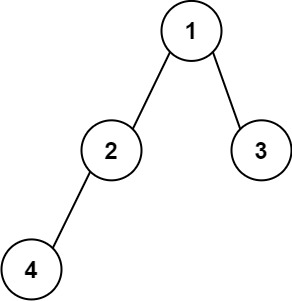
Input: root = [1,2,3,4]
Output: "1(2(4))(3)"
Explanation: Originally, it needs to be "1(2(4)())(3()())", but you need to omit all the empty parenthesis pairs. And it will be "1(2(4))(3)".
Example 2:

Input: root = [1,2,3,null,4] Output: "1(2()(4))(3)" Explanation: Almost the same as the first example, except the()after2is necessary to indicate the absence of a left child for2and the presence of a right child.
Constraints:
- The number of nodes in the tree is in the range
[1, 104]. -1000 <= Node.val <= 1000

Solution
Clarifying Questions
When you get asked this question in a real-life environment, it will often be ambiguous (especially at FAANG). Make sure to ask these questions in that case:
- What value types will the nodes of the binary tree hold?
- Is it possible for the tree to be empty or contain null nodes?
- Are there any constraints on the size (number of nodes) of the binary tree?
- If there are multiple valid string representations due to symmetric subtrees, which one should I return?
- Is there any modification to the output string expected, like parentheses in different places, or can I construct the simplest valid representation?
Brute Force Solution
Approach
We want to build a string representation of a binary tree, including parentheses. The brute force way explores every possible arrangement of parentheses around each node's value, fully exploring the tree's structure at each step to decide if parentheses are necessary.
Here's how the algorithm would work step-by-step:
- Start at the root of the tree.
- Convert the root's value into a string. This will always be part of our final string.
- Consider the left child. If it exists, explore all ways to represent its subtree within parentheses. If it doesn't exist, consider the case where no parentheses are added yet.
- Consider the right child. If it exists, explore all ways to represent its subtree within parentheses. If it doesn't exist, consider the case where no parentheses are added yet.
- Combine the string representation of the root with all combinations of string representations of its left and right subtrees (with and without parentheses where needed).
- Repeat this process for every node in the tree, always exploring every possibility of adding or omitting parentheses for each left and right subtree.
- After considering all possibilities, check if some parentheses are unnecessarily present to indicate the tree structure. Only remove these redundant parenthesis if they do not alter the pre-order traversal of the tree.
- Of all possible string representations, the final result is the one with the fewest unnecessary parentheses while still preserving the tree's structure (implicitly through pre-order traversal).
Code Implementation
class TreeNode:
	def __init__(self, val=0, left=None, right=None):
		self.val = val
		self.left = left
		self.right = right

def construct_string_from_binary_tree(root):
	def tree_to_string(node):
		if not node:
			return ""

		root_string = str(node.val)
		left_string = tree_to_string(node.left)
		right_string = tree_to_string(node.right)

		# Always include parenthesis for left subtree if it exists
		if node.left:
			left_subtree = "(" + left_string + ")"

		# If right exists, need to include left
			if node.right:
				right_subtree = "(" + right_string + ")"
				return root_string + left_subtree + right_subtree

			# If right doesn't exist, just return the left
			else:
				return root_string + left_subtree

		# Omit left parentheses only if right subtree exists.
		else:
			if node.right:
				right_subtree = "(" + right_string + ")"
				return root_string + "()" + right_subtree
			else:
				return root_string

return tree_to_string(root)Big(O) Analysis
Optimal Solution
Approach
We want to represent the tree structure as a string using parentheses. The key is to recursively traverse the tree and build the string piece by piece, deciding whether or not to include empty parentheses for missing right or left subtrees to maintain the correct structure.
Here's how the algorithm would work step-by-step:
- Start at the very top of the tree (the root).
- Add the value of the current node to the string.
- If the current node has a left branch, add a parenthesis, process the left branch in the same way, and then close the parenthesis.
- If the current node has a right branch, we need to be careful. If there's NO left branch, we MUST add empty parentheses '()' to show there was a left branch, even if it's empty. This keeps the structure clear. Then add a parenthesis, process the right branch, and close the parenthesis.
- If the current node only has a right branch but no left branch, you MUST include '()' before processing the right branch. The empty '()' indicates the missing left child.
- If there is no right branch, just move on. You don't need to add '()' if the right branch is missing and the left branch is present.
- Continue these steps for each branch until you reach the end of the tree.
- The string you build is the representation of your tree.
Code Implementation
def construct_string_from_binary_tree(root):
    if not root:
        return ""

    result = str(root.val)

    if root.left:
        # Recursively process the left subtree and enclose it in parentheses.
        result += "(" + construct_string_from_binary_tree(root.left) + ")"

    if root.right:
        # We need empty parentheses if there is no left child.
        if not root.left:
            result += "()"

        # Recursively process the right subtree and enclose it in parentheses.
        result += "(" + construct_string_from_binary_tree(root.right) + ")"

return resultBig(O) Analysis
Edge Cases
| Case | How to Handle |
|---|---|
| Null root node | Return an empty string if the root is null, signifying an empty tree |
| Single node tree | Return the string representation of the single node's value directly |
| Skewed tree (all nodes on one side) | The recursive calls should still function correctly, although the resulting string may be long and potentially affect stack depth in some languages |
| Large tree causing stack overflow (recursion depth) | Consider iterative solution with explicit stack to avoid potential stack overflow issues if the tree is extremely deep. |
| Tree with negative node values | The algorithm should handle negative values without issue as it just converts node values to strings |
| Tree with zero node values | The algorithm should handle zero values correctly by converting them to the string '0' |
| Nodes with large integer values that might cause integer overflow when converted to strings | Ensure the integer-to-string conversion method used can handle the maximum possible integer value without overflow. |
| Tree where all nodes have the same value | The output string will simply be the repeated value with parentheses appropriately placed, which is a valid representation. |






