

Container With Most Water
Medium












































You are given an integer array height of length n. There are n vertical lines drawn such that the two endpoints of the ith line are (i, 0) and (i, height[i]).
Find two lines that together with the x-axis form a container, such that the container contains the most water.
Return the maximum amount of water a container can store.
Notice that you may not slant the container.
Example 1:
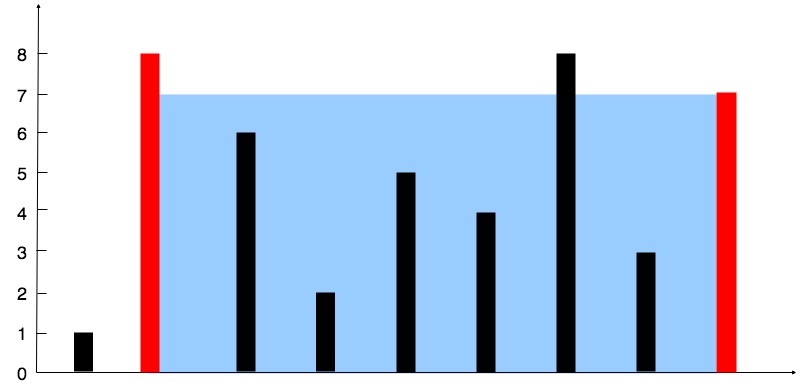
Input: height = [1,8,6,2,5,4,8,3,7]
Output: 49
Explanation: The above vertical lines are represented by array [1,8,6,2,5,4,8,3,7]. In this case, the max area of water (blue section) the container can contain is 49.
Example 2:
Input: height = [1,1]
Output: 1
Constraints:
n == height.length2 <= n <= 1050 <= height[i] <= 104

Solution
Clarifying Questions
When you get asked this question in a real-life environment, it will often be ambiguous (especially at FAANG). Make sure to ask these questions in that case:
- What should we return if the input array has fewer than two elements?
- Are all the values in the height array guaranteed to be non-negative integers?
- Can the width of the container be calculated simply by the difference in the indices of the two lines?
- If there are multiple pairs that yield the same maximum water amount, does it matter which one's capacity we return?
- Should we handle cases where the input array is null or empty, and what should be returned in such cases?
Brute Force Solution
Approach
Imagine you have a row of vertical walls of different heights and you want to pick any two walls to form a container that holds the most water. The brute force approach involves trying every single possible pair of walls, measuring how much water each pair can hold, and keeping track of the largest amount found.
Here's how the algorithm would work step-by-step:
- Begin by selecting the very first wall on the far left as the first side of your container.
- Pair this first wall with every other wall to its right, one by one.
- For each pair, calculate how much water the container can hold based on the distance between the two walls and the height of the shorter wall.
- Remember the amount of water held if it is greater than any previous amount you have checked.
- Once you have paired the first wall with every other wall, move to the second wall in line.
- Pair this second wall with every wall to its right, calculating the water capacity for each combination and updating your largest amount.
- Repeat this process for every possible wall, systematically testing every combination of two walls.
- After you have checked every single pair, the largest amount of water you recorded is your final answer.
Code Implementation
def max_area(heights): maximum_water = 0 total_walls = len(heights) # Evaluate every possible pair of walls to find the maximum possible container volume for left_index in range(total_walls): for right_index in range(left_index + 1, total_walls): distance_between = right_index - left_index shorter_height = min(heights[left_index], heights[right_index]) current_water = distance_between * shorter_height # Track the peak water capacity found across all evaluated wall pairings if current_water > maximum_water: maximum_water = current_water return maximum_waterBig(O) Analysis
Optimal Solution
Approach
Instead of checking every single combination of walls to find the biggest area, the optimal approach uses a clever narrowing strategy from the outer edges inward. By starting with the widest possible container and smartly moving our boundaries based on height, we can quickly find the maximum possible water capacity.
Here's how the algorithm would work step-by-step:
- Imagine placing one marker at the very beginning of the row of walls and another marker at the very end to create the widest possible container.
- Measure the amount of water this outer container can hold, keeping in mind that the water level is limited by whichever of the two boundary walls is shorter.
- Compare this current container's capacity to the largest amount of water you have seen so far, and update your record if the current one is bigger.
- Look at the two walls forming the current container and identify the shorter one.
- Move the marker of the shorter wall one step inward toward the middle, because keeping that short wall will never allow you to hold more water even if you find a taller wall on the other side.
- Leave the taller wall marker right where it is, since it still has a chance to form an even bigger container with a different partner.
- Repeat this process of measuring, comparing, and moving the shorter wall inward until the two markers finally meet in the middle.
Code Implementation
def max_area(height_list):
    left_marker = 0
    right_marker = len(height_list) - 1
    max_water_seen = 0

    while left_marker < right_marker:
        # Width decreases, so we must greedily move the shorter wall to seek a taller replacement.
        width_between = right_marker - left_marker

        height_left = height_list[left_marker]
        height_right = height_list[right_marker]
        limiting_height = min(height_left, height_right)
        current_capacity = width_between * limiting_height

        # Track the absolute maximum capacity found across all pointer positions.
        if current_capacity > max_water_seen:
            max_water_seen = current_capacity

        # The shorter wall limits capacity; keeping it can never yield a larger area with new widths.
        if height_left < height_right:
            left_marker += 1
        else:
            right_marker -= 1

return max_water_seenBig(O) Analysis
Edge Cases
| Case | How to Handle |
|---|---|
| Array with fewer than two elements | Return zero immediately since a container requires at least two vertical lines. |
| Array with exactly two elements | Calculate the area for the single possible pair and return that value as the maximum. |
| Heights containing zeros | The two-pointer approach naturally moves past zeros because the minimum height formula results in zero area, driving the pointer inward. |
| Array with all identical height values | The initial outer pointers calculate the maximum possible width container, and subsequent pointer movements safely evaluate smaller widths. |
| Highly skewed distributions such as tall walls on the outside and short walls in the middle | The greedy two-pointer strategy ensures we always discard the shorter line, guaranteeing we do not miss the optimal container. |
| Extremely large inputs with maximum constraint sizes | An O(n) linear scan using two pointers processes millions of elements efficiently within time limits without exceeding memory or recursion limits. |
| Maximum possible integer values for heights and maximum array length | Use 64-bit integers for the area calculation to prevent potential integer overflow when multiplying maximum width by maximum height. |






