

Count Paths That Can Form a Palindrome in a Tree
Hard
You are given a tree (i.e. a connected, undirected graph that has no cycles) rooted at node 0 consisting of n nodes numbered from 0 to n - 1. The tree is represented by a 0-indexed array parent of size n, where parent[i] is the parent of node i. Since node 0 is the root, parent[0] == -1.
You are also given a string s of length n, where s[i] is the character assigned to the edge between i and parent[i]. s[0] can be ignored.
Return the number of pairs of nodes (u, v) such that u < v and the characters assigned to edges on the path from u to v can be rearranged to form a palindrome.
A string is a palindrome when it reads the same backwards as forwards.
Example 1:
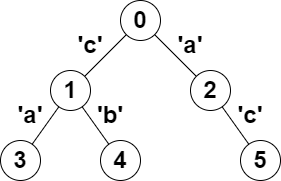
Input: parent = [-1,0,0,1,1,2], s = "acaabc"
Output: 8
Explanation: The valid pairs are:
- All the pairs (0,1), (0,2), (1,3), (1,4) and (2,5) result in one character which is always a palindrome.
- The pair (2,3) result in the string "aca" which is a palindrome.
- The pair (1,5) result in the string "cac" which is a palindrome.
- The pair (3,5) result in the string "acac" which can be rearranged into the palindrome "acca".
Example 2:
Input: parent = [-1,0,0,0,0], s = "aaaaa"
Output: 10
Explanation: Any pair of nodes (u,v) where u < v is valid.
Constraints:
n == parent.length == s.length1 <= n <= 1050 <= parent[i] <= n - 1for alli >= 1parent[0] == -1parentrepresents a valid tree.sconsists of only lowercase English letters.

Solution
Clarifying Questions
When you get asked this question in a real-life environment, it will often be ambiguous (especially at FAANG). Make sure to ask these questions in that case:
- What is the maximum number of nodes `n` in the tree? Are there any memory constraints I should be aware of?
- If an edge connects a node to itself (a self-loop), is that a valid path to consider, and what character is associated with it?
- Is the tree guaranteed to be connected, or could it consist of multiple disjoint components?
- Are the edge list and node count always valid, or should I expect and handle potential errors such as an invalid edge list that doesn't correspond to the given number of nodes?
- If no palindrome paths exist, what value should I return?
Brute Force Solution
Approach
The brute force method for this problem involves checking every possible path within the tree. For each path, we build the string formed by the node labels and then determine if that string could be rearranged to form a palindrome. We continue exhaustively until every path has been explored and counted if applicable.
Here's how the algorithm would work step-by-step:
- Start at any node in the tree.
- Consider a path that just consists of that single starting node.
- Check if the string formed by just that node's label can form a palindrome (a single character always can). If so, increase our count.
- Now, extend that path to one of its neighbors.
- Build the string formed by concatenating the labels of the nodes in this new path.
- Check if the string can form a palindrome. If so, increase the count.
- Keep extending the path by adding a neighbor at the end, creating a new string, and checking for palindromes. Repeat this until you reach a dead end (a leaf node).
- Once you've exhausted all paths starting from a given node, repeat the entire process by starting from a different node in the tree.
- Continue doing this for every single node in the tree as a starting point.
- In the end, sum up all the instances where a path formed a string that can become a palindrome. That sum is the final answer.
Code Implementation
def count_palindrome_paths_brute_force(tree):

    number_of_nodes = len(tree)
    palindrome_path_count = 0

    # Iterate through all possible pairs of nodes to check paths
    for start_node in range(number_of_nodes):
        for end_node in range(start_node, number_of_nodes):

            path = find_path(tree, start_node, end_node)

            if path:
                character_counts = {}
                for node_value in path:
                    if node_value not in character_counts:
                        character_counts[node_value] = 0
                    character_counts[node_value] += 1

                odd_count = 0
                for count in character_counts.values():
                    if count % 2 != 0:
                        odd_count += 1

                # Check if the path can form a palindrome
                if odd_count <= 1:
                    palindrome_path_count += 1

    return palindrome_path_count

def find_path(tree, start_node, end_node):
    if start_node == end_node:
        return [start_node]

    paths = {
        start_node: [start_node]
    }

    queue = [start_node]

    while queue:
        current_node = queue.pop(0)

        for neighbor in tree[current_node]:
            if neighbor not in paths:
                paths[neighbor] = paths[current_node] + [neighbor]
                if neighbor == end_node:
                    return paths[neighbor]
                queue.append(neighbor)

    return None

# Example Usage (assuming tree is an adjacency list)
# tree = {
#     0: [1, 2],
#     1: [0, 3, 4],
#     2: [0, 5],
#     3: [1],
#     4: [1],
#     5: [2]
# }
# result = count_palindrome_paths_brute_force(tree)
# print(result)Big(O) Analysis
Optimal Solution
Approach
To efficiently count palindrome-forming paths in a tree, we leverage a clever trick using bit manipulation. The core idea is to represent the path's character composition as a bitmask and use this information to quickly check for palindromes.
Here's how the algorithm would work step-by-step:
- Think of each path from the root to a node as a string of characters, and we want to know how many of these paths can rearrange to form a palindrome.
- Instead of actually rearranging characters, we use a 'bitmask'. Each letter of the alphabet will have its own assigned bit in the mask. As we travel down a path, whenever we see a letter, we flip its corresponding bit in the mask.
- A palindrome can have at most one letter that appears an odd number of times. This means in our bitmask representation, at most one bit can be set to 1.
- So, for each node in the tree, we store the bitmask representing the path from the root to that node.
- Now, we use a technique such as depth-first search to traverse the tree. When we visit a node, we check how many paths from the root to other nodes have a bitmask that differs from the current node's bitmask by at most one bit being set.
- Each path from the root to another node that has a different bitmask by at most one set bit can be rearranged into a Palindrome. Add that to our count.
- By using the bitmask, we have avoided the need to actually construct and check for Palindromes, which makes the process much faster. This enables efficient counting of palindrome-forming paths throughout the entire tree.
Code Implementation
def count_palindrome_paths(number_of_nodes, edges, string):

    graph = [[] for _ in range(number_of_nodes)]
    for node_1, node_2 in edges:
        graph[node_1].append(node_2)
        graph[node_2].append(node_1)

    count = 0

    def depth_first_search(current_node, parent_node, path_bitmask):
        nonlocal count
        path_bitmask ^= (1 << (ord(string[current_node]) - ord('a')))

        # Count paths ending at the current node
        if is_palindrome(path_bitmask):
            count += 1

        # Explore children
        for neighbor_node in graph[current_node]:
            if neighbor_node != parent_node:

                # Traverse only if node is not parent
                depth_first_search(neighbor_node, current_node, path_bitmask)

    def is_palindrome(bitmask):

        # Allows one odd frequency
        if bitmask == 0 or (bitmask & (bitmask - 1)) == 0:
            return True

        return False

    # Initialize bitmask for root node path
    for start_node in range(number_of_nodes):
        depth_first_search(start_node, -1, 0)

return countBig(O) Analysis
Edge Cases
| Case | How to Handle |
|---|---|
| Empty tree (n=0 or edges list is empty) | Return 0 as there are no paths. |
| Tree with only one node (n=1) | Return 1 as the path from the root to itself is considered a palindrome. |
| Tree where all edge characters are the same | Many paths will be palindromes, test efficiency of palindrome check. |
| Tree where no paths are palindromes | The algorithm should correctly return 0 without errors. |
| Large tree (large n) and deep paths | Ensure algorithm avoids excessive recursion depth (stack overflow) and is time-efficient (e.g., using efficient path tracking and palindrome checking). |
| Integer overflow when calculating path representation (using bitmask) | Consider using a larger integer type or an alternative representation if the number of distinct characters is large enough to cause an overflow. |
| Disconnected graph (not a single tree) | The problem assumes a tree so handle by ensuring the code does not error out or return incorrect results. |
| Edge list contains invalid characters (not lowercase letters) | Handle by either validating the inputs before processing or ensuring that any unexpected characters are ignored during the path evaluation. |






