

Count Submatrices With Equal Frequency of X and Y
Count Submatrices With Equal Frequency of X and Y #282 Most Asked
Medium
Given a 2D character matrix grid, where grid[i][j] is either 'X', 'Y', or '.', return the number of submatrices that contain:
grid[0][0]- an equal frequency of
'X'and'Y'. - at least one
'X'.
Example 1:
Input: grid = [["X","Y","."],["Y",".","."]]
Output: 3
Explanation:
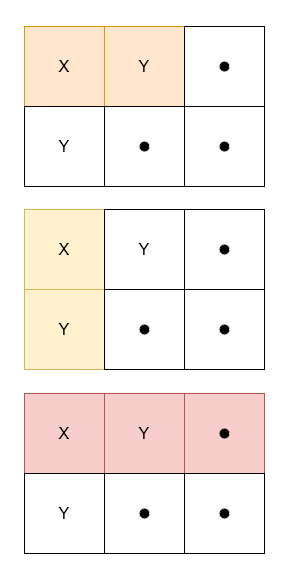
Example 2:
Input: grid = [["X","X"],["X","Y"]]
Output: 0
Explanation:
No submatrix has an equal frequency of 'X' and 'Y'.
Example 3:
Input: grid = [[".","."],[".","."]]
Output: 0
Explanation:
No submatrix has at least one 'X'.
Constraints:
1 <= grid.length, grid[i].length <= 1000grid[i][j]is either'X','Y', or'.'.

Solution
Clarifying Questions
When you get asked this question in a real-life environment, it will often be ambiguous (especially at FAANG). Make sure to ask these questions in that case:
- What are the constraints on the dimensions of the matrix, and the ranges for x, y, and the matrix elements?
- If x and y are the same value, is a submatrix with an equal number of them considered a valid submatrix?
- If no submatrices satisfy the condition, what value should I return?
- Can the input matrix be empty or null? What about x or y being null?
- Is the matrix guaranteed to be rectangular (i.e., all rows have the same length)?
Brute Force Solution
Approach
The brute force strategy involves checking every possible submatrix within the given matrix. For each submatrix, we count the occurrences of X and Y and determine if they are equal. If they are equal, we increment our count of valid submatrices.
Here's how the algorithm would work step-by-step:
- Consider every possible top-left corner of a submatrix within the bigger matrix.
- For each top-left corner, consider every possible bottom-right corner that is located below and to the right of it, thus defining a submatrix.
- Within each defined submatrix, count how many times X appears and how many times Y appears.
- Compare the counts of X and Y. If they are equal, then this submatrix is a valid one, so add 1 to our total count.
- Repeat steps 2-4 until you have explored every possible submatrix, determined by all combinations of top-left and bottom-right corners.
- Once all submatrices have been examined, the final total count represents the number of valid submatrices with an equal frequency of X and Y.
Code Implementation
def count_submatrices_equal_frequency(matrix):
    rows = len(matrix)
    cols = len(matrix[0])
    count = 0

    for top_row in range(rows):
        for left_col in range(cols):

            # Iterate through all possible bottom right corners
            for bottom_row in range(top_row, rows):
                for right_col in range(left_col, cols):
                    x_count = 0
                    y_count = 0

                    # Count X's and Y's within the submatrix
                    for i in range(top_row, bottom_row + 1):
                        for j in range(left_col, right_col + 1):
                            if matrix[i][j] == 'X':
                                x_count += 1
                            elif matrix[i][j] == 'Y':
                                y_count += 1

                    # Check if the counts are equal
                    # If they are, increment our counter
                    if x_count == y_count:
                        count += 1

return countBig(O) Analysis
Optimal Solution
Approach
The key is to efficiently count submatrices that meet the criteria without checking every single possible submatrix. We use a technique to precompute sums, allowing us to quickly determine the count of X's and Y's within any rectangular region.
Here's how the algorithm would work step-by-step:
- First, create a helper structure that lets you quickly calculate the sum of any rectangular portion of the original matrix. This structure records cumulative counts from the start up to each point in the matrix.
- Pick two corners of the original matrix to define a submatrix. Instead of manually counting X's and Y's in that submatrix, use the helper structure to determine the total number of X's and Y's very quickly.
- Check if the number of X's equals the number of Y's. If they are equal, increment a counter.
- Repeat the corner selection and counting process for all possible submatrices within the original matrix.
- The final count you've accumulated is the total number of submatrices with an equal frequency of X and Y.
Code Implementation
def count_submatrices(matrix, x_value, y_value):
    rows = len(matrix)
    cols = len(matrix[0])

    # Initialize the difference table with zeros.
    difference_table = [[0] * (cols + 1) for _ in range(rows + 1)]

    # Populate the difference table.
    for row_index in range(1, rows + 1):
        for col_index in range(1, cols + 1):
            if matrix[row_index-1][col_index-1] == x_value:
                difference_table[row_index][col_index] = difference_table[row_index - 1][col_index] + difference_table[row_index][col_index - 1] - difference_table[row_index - 1][col_index - 1] + 1
            elif matrix[row_index-1][col_index-1] == y_value:
                difference_table[row_index][col_index] = difference_table[row_index - 1][col_index] + difference_table[row_index][col_index - 1] - difference_table[row_index - 1][col_index - 1] - 1
            else:
                difference_table[row_index][col_index] = difference_table[row_index - 1][col_index] + difference_table[row_index][col_index - 1] - difference_table[row_index - 1][col_index - 1]

    equal_frequency_count = 0

    # Iterate through all possible submatrices.
    for row_start in range(1, rows + 1):
        for col_start in range(1, cols + 1):
            for row_end in range(row_start, rows + 1):
                for col_end in range(col_start, cols + 1):

                    # Calculate the difference of X and Y counts in the submatrix.
                    submatrix_difference = difference_table[row_end][col_end] - difference_table[row_start - 1][col_end] - difference_table[row_end][col_start - 1] + difference_table[row_start - 1][col_start - 1]

                    # Count submatrices with equal frequency.
                    if submatrix_difference == 0:
                        equal_frequency_count += 1

return equal_frequency_countBig(O) Analysis
Edge Cases
| Case | How to Handle |
|---|---|
| Null or empty matrix | Return 0, as there are no submatrices to evaluate. |
| Matrix with zero rows or zero columns | Return 0, as there are no valid submatrices. |
| Matrix with a single element (1x1 matrix) | Check if the single element is equal to both x and y; if so, return 1, otherwise return 0. |
| Matrix with all elements equal to x, and y is different | Count submatrices with number of x's and y's both 0, so the return value should be a count of all possible submatrices. |
| Matrix with all elements equal to y, and x is different | Count submatrices with number of x's and y's both 0, so the return value should be a count of all possible submatrices. |
| Large matrix (performance considerations) | Use a prefix sum approach to efficiently calculate the frequencies of x and y within submatrices. |
| x and y are equal | If x and y are equal, we need to find submatrices with an even number of occurrences of x (or y). |
| Integer overflow when calculating submatrix size | Use `long` data type for calculations involving the product of row and column sizes to prevent overflow. |






