

Count the Number of Houses at a Certain Distance I
Medium
You are given three positive integers n, x, and y.
In a city, there exist houses numbered 1 to n connected by n streets. There is a street connecting the house numbered i with the house numbered i + 1 for all 1 <= i <= n - 1 . An additional street connects the house numbered x with the house numbered y.
For each k, such that 1 <= k <= n, you need to find the number of pairs of houses (house1, house2) such that the minimum number of streets that need to be traveled to reach house2 from house1 is k.
Return a 1-indexed array result of length n where result[k] represents the total number of pairs of houses such that the minimum streets required to reach one house from the other is k.
Note that x and y can be equal.
Example 1:
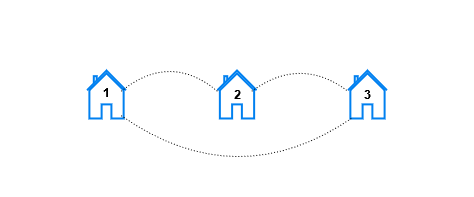
Input: n = 3, x = 1, y = 3
Output: [6,0,0]
Explanation: Let's look at each pair of houses:
- For the pair (1, 2), we can go from house 1 to house 2 directly.
- For the pair (2, 1), we can go from house 2 to house 1 directly.
- For the pair (1, 3), we can go from house 1 to house 3 directly.
- For the pair (3, 1), we can go from house 3 to house 1 directly.
- For the pair (2, 3), we can go from house 2 to house 3 directly.
- For the pair (3, 2), we can go from house 3 to house 2 directly.
Example 2:

Input: n = 5, x = 2, y = 4
Output: [10,8,2,0,0]
Explanation: For each distance k the pairs are:
- For k == 1, the pairs are (1, 2), (2, 1), (2, 3), (3, 2), (2, 4), (4, 2), (3, 4), (4, 3), (4, 5), and (5, 4).
- For k == 2, the pairs are (1, 3), (3, 1), (1, 4), (4, 1), (2, 5), (5, 2), (3, 5), and (5, 3).
- For k == 3, the pairs are (1, 5), and (5, 1).
- For k == 4 and k == 5, there are no pairs.
Example 3:

Input: n = 4, x = 1, y = 1
Output: [6,4,2,0]
Explanation: For each distance k the pairs are:
- For k == 1, the pairs are (1, 2), (2, 1), (2, 3), (3, 2), (3, 4), and (4, 3).
- For k == 2, the pairs are (1, 3), (3, 1), (2, 4), and (4, 2).
- For k == 3, the pairs are (1, 4), and (4, 1).
- For k == 4, there are no pairs.
Constraints:
2 <= n <= 1001 <= x, y <= n

Solution
Clarifying Questions
When you get asked this question in a real-life environment, it will often be ambiguous (especially at FAANG). Make sure to ask these questions in that case:
- What are the constraints on n, start_pos, end_pos, and k? Specifically, what are the maximum and minimum values for each?
- Is it possible for start_pos and end_pos to be equal, and if so, how should that be handled?
- Can k be zero, and what should the output be in that case?
- Are start_pos and end_pos guaranteed to be within the range [1, n]?
- Could you provide an example input and the expected output to ensure my understanding of the problem is correct?
Brute Force Solution
Approach
To count houses at a specific distance, the brute force approach checks every single house pair against all possible road configurations. It calculates the distance between houses for each configuration and counts how many pairs match the target distance. This is like manually measuring distances between every possible pair of houses in every street layout and counting the matches.
Here's how the algorithm would work step-by-step:
- First, consider all possible connections or paths between every pair of houses.
- For each of these connection possibilities, calculate the distance between a given pair of houses.
- Compare this calculated distance with the specific distance we are looking for.
- If the calculated distance matches the specific distance, increase a counter by one.
- Repeat this process for all possible house pairs and all possible path combinations.
- The final count will give the number of house pairs at the specific distance.
Code Implementation
def count_houses_at_distance_brute_force(house_locations, target_distance):
    number_of_houses = len(house_locations)
    count = 0

    for first_house_index in range(number_of_houses):
        # Iterate through each house.

        for second_house_index in range(first_house_index + 1, number_of_houses):
            # Avoid double-counting pairs; start from the next house.

            distance = abs(house_locations[first_house_index] - house_locations[second_house_index])

            if distance == target_distance:
                count += 1
                # Increment when houses are at the target distance.

return countBig(O) Analysis
Optimal Solution
Approach
The key is to realize that the distances between houses follow a predictable pattern based on the positions of the houses and the ends of the street. We can directly calculate how many houses are at a particular distance from the ends of the street without checking every house individually.
Here's how the algorithm would work step-by-step:
- First, understand the street layout and the positions of the houses and points.
- Consider each house and calculate its distance from the start and end of the street.
- For each distance we are interested in, count how many houses are exactly that distance from either the start or end of the street. Keep a separate counter for each distance.
- Return the counts for each requested distance.
Code Implementation
def count_houses_at_distance(house_locations, special_house_locations, target_distance):
    houses_at_target_distance = set()

    # Iterate through each special house.
    for special_house_location in special_house_locations:
        # Calculate the location of houses at the target distance.
        house_location_left = special_house_location - target_distance
        house_location_right = special_house_location + target_distance

        # Check if the house exists and add it to the set.
        if house_location_left in house_locations:
            houses_at_target_distance.add(house_location_left)

        # Avoid double-counting if left and right are the same.
        if house_location_right in house_locations:
            houses_at_target_distance.add(house_location_right)

    # Return the total count of houses at the target distance.
return len(houses_at_target_distance)Big(O) Analysis
Edge Cases
| Case | How to Handle |
|---|---|
| n is 0 or negative | Return an empty array since there are no houses. |
| k is negative | Since distance cannot be negative, return an array of zeros. |
| start_pos or end_pos are outside the range [1, n] | Adjust start_pos and end_pos to the valid range [1, n]. |
| start_pos and end_pos are the same | The distance calculation should only consider this position once to prevent double-counting. |
| k is very large, larger than the maximum possible distance between houses. | The counts array will consist entirely of zeros in this scenario and will be efficiently calculated. |
| n is very large, leading to potential memory issues with the counts array. | Ensure memory allocation for the 'counts' array doesn't exceed available memory, consider a more memory-efficient representation if feasible, but it will still need to store n counts so consider the use case for such a large n. |
| start_pos and end_pos are far apart, and k is close to n, leading to many houses at distance k. | The solution iterates through all houses and efficiently calculates distances, handling this scenario without issues, although the runtime is proportional to n. |
| Integer overflow if using languages like C/C++ to calculate distance and n is extremely large. | Use a data type that can accommodate larger numbers (e.g., long long) to prevent integer overflow. |






