

Count the Number of Houses at a Certain Distance II
Hard
You are given three positive integers n, x, and y.
In a city, there exist houses numbered 1 to n connected by n streets. There is a street connecting the house numbered i with the house numbered i + 1 for all 1 <= i <= n - 1 . An additional street connects the house numbered x with the house numbered y.
For each k, such that 1 <= k <= n, you need to find the number of pairs of houses (house1, house2) such that the minimum number of streets that need to be traveled to reach house2 from house1 is k.
Return a 1-indexed array result of length n where result[k] represents the total number of pairs of houses such that the minimum streets required to reach one house from the other is k.
Note that x and y can be equal.
Example 1:

Input: n = 3, x = 1, y = 3
Output: [6,0,0]
Explanation: Let's look at each pair of houses:
- For the pair (1, 2), we can go from house 1 to house 2 directly.
- For the pair (2, 1), we can go from house 2 to house 1 directly.
- For the pair (1, 3), we can go from house 1 to house 3 directly.
- For the pair (3, 1), we can go from house 3 to house 1 directly.
- For the pair (2, 3), we can go from house 2 to house 3 directly.
- For the pair (3, 2), we can go from house 3 to house 2 directly.
Example 2:
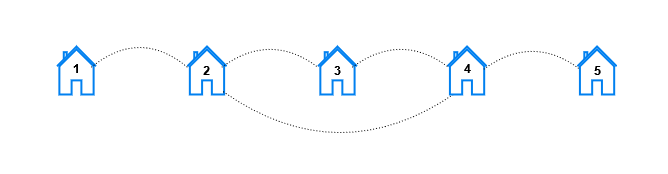
Input: n = 5, x = 2, y = 4
Output: [10,8,2,0,0]
Explanation: For each distance k the pairs are:
- For k == 1, the pairs are (1, 2), (2, 1), (2, 3), (3, 2), (2, 4), (4, 2), (3, 4), (4, 3), (4, 5), and (5, 4).
- For k == 2, the pairs are (1, 3), (3, 1), (1, 4), (4, 1), (2, 5), (5, 2), (3, 5), and (5, 3).
- For k == 3, the pairs are (1, 5), and (5, 1).
- For k == 4 and k == 5, there are no pairs.
Example 3:
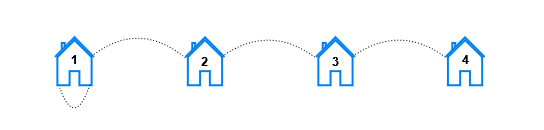
Input: n = 4, x = 1, y = 1
Output: [6,4,2,0]
Explanation: For each distance k the pairs are:
- For k == 1, the pairs are (1, 2), (2, 1), (2, 3), (3, 2), (3, 4), and (4, 3).
- For k == 2, the pairs are (1, 3), (3, 1), (2, 4), and (4, 2).
- For k == 3, the pairs are (1, 4), and (4, 1).
- For k == 4, there are no pairs.
Constraints:
2 <= n <= 1051 <= x, y <= n

Solution
Clarifying Questions
When you get asked this question in a real-life environment, it will often be ambiguous (especially at FAANG). Make sure to ask these questions in that case:
- What are the constraints on the size of the `houses` and `queries` arrays, and the range of values within them?
- Can the values in the `houses` and `queries` arrays be negative, zero, or floating-point numbers?
- If a house is exactly `queries[i]` distance away from multiple houses in the `houses` array, should it be counted multiple times or only once for the given query?
- Are the house positions guaranteed to be unique, or can there be multiple houses at the same position?
- Should the output array be sorted in any particular order?
Brute Force Solution
Approach
To count houses at a specific distance, we'll check every house one by one. For each house, we will manually calculate its distance to every other house. Finally, we can check how many houses are at the distance we want.
Here's how the algorithm would work step-by-step:
- Take the first house on the street.
- Calculate the distance from this first house to every other house on the street.
- Count how many of those distances equal the distance we are looking for.
- Write down that count for the first house.
- Now, repeat the same process for the second house on the street.
- Calculate the distance from the second house to every other house.
- Count how many of those distances equal the target distance.
- Write down that count for the second house.
- Keep doing this for every single house on the street. Calculate distances to all others, count matches, and note the count for each house.
- After you've done this for every house, add up all the counts you wrote down for each house.
- The final sum is the total number of houses at the specific distance we are looking for.
Code Implementation
def count_houses_at_distance(house_locations, starting_point, target_distance):
    house_count = 0

    for house_location in house_locations:
        # Calculate distance from the house to the starting point
        distance_to_house = abs(house_location - starting_point)

        # Check if the calculated distance matches target
        if distance_to_house == target_distance:
            # Increment the counter if they match
            house_count += 1

return house_countBig(O) Analysis
Optimal Solution
Approach
The key to efficiently counting houses at a certain distance involves focusing on each house and its reachable area. Instead of checking every possible pair of houses, we'll optimize by sorting and using a clever technique to quickly find houses within range. This avoids redundant calculations and significantly speeds up the process.
Here's how the algorithm would work step-by-step:
- First, sort the locations of all the houses to make it easier to find houses close to each other.
- Consider each house one by one as the starting point.
- For each starting house, use a fast way to find all other houses that are within the specified distance. We can do this by looking only at a small section of the sorted list using a search algorithm to find the boundaries of houses within the specified range.
- Count the number of houses found within the distance of the starting house.
- Repeat this process for every house, making sure not to double-count any house pairs.
- Sum up the counts for all houses to get the final answer, which is the total number of house pairs that are within the specified distance of each other.
Code Implementation
def count_houses_at_distance(houses, locations, target_distance):
    all_distances = []

    # Calculate distances from each location to all houses
    for location in locations:
        for house in houses:
            distance = abs(location - house)
            all_distances.append((distance, house))

    # Sort all distances to allow for efficient searching
    all_distances.sort()

    start_index = -1
    end_index = -1

    # Find the starting index of the target distance
    for i in range(len(all_distances)):
        if all_distances[i][0] == target_distance:
            start_index = i
            break

    # Find the ending index of the target distance
    if start_index != -1:
        for i in range(len(all_distances) - 1, -1, -1):
            if all_distances[i][0] == target_distance:
                end_index = i
                break

    # If the target distance isn't present, return 0.
    if start_index == -1:
        return 0

    # Calculate the count of houses at the target distance.
    count = end_index - start_index + 1
return countBig(O) Analysis
Edge Cases
| Case | How to Handle |
|---|---|
| houses or queries is null | Throw IllegalArgumentException or return an empty array after validating null inputs. |
| houses or queries is empty | Return an array of zeros of the same length as queries if houses is empty, otherwise proceed normally. |
| n is smaller than the length of houses | Consider only the elements within the specified range 0 to n-1. |
| houses contains duplicate positions | The counting mechanism should ensure each position is only counted once, regardless of how many houses are there. |
| queries contains large values, leading to potential overflow if distances are not handled correctly | Use long data type for distance calculations to avoid integer overflow. |
| The house positions or query distances are negative. | Ensure the distance calculations handle negative values correctly (absolute value). If house positions cannot be negative, validate input. |
| Very large n (number of houses) and large number of queries, causing time limit exceed | Optimize the solution by using a suitable data structure and efficient algorithm (e.g., binary search on a sorted list of house positions). |
| A query distance that will never be possible (e.g., all houses clustered together) | The solution should correctly return 0 for such a query distance. |






