

Count Unguarded Cells in the Grid
Medium
You are given two integers m and n representing a 0-indexed m x n grid. You are also given two 2D integer arrays guards and walls where guards[i] = [rowi, coli] and walls[j] = [rowj, colj] represent the positions of the ith guard and jth wall respectively.
A guard can see every cell in the four cardinal directions (north, east, south, or west) starting from their position unless obstructed by a wall or another guard. A cell is guarded if there is at least one guard that can see it.
Return the number of unoccupied cells that are not guarded.
Example 1:

Input: m = 4, n = 6, guards = [[0,0],[1,1],[2,3]], walls = [[0,1],[2,2],[1,4]]
Output: 7
Explanation: The guarded and unguarded cells are shown in red and green respectively in the above diagram.
There are a total of 7 unguarded cells, so we return 7.
Example 2:
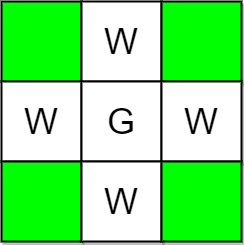
Input: m = 3, n = 3, guards = [[1,1]], walls = [[0,1],[1,0],[2,1],[1,2]]
Output: 4
Explanation: The unguarded cells are shown in green in the above diagram.
There are a total of 4 unguarded cells, so we return 4.
Constraints:
1 <= m, n <= 1052 <= m * n <= 1051 <= guards.length, walls.length <= 5 * 1042 <= guards.length + walls.length <= m * nguards[i].length == walls[j].length == 20 <= rowi, rowj < m0 <= coli, colj < n- All the positions in
guardsandwallsare unique.

Solution
Clarifying Questions
When you get asked this question in a real-life environment, it will often be ambiguous (especially at FAANG). Make sure to ask these questions in that case:
- What are the dimensions of the grid (m, n), and what are the possible ranges for these values?
- What values are possible within the 'guards' and 'walls' arrays? Are the coordinates guaranteed to be within the grid boundaries?
- If a cell is guarded by multiple guards, should it be counted multiple times or only once?
- Is the grid guaranteed to be rectangular, or could it be irregular?
- If there are no unguarded cells, what value should I return?
Brute Force Solution
Approach
The problem involves figuring out which spots on a grid are safe from being seen by guards. A brute force method involves checking every single spot on the grid to determine if it's guarded or not.
Here's how the algorithm would work step-by-step:
- Start with the first empty spot on the grid.
- Imagine a beam of light extending from each guard in all four directions: up, down, left, and right.
- Check if any of these light beams hit the current empty spot you are considering. Consider that the light beams stop when they hit a wall or another guard.
- If any of the beams hit the spot, then the spot is guarded.
- If none of the beams hit the spot, then the spot is unguarded.
- Repeat this process, checking every single empty spot on the entire grid, one at a time.
- After checking all the spots, count how many spots were determined to be unguarded.
Code Implementation
def count_unguarded_cells_brute_force(grid):
    rows = len(grid)
    cols = len(grid[0])
    unguarded_count = 0

    for row_index in range(rows):
        for col_index in range(cols):
            if grid[row_index][col_index] == 0:
                is_guarded = False

                # Iterate through all guards
                for guard_row in range(rows):
                    for guard_col in range(cols):
                        if grid[guard_row][guard_col] == 1:

                            # Check upwards direction
                            blocked = False
                            for k in range(guard_row - 1, -1, -1):
                                if grid[k][guard_col] == 1:
                                    blocked = True
                                    break
                                if k == row_index and guard_col == col_index:
                                    is_guarded = True
                                    blocked = True
                                    break
                            if is_guarded:
                                break

                            # Check downwards direction
                            blocked = False
                            for k in range(guard_row + 1, rows):
                                if grid[k][guard_col] == 1:
                                    blocked = True
                                    break
                                if k == row_index and guard_col == col_index:
                                    is_guarded = True
                                    blocked = True
                                    break
                            if is_guarded:
                                break

                            # Check left direction
                            blocked = False
                            for k in range(guard_col - 1, -1, -1):
                                if grid[guard_row][k] == 1:
                                    blocked = True
                                    break
                                if guard_row == row_index and k == col_index:
                                    is_guarded = True
                                    blocked = True
                                    break
                            if is_guarded:
                                break

                            # Check right direction
                            for k in range(guard_col + 1, cols):
                                if grid[guard_row][k] == 1:
                                    break
                                if guard_row == row_index and k == col_index:
                                    is_guarded = True
                                    break
                            if is_guarded:
                                break
                    if is_guarded:
                        break

                if not is_guarded:
                    unguarded_count += 1

return unguarded_countBig(O) Analysis
Optimal Solution
Approach
The most efficient strategy involves simulating the movement of guards from each guard location and marking all the cells they cover. Cells that are guarded are marked, and the unguarded cells can then be counted easily. This approach avoids redundant checks and directly determines which cells are protected.
Here's how the algorithm would work step-by-step:
- First, imagine the grid and the initial positions of the walls and guards.
- Then, simulate the 'vision' of each guard moving in all four directions (up, down, left, right).
- As a guard moves in a direction, mark every cell it can 'see' as 'guarded' until it hits a wall or another guard.
- Repeat this process for every guard in the grid.
- Once all guards have extended their vision and marked the grid, count the number of cells that are NOT marked as 'guarded'. These are the unguarded cells.
Code Implementation
def count_unguarded(rows, cols, guards, walls):
    grid = [['unguarded' for _ in range(cols)] for _ in range(rows)]

    for row_index, col_index in walls:
        grid[row_index][col_index] = 'wall'

    for row_index, col_index in guards:
        grid[row_index][col_index] = 'guard'

    for start_row, start_col in guards:
        # Simulate guard vision in each direction.
        for direction_row, direction_col in [(0, 1), (0, -1), (1, 0), (-1, 0)]:
            current_row = start_row
            current_col = start_col

            while True:
                current_row += direction_row
                current_col += direction_col

                if 0 <= current_row < rows and 0 <= current_col < cols:
                    cell_type = grid[current_row][current_col]

                    if cell_type == 'wall' or cell_type == 'guard':
                        break

                    # Mark the cell as guarded.
                    grid[current_row][current_col] = 'guarded'

                else:
                    break

    # Count unguarded cells after marking all guarded cells.
    unguarded_count = 0
    for row in grid:
        for cell in row:
            if cell == 'unguarded':
                unguarded_count += 1

return unguarded_countBig(O) Analysis
Edge Cases
| Case | How to Handle |
|---|---|
| Empty grid (m=0 or n=0) | Return 0 because there are no cells at all. |
| Grid with only guards or only walls | The algorithm should still correctly identify unguarded cells when all cells are initially marked as guarded or blocked. |
| Guard and wall on same cell | Prioritize the guard on that cell, meaning it becomes a guarding point, not a blockage. |
| Large grid dimensions (m and n are large) | Ensure the time complexity is optimal, possibly avoiding brute force iteration of every cell for each guard. |
| Guards clustered together | Multiple guards guarding the same cell should not cause incorrect counting. |
| Walls completely block guards from some sections of the grid | The algorithm should correctly identify unguarded cells in sections isolated by walls. |
| Grid is a single row or single column | Ensure correct handling of edge cases when the grid's dimensions are severely skewed. |
| Integer overflow when calculating grid size or cell counts | Use appropriate data types (e.g., long) to prevent potential overflow errors. |






