

Count Visited Nodes in a Directed Graph
Hard

There is a directed graph consisting of n nodes numbered from 0 to n - 1 and n directed edges.
You are given a 0-indexed array edges where edges[i] indicates that there is an edge from node i to node edges[i].
Consider the following process on the graph:
- You start from a node
xand keep visiting other nodes through edges until you reach a node that you have already visited before on this same process.
Return an array answer where answer[i] is the number of different nodes that you will visit if you perform the process starting from node i.
Example 1:
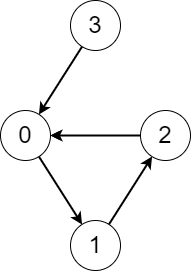
Input: edges = [1,2,0,0]
Output: [3,3,3,4]
Explanation: We perform the process starting from each node in the following way:
- Starting from node 0, we visit the nodes 0 -> 1 -> 2 -> 0. The number of different nodes we visit is 3.
- Starting from node 1, we visit the nodes 1 -> 2 -> 0 -> 1. The number of different nodes we visit is 3.
- Starting from node 2, we visit the nodes 2 -> 0 -> 1 -> 2. The number of different nodes we visit is 3.
- Starting from node 3, we visit the nodes 3 -> 0 -> 1 -> 2 -> 0. The number of different nodes we visit is 4.
Example 2:
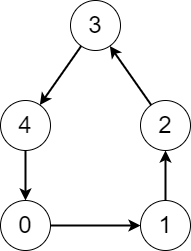
Input: edges = [1,2,3,4,0]
Output: [5,5,5,5,5]
Explanation: Starting from any node we can visit every node in the graph in the process.
Constraints:
n == edges.length2 <= n <= 1050 <= edges[i] <= n - 1edges[i] != i

Solution
Clarifying Questions
When you get asked this question in a real-life environment, it will often be ambiguous (especially at FAANG). Make sure to ask these questions in that case:
- What is the representation of the directed graph? Is it an adjacency list, adjacency matrix, or something else?
- What are the possible values for the nodes in the graph? Are they integers, strings, or some other data type, and what's the range?
- Is the graph guaranteed to be connected, or could there be isolated nodes/components?
- What should be returned if the graph is empty or contains cycles?
- Does the traversal to count visited nodes need to start from a specific node, or can I choose any node as the starting point?
Brute Force Solution
Approach
To find the number of visited nodes in a directed graph using a brute force method, we essentially try every possible path starting from each node. We explore each path until we either find a cycle or reach a dead end, counting each node we visit along the way.
Here's how the algorithm would work step-by-step:
- Start at a node in the graph.
- Follow a path from that node, marking each node you visit.
- If you reach a node you've already visited on the current path, you've found a cycle. Count all the nodes visited in that path.
- If you reach a node with no outgoing paths (a dead end), count all the nodes visited in that path.
- Repeat the above steps, starting from a different node in the graph.
- Continue this process until you have explored all possible paths starting from every node in the graph.
- Finally, combine the counts from all the paths to get the total number of visited nodes.
Code Implementation
def count_visited_nodes_brute_force(graph):
    total_visited_nodes = 0

    for start_node in range(len(graph)):
        # Explore paths starting from each node
        visited_nodes_count = explore_path(graph, start_node)
        total_visited_nodes += visited_nodes_count

    return total_visited_nodes

def explore_path(graph, start_node):
    visited_nodes = set()
    current_path = []

    def dfs(node):
        nonlocal visited_nodes

        current_path.append(node)

        # Cycle detected. Count all nodes in the current path.
        if node in visited_nodes:
            return len(current_path)

        visited_nodes.add(node)

        neighbors = graph[node]

        # Dead end reached.  Count all nodes in current path
        if not neighbors:
            return len(current_path)

        for neighbor in neighbors:
            result = dfs(neighbor)
            if result > 0:
                return result

        current_path.pop()
        return 0

    result = dfs(start_node)

    # Ensure that visited_nodes is cleared
    visited_nodes = set()

return resultBig(O) Analysis
Optimal Solution
Approach
The most efficient way to count visited nodes in a directed graph involves detecting cycles. We use a method that marks nodes as we explore them to identify loops, allowing us to accurately count the nodes within those loops.
Here's how the algorithm would work step-by-step:
- Begin exploring the graph from a starting node, tracking the path we're currently following.
- As we visit each node, mark it as being 'in progress' in our current exploration path.
- If we encounter a node that's already marked as 'in progress' in our current path, it means we've found a cycle.
- When a cycle is detected, identify all the nodes present within that cycle. These nodes are part of the same loop.
- For each node encountered in the cycle, count it towards the total number of visited nodes.
- After finishing the exploration of a path (or when a cycle is found and processed), remove the 'in progress' mark from all nodes in that specific path, to accurately explore another path.
- Repeat this process for each unvisited node in the graph, ensuring all possible paths and cycles are explored and counted correctly.
- The final count represents the total number of unique nodes visited during the process of exploring all paths and cycles in the graph.
Code Implementation
def count_visited_nodes(graph):
    number_of_nodes = len(graph)
    visited = [False] * number_of_nodes
    recursion_stack = [False] * number_of_nodes
    count = 0

    def depth_first_search(node):
        nonlocal count

        visited[node] = True
        recursion_stack[node] = True

        neighbors = graph[node]
        for neighbor in neighbors:
            if not visited[neighbor]:
                depth_first_search(neighbor)

            # Cycle detected.
            elif recursion_stack[neighbor]:
                current_node = node

                # Count all nodes in cycle.
                while current_node != neighbor:
                    count += 1
                    for i in range(number_of_nodes):
                        if neighbor in graph[i] and visited[i] and recursion_stack[i]:
                            neighbor = i
                            break
                count +=1

        # Remove node from current path
        recursion_stack[node] = False

    # Iterate through each unvisited node to start DFS
    for node in range(number_of_nodes):
        if not visited[node]:
            depth_first_search(node)
            count += 1

return countBig(O) Analysis
Edge Cases
| Case | How to Handle |
|---|---|
| Null or empty graph | Return an empty list immediately, as there are no nodes to visit. |
| Graph with a single node and no edges | Return a list containing only the starting node, as it's the only one visited. |
| Graph with self-loops (node pointing to itself) | The algorithm should correctly identify and handle self-loops, preventing infinite loops by tracking visited nodes. |
| Graph with cycles | The algorithm must correctly identify and terminate when encountering a cycle by tracking visited nodes, preventing infinite loops and reporting the cycle's nodes. |
| Disconnected graph; not all nodes are reachable from the starting node | The algorithm only visits nodes reachable from the starting node, thus only returns the count for that connected component; the rest of the graph is ignored. |
| Large graph (many nodes and edges), potential stack overflow with recursive solutions | Use an iterative approach (e.g., using a stack or queue) instead of recursion to avoid stack overflow errors. |
| Graph where all nodes point to the same node (star graph) | The algorithm should efficiently traverse this structure without issues, correctly counting the visited nodes until a cycle is reached or all reachable nodes are visited. |
| Integer overflow if the number of nodes is very large. | Use appropriate data types (e.g., long in Java) to store the count of visited nodes to prevent integer overflow. |






