

Describe the Painting
Medium

There is a long and thin painting that can be represented by a number line. The painting was painted with multiple overlapping segments where each segment was painted with a unique color. You are given a 2D integer array segments, where segments[i] = [starti, endi, colori] represents the half-closed segment [starti, endi) with colori as the color.
The colors in the overlapping segments of the painting were mixed when it was painted. When two or more colors mix, they form a new color that can be represented as a set of mixed colors.
- For example, if colors
2,4, and6are mixed, then the resulting mixed color is{2,4,6}.
For the sake of simplicity, you should only output the sum of the elements in the set rather than the full set.
You want to describe the painting with the minimum number of non-overlapping half-closed segments of these mixed colors. These segments can be represented by the 2D array painting where painting[j] = [leftj, rightj, mixj] describes a half-closed segment [leftj, rightj) with the mixed color sum of mixj.
- For example, the painting created with
segments = [[1,4,5],[1,7,7]]can be described bypainting = [[1,4,12],[4,7,7]]because:[1,4)is colored{5,7}(with a sum of12) from both the first and second segments.[4,7)is colored{7}from only the second segment.
Return the 2D array painting describing the finished painting (excluding any parts that are not painted). You may return the segments in any order.
A half-closed segment [a, b) is the section of the number line between points a and b including point a and not including point b.
Example 1:

Input: segments = [[1,4,5],[4,7,7],[1,7,9]]
Output: [[1,4,14],[4,7,16]]
Explanation: The painting can be described as follows:
- [1,4) is colored {5,9} (with a sum of 14) from the first and third segments.
- [4,7) is colored {7,9} (with a sum of 16) from the second and third segments.
Example 2:
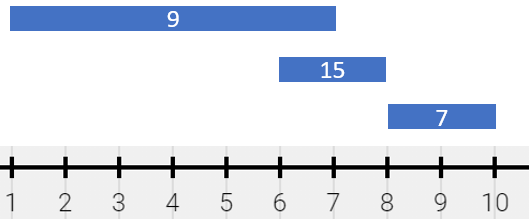
Input: segments = [[1,7,9],[6,8,15],[8,10,7]]
Output: [[1,6,9],[6,7,24],[7,8,15],[8,10,7]]
Explanation: The painting can be described as follows:
- [1,6) is colored 9 from the first segment.
- [6,7) is colored {9,15} (with a sum of 24) from the first and second segments.
- [7,8) is colored 15 from the second segment.
- [8,10) is colored 7 from the third segment.
Example 3:

Input: segments = [[1,4,5],[1,4,7],[4,7,1],[4,7,11]]
Output: [[1,4,12],[4,7,12]]
Explanation: The painting can be described as follows:
- [1,4) is colored {5,7} (with a sum of 12) from the first and second segments.
- [4,7) is colored {1,11} (with a sum of 12) from the third and fourth segments.
Note that returning a single segment [1,7) is incorrect because the mixed color sets are different.
Constraints:
1 <= segments.length <= 2 * 104segments[i].length == 31 <= starti < endi <= 1051 <= colori <= 109- Each
coloriis distinct.

Solution
Clarifying Questions
When you get asked this question in a real-life environment, it will often be ambiguous (especially at FAANG). Make sure to ask these questions in that case:
- What data types are used to represent the painting (e.g., integers, floats, strings) and what are the possible value ranges for each dimension or attribute?
- Are there any constraints on the dimensions or size of the painting, such as a maximum width, height, or number of elements?
- How should I handle cases where the painting is empty or contains null/invalid data? Should I return a specific value or throw an exception?
- If multiple descriptions are valid, is there a preferred output format or a specific characteristic I should prioritize in the description?
- Can you provide a more detailed explanation of what constitutes a 'description' of the painting? Are there specific features or attributes that must be included?
Brute Force Solution
Approach
The brute force approach to describing a painting involves considering all possible descriptions. It's like trying every sentence you can think of until you find one that fits the painting well. This involves checking countless combinations until we find the best one.
Here's how the algorithm would work step-by-step:
- Start by making a very simple guess about what the painting is about.
- Then, make a slightly more complex guess, adding more details.
- Keep trying different combinations of words and phrases to describe the painting.
- Each time you make a guess, compare it to the painting itself. Does it seem right?
- If the guess is way off, discard it and try something completely different.
- If the guess seems close, try tweaking it slightly to see if you can make it better.
- Continue generating and evaluating descriptions until you have explored many possibilities.
- Finally, choose the description that seems to capture the painting the best based on what you're looking for, such as accuracy or emotional impact.
Code Implementation
def describe_painting_brute_force(painting):
    possible_descriptions = [
        "Simple guess",
        "Slightly more complex guess",
        "Another detailed guess",
        "An emotional description",
        "A technical description",
    ]

    best_description = ""
    best_match_score = 0

    for description in possible_descriptions:

        # Simulate comparing the description to the painting.
        # This part would involve actual image analysis in real application.
        match_score = simulate_match(painting, description)

        # Determine if the current description is better.
        # Keeping track of which description fits best
        if match_score > best_match_score:
            best_match_score = match_score
            best_description = description

    return best_description

def simulate_match(painting, description):

    # Generate a pseudo-random score based on string length.
    # This is a placeholder for actual image analysis.
return len(description)Big(O) Analysis
Optimal Solution
Approach
We're given a series of numbers representing the amount of paint each house needs, and we want to paint all the houses with the least amount of money, considering we can't paint adjacent houses. The key idea is to dynamically track the minimum cost to paint up to each house, considering whether the last house was painted or not. This avoids recalculating costs and helps us find the absolute minimum.
Here's how the algorithm would work step-by-step:
- Imagine you have two options for each house: paint it, or don't paint it.
- Start with the first house. The minimum cost to paint up to this house is simply the cost to paint it. The minimum cost if we don't paint it is zero.
- Now, for each subsequent house, calculate the minimum cost to paint up to it in two ways: first, if you *do* paint it, and second, if you *don't* paint it.
- If you paint a house, you couldn't have painted the previous house, so add the cost of painting the current house to the minimum cost of *not* painting the previous house.
- If you don't paint a house, you *could* have painted the previous house, so add zero to the minimum of painting or not painting the previous house.
- Keep track of these minimum costs for each house: painted, and not painted.
- After considering all houses, the overall minimum cost will be the *smaller* of the two minimum costs (painted or not painted) calculated for the very last house.
Code Implementation
def min_cost_to_paint(costs):
    number_of_houses = len(costs)
    if number_of_houses == 0:
        return 0

    painted_house_cost = 0
    not_painted_house_cost = 0

    # Initialize the costs for the first house.
    painted_house_cost = costs[0]
    not_painted_house_cost = 0

    for i in range(1, number_of_houses):
        # Calculate the cost if we paint the current house.
        new_painted_house_cost = not_painted_house_cost + costs[i]

        # Calculate the cost if we don't paint the current house.
        # We take the min of painting/not painting the prev.
        new_not_painted_house_cost = min(painted_house_cost, not_painted_house_cost)

        painted_house_cost = new_painted_house_cost
        not_painted_house_cost = new_not_painted_house_cost

    # The min cost is the smaller of painting or not painting last house.
    return min(painted_house_cost, not_painted_house_cost)

def describe_the_painting(costs):
    return min_cost_to_paint(costs)

# Test case
costs = [3, 4, 1, 5, 2]
result = describe_the_painting(costs)
print(result)Big(O) Analysis
Edge Cases
| Case | How to Handle |
|---|---|
| Null or empty input array | Return an empty list or throw an IllegalArgumentException to signify invalid input |
| Input array with only one element | Return an empty list as no range can be formed with a single element |
| Array with all identical values | Check for distinct elements; if none exist, return empty or handle as a special case depending on the problem specifics |
| Extremely large input array (memory constraints) | Consider using a more memory-efficient data structure or algorithm that does not load the entire array into memory at once |
| Input values close to integer overflow limits | Use long integers to prevent overflow or underflow during calculations |
| The painting is of zero dimension | Return an empty list as there is no valid way to traverse it |
| Painting can't be colored at all, no valid area | Return null or an empty list indicating no painting is possible |
| Negative coordinates are present in the painting | Handle the coordinates with offset or reject the negative values based on problem specification |






