

Diagonal Traverse II
Medium





Given a 2D integer array nums, return all elements of nums in diagonal order as shown in the below images.
Example 1:
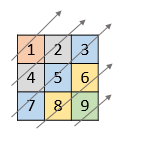
Input: nums = [[1,2,3],[4,5,6],[7,8,9]]
Output: [1,4,2,7,5,3,8,6,9]
Example 2:
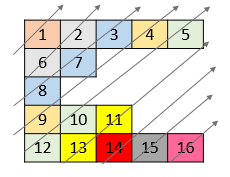
Input: nums = [[1,2,3,4,5],[6,7],[8],[9,10,11],[12,13,14,15,16]]
Output: [1,6,2,8,7,3,9,4,12,10,5,13,11,14,15,16]
Constraints:
1 <= nums.length <= 1051 <= nums[i].length <= 1051 <= sum(nums[i].length) <= 1051 <= nums[i][j] <= 105

Solution
Clarifying Questions
When you get asked this question in a real-life environment, it will often be ambiguous (especially at FAANG). Make sure to ask these questions in that case:
- What are the constraints on the dimensions of the input list of lists, specifically the maximum number of rows and the maximum length of each row?
- Can the integer values within the lists be negative, zero, or are they guaranteed to be positive?
- Is the input list guaranteed to be rectangular (i.e., each inner list has the same length), or can the inner lists have varying lengths?
- If the input list `nums` is empty or contains only empty lists, what should the function return: an empty list or should it throw an exception?
- Are there any memory constraints I should be aware of, given the potential size of the input?
Brute Force Solution
Approach
We're given a collection of numbers organized like a table that isn't perfectly square. The brute force method means we'll explore all possible diagonal paths through this table, one at a time. We'll examine each number as we go along these paths and construct the final sequence.
Here's how the algorithm would work step-by-step:
- Start with the top-left number. This is the beginning of our first diagonal.
- Now, consider all other potential diagonals. Each diagonal has a starting point.
- For each possible diagonal start position, trace the diagonal: Gather the numbers along that diagonal one by one.
- As we trace the diagonal, make sure we don't go off the edge of the table.
- Once we reach the end of a diagonal, save the list of numbers we collected along that path.
- Repeat this process for every possible starting point until we've found all possible diagonals.
- Finally, combine all the diagonal sequences we found into a single sequence in the order we visited their starting points.
Code Implementation
def diagonal_traverse_two_brute_force(matrix):
    rows = len(matrix)
    cols = max(len(row) for row in matrix)
    result = []

    # Iterate through all possible starting points.
    for start_row in range(rows):
        diagonal_elements = []
        row_index = start_row
        col_index = 0

        # Traverse the diagonal from the starting point.
        while row_index >= 0 and col_index < cols:
            if col_index < len(matrix[row_index]):
                diagonal_elements.append(matrix[row_index][col_index])
            row_index -= 1
            col_index += 1
        result.extend(diagonal_elements)

    # Iterate through starting columns of the first row.
    for start_col in range(1, cols):
        diagonal_elements = []
        row_index = 0
        col_index = start_col

        # Traverse diagonal. Skip empty cells.
        while row_index < rows and col_index < cols:
            if col_index < len(matrix[row_index]):
                diagonal_elements.append(matrix[row_index][col_index])
            row_index += 1
            col_index += 1
        result.extend(diagonal_elements)

    # Accumulate the diagonal sequences found into a single sequence.
return resultBig(O) Analysis
Optimal Solution
Approach
The trick to solving this quickly is realizing that elements on the same diagonal have a constant sum of their row and column positions. We group elements by these sums and then extract them in the right order, ensuring a fast and efficient traversal.
Here's how the algorithm would work step-by-step:
- First, figure out which diagonal each number belongs to by adding its row and column position together. Numbers on the same diagonal will have the same sum.
- Next, group all the numbers that belong to the same diagonal together. So, all numbers with the same row+column sum will be in the same group.
- Now that you have the numbers grouped by diagonal, you need to arrange each diagonal's numbers in the correct order. Think about it: within each diagonal, you want to read the numbers from bottom to top.
- Finally, go through each diagonal group, one after another, and put the numbers into a single list to get the desired diagonal order.
Code Implementation
def diagonal_traverse_ii(matrix):
    diagonals = {}

    # Group elements by their diagonal index (row + col).
    for row_index in range(len(matrix)):
        for col_index in range(len(matrix[row_index])):
            diagonal_index = row_index + col_index
            if diagonal_index not in diagonals:
                diagonals[diagonal_index] = []
            diagonals[diagonal_index].append(matrix[row_index][col_index])

    result = []

    # Iterate through diagonals in ascending order.
    for diagonal_index in sorted(diagonals.keys()):
        # Reverse each diagonal to get correct order
        diagonals_list = diagonals[diagonal_index][::-1]

        # Extend result with the elements from the current diagonal.
        result.extend(diagonals_list)

return resultBig(O) Analysis
Edge Cases
| Case | How to Handle |
|---|---|
| Empty input list `nums` | Return an empty list since there are no elements to traverse. |
| Empty inner lists within `nums` | Skip over empty inner lists during traversal to avoid errors. |
| `nums` contains only one row | Iterate directly over the single row and return the elements in order. |
| `nums` contains only one element | Return a list containing only that single element. |
| Large input size that could cause memory issues if all elements are added to a single list simultaneously. | The solution should handle large input sizes by processing elements in batches or using an iterator pattern if needed to avoid excessive memory consumption |
| Input list with extremely different lengths of inner lists. | The algorithm should correctly handle jagged lists, ensuring that out-of-bounds access does not occur by checking boundaries before element access. |
| Input list containing negative numbers, zeros and large positive numbers | The algorithm should handle negative numbers, zeros, and large positive numbers without issues as they do not affect the logic of diagonal traversal. |
| Potential integer overflow if row + col index exceeds the maximum integer value | Use a data type with larger capacity if row + col index could cause integer overflow, or consider alternative approach that avoids addition of row and column indices. |






