

Divide Nodes Into the Maximum Number of Groups
Hard




You are given a positive integer n representing the number of nodes in an undirected graph. The nodes are labeled from 1 to n.
You are also given a 2D integer array edges, where edges[i] = [ai, bi] indicates that there is a bidirectional edge between nodes ai and bi. Notice that the given graph may be disconnected.
Divide the nodes of the graph into m groups (1-indexed) such that:
- Each node in the graph belongs to exactly one group.
- For every pair of nodes in the graph that are connected by an edge
[ai, bi], ifaibelongs to the group with indexx, andbibelongs to the group with indexy, then|y - x| = 1.
Return the maximum number of groups (i.e., maximum m) into which you can divide the nodes. Return -1 if it is impossible to group the nodes with the given conditions.
Example 1:
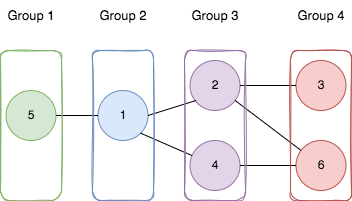
Input: n = 6, edges = [[1,2],[1,4],[1,5],[2,6],[2,3],[4,6]]
Output: 4
Explanation: As shown in the image we:
- Add node 5 to the first group.
- Add node 1 to the second group.
- Add nodes 2 and 4 to the third group.
- Add nodes 3 and 6 to the fourth group.
We can see that every edge is satisfied.
It can be shown that that if we create a fifth group and move any node from the third or fourth group to it, at least on of the edges will not be satisfied.
Example 2:
Input: n = 3, edges = [[1,2],[2,3],[3,1]]
Output: -1
Explanation: If we add node 1 to the first group, node 2 to the second group, and node 3 to the third group to satisfy the first two edges, we can see that the third edge will not be satisfied.
It can be shown that no grouping is possible.
Constraints:
1 <= n <= 5001 <= edges.length <= 104edges[i].length == 21 <= ai, bi <= nai != bi- There is at most one edge between any pair of vertices.

Solution
Clarifying Questions
When you get asked this question in a real-life environment, it will often be ambiguous (especially at FAANG). Make sure to ask these questions in that case:
- What is the maximum number of nodes and edges in the graph? What are the constraints on the values associated with the nodes?
- Can the graph be disconnected? If so, how should I handle multiple disconnected components?
- What should I return if it's impossible to divide the nodes into any groups based on the given condition?
- Are there any constraints on the structure of the graph? For example, is it guaranteed to be acyclic, or can it contain cycles?
- Are there any specific requirements for how the nodes are assigned to groups (e.g., minimizing the difference in group sizes or prioritizing certain nodes)? Or is any valid grouping acceptable?
Brute Force Solution
Approach
The goal is to split a network of people into the largest number of groups possible, where people in the same group aren't 'enemies' and people in adjacent groups *are* 'enemies'. The brute-force method considers *every single* possible way to divide people into groups. It's about trying absolutely everything until you find the best option.
Here's how the algorithm would work step-by-step:
- Start by trying to put each person in group one.
- Then check if any 'enemies' are in the same group. If they are, this arrangement isn't valid.
- Next, try putting each person in group two, and then group three, and so on. Keep going until each person has been assigned to a group.
- Check all of the groupings to ensure that 'enemies' never share the same group. Also verify that people in nearby groups *are* enemies.
- Record the number of groups each valid arrangement uses.
- Finally, compare all the valid arrangements and choose the one that uses the most groups.
Code Implementation
def divide_nodes_into_maximum_number_of_groups_brute_force(number_of_nodes, edges):

    maximum_number_of_groups = 0

    # Generate all possible group assignments for each node.
    for i in range(1, 2**(number_of_nodes)):  # Iterate through all possible group assignments
        group_assignments = []
        for node_index in range(number_of_nodes):
            group_assignments.append((i >> node_index) & 1)

        # Convert binary assignments to group numbers starting from 1.
        groups = [assignment + 1 for assignment in group_assignments]
        number_of_groups = len(set(groups))

        # Check if the current grouping is valid.
        is_valid = True
        for edge in edges:
            node1 = edge[0] - 1
            node2 = edge[1] - 1

            # Enemies must NOT be in the same group.
            if groups[node1] == groups[node2]:
                is_valid = False
                break

        if is_valid:
            # Verify that people in adjacent groups are enemies.
            for edge in edges:
                node1 = edge[0] - 1
                node2 = edge[1] - 1

                group_difference = abs(groups[node1] - groups[node2])

                # Check if adjacent groups are enemies.
                if group_difference == 1:
                    continue
                elif group_difference == 0:
                    is_valid = False
                    break
                else:
                    continue

            if is_valid:
                maximum_number_of_groups = max(maximum_number_of_groups, number_of_groups)

return maximum_number_of_groupsBig(O) Analysis
Optimal Solution
Approach
This problem is about splitting things into groups to maximize the number of groups, with constraints on what can be in the same group. The clever approach involves recognizing this as a shortest path problem on a graph, then using that shortest path to determine the maximum group number.
Here's how the algorithm would work step-by-step:
- Imagine each of the things you want to group as a point on a map.
- If two things cannot be in the same group, draw a line connecting those two points on the map.
- Now, think of each point as having a 'group number' associated with it. We want to find the largest possible group number.
- The key idea is that the group number for a point is one more than the shortest distance from that point to any point that has no group number.
- We can use something like a 'wave' spreading out from the points without a group number, where each wave increases the distance (and thus the group number) by one.
- The maximum group number is simply the largest group number assigned to any of the points.
Code Implementation
def divide_nodes_into_maximum_number_of_groups(number_of_nodes: int, edges: list[list[int]]) -> int:

    adjacency_list = [[] for _ in range(number_of_nodes + 1)]
    for first_node, second_node in edges:
        adjacency_list[first_node].append(second_node)
        adjacency_list[second_node].append(first_node)

    group_assignments = [0] * (number_of_nodes + 1)
    maximum_group_number = 0

    for start_node in range(1, number_of_nodes + 1):
        if group_assignments[start_node] != 0:
            continue

        group_assignments[start_node] = 1
        queue = [start_node]

        while queue:
            current_node = queue.pop(0)

            for neighbor_node in adjacency_list[current_node]:
                # Ensures bipartite graph for valid group assignment
                if group_assignments[neighbor_node] == 0:
                    group_assignments[neighbor_node] = group_assignments[current_node] + 1
                    queue.append(neighbor_node)
                elif group_assignments[neighbor_node] == group_assignments[current_node]:
                    return -1

    # Find maximum group number among all nodes
    for i in range(1, number_of_nodes + 1):
        maximum_group_number = max(maximum_group_number, group_assignments[i])

    # Sum of group assignments constitutes total group count
    total_group_count = sum(group_assignments)

return total_group_countBig(O) Analysis
Edge Cases
| Case | How to Handle |
|---|---|
| Empty graph (no nodes) | Return 0 since there are no nodes to group. |
| Single node graph (one node, no edges) | Return 1, as the single node forms a group. |
| Graph with only one edge | Return 2, since the two nodes connected by the edge form two groups. |
| Disconnected graph (multiple components) | Process each connected component separately and sum their maximum group counts. |
| Graph containing cycles | BFS or DFS based solutions should handle cycles automatically by tracking visited nodes. |
| Bipartite graph | A bipartite graph can always be divided into two groups with nodes on each side of any edge belonging to separate groups. |
| Graph that cannot be divided (odd cycle) | The algorithm should be able to identify cases where no valid group division is possible and return -1 or an appropriate error code. |
| Large graph (potential stack overflow with recursion) | Use iterative BFS/DFS to avoid stack overflow errors with very large graphs. |






