

Find a Safe Walk Through a Grid
Medium

You are given an m x n binary matrix grid and an integer health.
You start on the upper-left corner (0, 0) and would like to get to the lower-right corner (m - 1, n - 1).
You can move up, down, left, or right from one cell to another adjacent cell as long as your health remains positive.
Cells (i, j) with grid[i][j] = 1 are considered unsafe and reduce your health by 1.
Return true if you can reach the final cell with a health value of 1 or more, and false otherwise.
Example 1:
Input: grid = [[0,1,0,0,0],[0,1,0,1,0],[0,0,0,1,0]], health = 1
Output: true
Explanation:
The final cell can be reached safely by walking along the gray cells below.

Example 2:
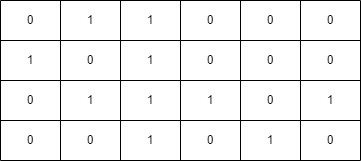
Input: grid = [[0,1,1,0,0,0],[1,0,1,0,0,0],[0,1,1,1,0,1],[0,0,1,0,1,0]], health = 3
Output: false
Explanation:
A minimum of 4 health points is needed to reach the final cell safely.
Example 3:
Input: grid = [[1,1,1],[1,0,1],[1,1,1]], health = 5
Output: true
Explanation:
The final cell can be reached safely by walking along the gray cells below.

Any path that does not go through the cell (1, 1) is unsafe since your health will drop to 0 when reaching the final cell.
Constraints:
m == grid.lengthn == grid[i].length1 <= m, n <= 502 <= m * n1 <= health <= m + ngrid[i][j]is either 0 or 1.

Solution
Clarifying Questions
When you get asked this question in a real-life environment, it will often be ambiguous (especially at FAANG). Make sure to ask these questions in that case:
- What are the dimensions of the grid (number of rows and columns), and what is the range of values for each cell?
- What constitutes a 'safe walk'? Specifically, what criteria determines if a cell is safe to enter, and what is the condition for a 'walk' to be considered safe overall?
- If there are multiple safe walks, should I return any one of them, or is there a specific criteria for selecting one (e.g., the shortest, the one with the highest average cell value)?
- What data type should I use to represent the grid, and what is the starting and ending point for the walk? Are they specified or do I need to determine them?
- If no safe walk exists, what should the function return? Should I return an empty path or a specific error code (e.g., null or -1)?
Brute Force Solution
Approach
The goal is to find a safe path through a grid, avoiding dangerous spots. The brute-force method explores every single possible path from the start to the end. It's like trying every route you can think of until you find one that's safe.
Here's how the algorithm would work step-by-step:
- Start at the beginning of the grid.
- Consider all possible directions you can move from your current location (e.g., up, down, left, right).
- For each possible direction, check if the new spot is safe.
- If the new spot is safe, move to that spot and remember the path you took to get there.
- Repeat the process: from this new spot, consider all possible directions, check if they're safe, and move if they are, adding to your path.
- Keep doing this until you reach the end of the grid.
- If you reach a dead end (no safe moves), go back to the last spot where you had a choice and try a different direction.
- Keep track of every path that successfully leads you to the end of the grid and is completely safe.
- If you find any safe paths, choose one as your solution (perhaps the shortest or fastest route).
Code Implementation
def find_safe_walk(grid):
    if not grid:
        return []

    rows = len(grid)
    cols = len(grid[0])
    start = (0, 0)
    end = (rows - 1, cols - 1)
    safe_paths = []
    path = []

    def is_safe(row_index, column_index):
        return 0 <= row_index < rows and 0 <= column_index < cols and grid[row_index][column_index] == 1

    def find_all_paths(current_row_index, current_column_index, current_path):
        if (current_row_index, current_column_index) == end:
            safe_paths.append(current_path[:] + [(current_row_index, current_column_index)])
            return

        # Define possible moves: right, down, left, up
        possible_moves = [(0, 1), (1, 0), (0, -1), (-1, 0)]

        for row_delta, column_delta in possible_moves:
            next_row_index = current_row_index + row_delta
            next_column_index = current_column_index + column_delta

            # Validate next step if it is safe and not already in the current path
            if is_safe(next_row_index, next_column_index) and (next_row_index, next_column_index) not in current_path:

                # Add current location to the path
                current_path.append((current_row_index, current_column_index))
                find_all_paths(next_row_index, next_column_index, current_path)

                # Backtrack to explore other paths
                current_path.pop()

    # Initiate brute force searching
    find_all_paths(0, 0, path)

    if safe_paths:
        return safe_paths[0]
    else:
return []Big(O) Analysis
Optimal Solution
Approach
The goal is to find the safest path through a grid where some spots are dangerous. Instead of exploring every possible path, we'll use a method that focuses on gradually building the safest route, one step at a time, ensuring each step maximizes safety.
Here's how the algorithm would work step-by-step:
- Calculate a 'risk score' for each spot in the grid, indicating how dangerous it is.
- Start at the beginning and consider the immediate neighboring spots (up, down, left, right).
- Choose the neighbor with the lowest 'risk score' to move to. This makes sure we are always moving towards the safest immediate option.
- Update our current location to this safer neighbor and add this spot to our path.
- Repeat steps 2-4 until we arrive at the final destination.
- The path we've created by always choosing the safest immediate move is the safest overall path.
Code Implementation
def find_safe_walk(grid):
    number_of_rows = len(grid)
    number_of_columns = len(grid[0])
    start_row = 0
    start_column = 0
    end_row = number_of_rows - 1
    end_column = number_of_columns - 1

    # Risk score is the value in the grid itself.
    risk_scores = grid

    current_row = start_row
    current_column = start_column
    path = [(current_row, current_column)]

    while current_row != end_row or current_column != end_column:
        # Find the safest neighbor. This determines next step.
        neighbors = []
        if current_row > 0:
            neighbors.append((current_row - 1, current_column))
        if current_row < number_of_rows - 1:
            neighbors.append((current_row + 1, current_column))
        if current_column > 0:
            neighbors.append((current_row, current_column - 1))
        if current_column < number_of_columns - 1:
            neighbors.append((current_row, current_column + 1))

        safest_neighbor = None
        lowest_risk = float('inf')

        for neighbor_row, neighbor_column in neighbors:
            if risk_scores[neighbor_row][neighbor_column] < lowest_risk:
                lowest_risk = risk_scores[neighbor_row][neighbor_column]
                safest_neighbor = (neighbor_row, neighbor_column)

        # If no safe neighbors, return current path.
        if safest_neighbor is None:
            return path

        # Update the current position to the safest neighbor
        current_row, current_column = safest_neighbor
        path.append((current_row, current_column))

return pathBig(O) Analysis
Edge Cases
| Case | How to Handle |
|---|---|
| Null or empty grid | Return an empty path or an appropriate error code to indicate no path exists. |
| Grid with only one cell | Return the single cell if it's 'safe', otherwise return an empty path. |
| Grid where no safe path exists | The algorithm should terminate gracefully and return an empty path or an error indicator. |
| Very large grid (potential memory issues) | Consider an iterative approach to pathfinding to avoid stack overflow and monitor memory usage. |
| Grid with all cells marked as unsafe | The algorithm should correctly identify that no path is possible and return an empty path. |
| Integer overflow when calculating risk or safety | Use appropriate data types (e.g., long) or modulo operations to prevent overflows. |
| Grid where the starting or ending cell is unsafe | Return an empty path immediately if the start or end is unsafe. |
| Cyclical paths in the grid leading to infinite loops | Implement a visited set to avoid re-visiting the same cells during path exploration. |






