

Find Maximum Area of a Triangle
Medium
You are given a 2D array coords of size n x 2, representing the coordinates of n points in an infinite Cartesian plane.
Find twice the maximum area of a triangle with its corners at any three elements from coords, such that at least one side of this triangle is parallel to the x-axis or y-axis. Formally, if the maximum area of such a triangle is A, return 2 * A.
If no such triangle exists, return -1.
Note that a triangle cannot have zero area.
Example 1:
Input: coords = [[1,1],[1,2],[3,2],[3,3]]
Output: 2
Explanation:
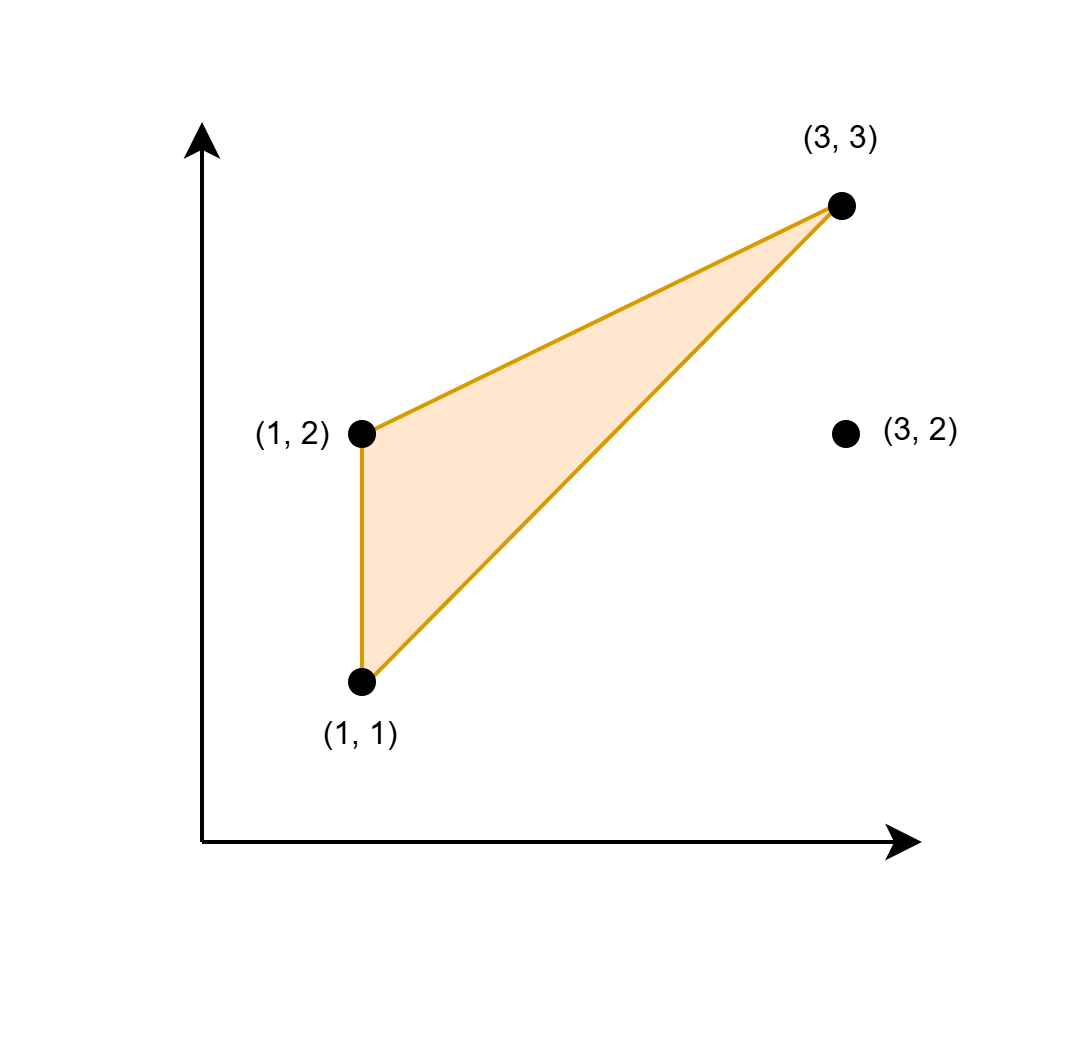
The triangle shown in the image has a base 1 and height 2. Hence its area is 1/2 * base * height = 1.
Example 2:
Input: coords = [[1,1],[2,2],[3,3]]
Output: -1
Explanation:
The only possible triangle has corners (1, 1), (2, 2), and (3, 3). None of its sides are parallel to the x-axis or the y-axis.
Constraints:
1 <= n == coords.length <= 1051 <= coords[i][0], coords[i][1] <= 106- All
coords[i]are unique.

Solution
Clarifying Questions
When you get asked this question in a real-life environment, it will often be ambiguous (especially at FAANG). Make sure to ask these questions in that case:
- What is the maximum number of points that can be in the input list, and what is the range of possible x and y coordinate values?
- Can the input list of points be empty or contain fewer than three points? If so, what should I return?
- Are the x and y coordinates guaranteed to be integers, or could they be floating-point numbers? If floating-point, what level of precision is required for the area calculation?
- If multiple sets of three points yield the same maximum area, is any one of those sets acceptable, or is there a specific criterion for choosing between them?
- Are duplicate points allowed in the input? If so, should I consider them as distinct points when forming triangles?
Brute Force Solution
Approach
The brute force approach to finding the maximum triangle area is like trying every single combination of three points to see which one makes the biggest triangle. We calculate the area for each possible triangle and keep track of the largest area we've seen so far.
Here's how the algorithm would work step-by-step:
- Consider each possible group of three points from the given list of points.
- For each group of three points, calculate the area of the triangle they form.
- Compare the calculated area with the largest area found so far.
- If the current triangle's area is larger than the largest area found so far, update the largest area.
- Repeat this process for all possible groups of three points.
- After checking all possible triangles, the largest area found is the maximum area of a triangle formed by any three points from the list.
Code Implementation
def find_maximum_area_of_a_triangle(points):
    number_of_points = len(points)
    maximum_area = 0

    # Iterate through all possible combinations of three points.
    for first_point_index in range(number_of_points):
        for second_point_index in range(first_point_index + 1, number_of_points):
            for third_point_index in range(second_point_index + 1, number_of_points):

                # Get the three points for the current triangle
                point_one = points[first_point_index]
                point_two = points[second_point_index]
                point_three = points[third_point_index]

                # Calculate the area of the triangle using the determinant method.
                area = 0.5 * abs(
                    point_one[0] * (point_two[1] - point_three[1]) +
                    point_two[0] * (point_three[1] - point_one[1]) +
                    point_three[0] * (point_one[1] - point_two[1])
                )

                # Keep track of the largest area found
                if area > maximum_area:
                    maximum_area = area

    return maximum_area
Big(O) Analysis
Optimal Solution
Approach
The goal is to find the largest triangle area formed by any three points from a given set of points. We avoid checking every possible triangle by cleverly using geometry to cut down the work we need to do. The key idea is to use the rotating calipers technique combined with the convex hull, a shape that encloses all the points.
Here's how the algorithm would work step-by-step:
- First, find the 'convex hull' of all the points. Imagine stretching a rubber band around all the points; the shape it forms is the convex hull. Only points on the edge of this shape can be corners of the largest triangle.
- Next, arrange the points on the convex hull in order, going around the shape in a circle.
- Now, pick any one of the points on the convex hull to be a corner of our triangle, and keep it fixed for now.
- Imagine two lines starting at the fixed point, each going to another point on the convex hull. Those other two points will be the other corners of our triangle. Imagine the two lines 'rotating' around the circle of points. This is similar to the rotating calipers algorithm for diameter.
- As the lines rotate, we calculate the area of the triangle they form. We keep track of the maximum area we've seen so far.
- The clever trick is that as one line rotates to the next point, we can predict which point the other line should go to next to maximize the triangle's area, based on the position of the first line's new point. This way, we don't have to check every single point combination.
- After sweeping all lines around the fixed point, we now select the next point in the convex hull and fix it. Repeat the rotating lines process.
- Once we've fixed every point of the convex hull, we can compare all the maximum areas calculated. The highest area is the area of the largest triangle that can be formed using three of the original points.
Code Implementation
def find_maximum_area_of_triangle(points):
    def cross_product(point1, point2, point3):
        return (point2[0] - point1[0]) * (point3[1] - point1[1]) - (point2[1] - point1[1]) * (point3[0] - point1[0])

    def calculate_area(point1, point2, point3):
        return 0.5 * abs(cross_product(point1, point2, point3))

    def convex_hull(points):
        points = sorted(points)
        if len(points) <= 1:
            return points

        upper_hull = []
        for point in points:
            while len(upper_hull) >= 2 and cross_product(upper_hull[-2], upper_hull[-1], point) <= 0:
                upper_hull.pop()
            upper_hull.append(point)

        lower_hull = []
        for point in reversed(points):
            while len(lower_hull) >= 2 and cross_product(lower_hull[-2], lower_hull[-1], point) <= 0:
                lower_hull.pop()
            lower_hull.append(point)

        return upper_hull[:-1] + lower_hull[:-1]

    convex_hull_points = convex_hull(points)
    number_of_hull_points = len(convex_hull_points)

    if number_of_hull_points < 3:
        return 0

    maximum_area = 0

    for i in range(number_of_hull_points):
        left_pointer = (i + 1) % number_of_hull_points
        right_pointer = (i + 2) % number_of_hull_points

        # Iterate through all possible combinations to maximize area.
        while True:
            area1 = calculate_area(convex_hull_points[i], convex_hull_points[left_pointer], convex_hull_points[right_pointer])
            next_right_pointer = (right_pointer + 1) % number_of_hull_points
            area2 = calculate_area(convex_hull_points[i], convex_hull_points[left_pointer], convex_hull_points[next_right_pointer])

            # Move right pointer if it leads to a bigger area.
            if area2 > area1:
                right_pointer = next_right_pointer
            else:
                maximum_area = max(maximum_area, area1)
                break

return maximum_areaBig(O) Analysis
Edge Cases
| Case | How to Handle |
|---|---|
| Empty input list | Return 0, as no triangle can be formed. |
| Input list with fewer than 3 points | Return 0, as a triangle requires at least 3 points. |
| All points are collinear (lie on the same line) | Return 0, as a degenerate triangle has zero area. |
| Duplicate points in the input list | The area calculation formula will still work correctly; duplicates should not affect the maximum area found if they do not constitute one of the vertices of the maximum area triangle. |
| Integer overflow during area calculation with large coordinate values | Use a data type capable of holding larger values (e.g., long) or floating-point numbers (e.g., double) for the area calculation. |
| Floating-point precision issues when calculating area | Use a small tolerance value when comparing areas to account for potential floating-point inaccuracies. |
| Input list contains points with very large absolute coordinate values | Ensure that the chosen data types (e.g., int, long, double) can accommodate the range of coordinate values without overflow or loss of precision. |
| The three points that form the largest area triangle are close to being collinear | Floating-point imprecision might affect which triangle is identified, but should generally converge to correct area. |






