

Find Number of Coins to Place in Tree Nodes
Hard

You are given an undirected tree with n nodes labeled from 0 to n - 1, and rooted at node 0. You are given a 2D integer array edges of length n - 1, where edges[i] = [ai, bi] indicates that there is an edge between nodes ai and bi in the tree.
You are also given a 0-indexed integer array cost of length n, where cost[i] is the cost assigned to the ith node.
You need to place some coins on every node of the tree. The number of coins to be placed at node i can be calculated as:
- If size of the subtree of node
iis less than3, place1coin. - Otherwise, place an amount of coins equal to the maximum product of cost values assigned to
3distinct nodes in the subtree of nodei. If this product is negative, place0coins.
Return an array coin of size n such that coin[i] is the number of coins placed at node i.
Example 1:

Input: edges = [[0,1],[0,2],[0,3],[0,4],[0,5]], cost = [1,2,3,4,5,6]
Output: [120,1,1,1,1,1]
Explanation: For node 0 place 6 * 5 * 4 = 120 coins. All other nodes are leaves with subtree of size 1, place 1 coin on each of them.
Example 2:
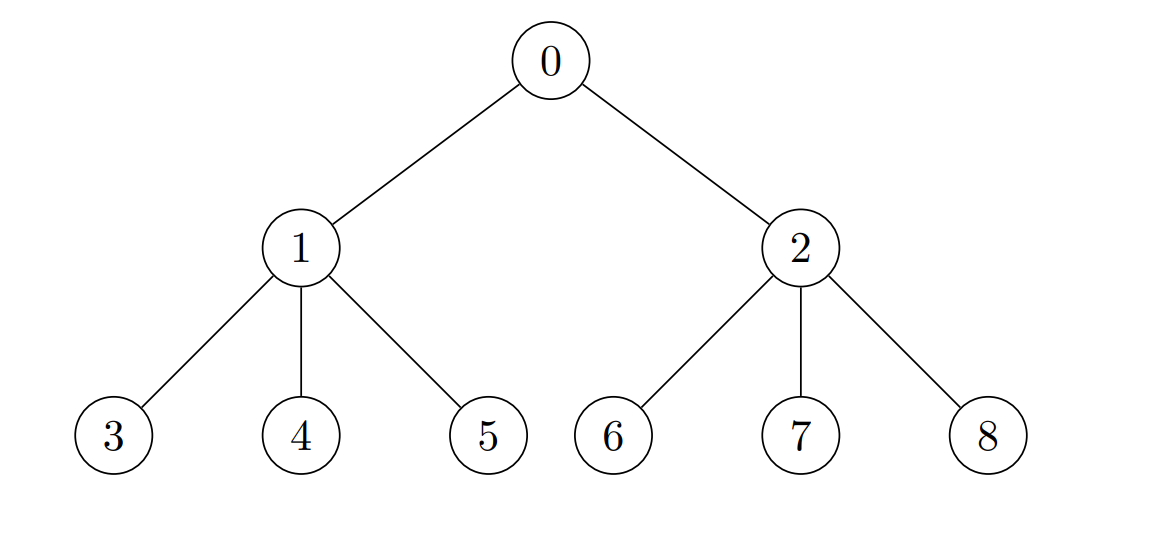
Input: edges = [[0,1],[0,2],[1,3],[1,4],[1,5],[2,6],[2,7],[2,8]], cost = [1,4,2,3,5,7,8,-4,2]
Output: [280,140,32,1,1,1,1,1,1]
Explanation: The coins placed on each node are:
- Place 8 * 7 * 5 = 280 coins on node 0.
- Place 7 * 5 * 4 = 140 coins on node 1.
- Place 8 * 2 * 2 = 32 coins on node 2.
- All other nodes are leaves with subtree of size 1, place 1 coin on each of them.
Example 3:

Input: edges = [[0,1],[0,2]], cost = [1,2,-2]
Output: [0,1,1]
Explanation: Node 1 and 2 are leaves with subtree of size 1, place 1 coin on each of them. For node 0 the only possible product of cost is 2 * 1 * -2 = -4. Hence place 0 coins on node 0.
Constraints:
2 <= n <= 2 * 104edges.length == n - 1edges[i].length == 20 <= ai, bi < ncost.length == n1 <= |cost[i]| <= 104- The input is generated such that
edgesrepresents a valid tree.

Solution
Clarifying Questions
When you get asked this question in a real-life environment, it will often be ambiguous (especially at FAANG). Make sure to ask these questions in that case:
- What is the range of possible values for the number of coins we can place in a node? Are negative values allowed?
- What happens if the tree is empty (has no nodes)? Should I return a specific value, or is an empty tree an invalid input?
- Are the node values (representing the coins placed) required to be integers?
- Is the input guaranteed to represent a valid tree structure, or do I need to validate that the parent-child relationships form a proper tree?
- Is there a limit to the number of nodes in the tree?
Brute Force Solution
Approach
The brute force method to solve this coin placement problem involves exploring every possible way to assign coins to the nodes in the tree. We try placing different numbers of coins at each node and see if any arrangement satisfies the given rules. It's like trying every combination until we find one that works.
Here's how the algorithm would work step-by-step:
- Start by choosing a number of coins to place at the first node.
- Then, choose a number of coins to place at each of its direct children (nodes connected to it).
- Continue this process for all the nodes in the tree, making sure you try every possible number of coins at each node.
- For each complete arrangement of coins, check if it follows the rule that the number of coins at each node is equal to the sum of coins at its children.
- If an arrangement satisfies the rule, save that arrangement.
- After trying all possible arrangements, find the arrangement that uses the smallest total number of coins. That is your answer.
Code Implementation
def find_min_coins_brute_force(tree):
    min_coins = float('inf')

    def is_valid_arrangement(coin_assignment):
        for node in tree:
            children_sum = sum(coin_assignment[child] for child in tree[node]['children'])
            if coin_assignment[node] != children_sum:
                return False
        return True

    def generate_coin_assignments(node, current_assignment):
        nonlocal min_coins

        # Base case: all nodes have coin assignments.
        if node is None:
            if is_valid_arrangement(current_assignment):
                total_coins = sum(current_assignment.values())
                min_coins = min(min_coins, total_coins)
            return

        # Iterate through possible coin values for the current node
        for coins in range(11): #Assuming a reasonable coin limit.
            new_assignment = current_assignment.copy()
            new_assignment[node] = coins

            #Recursive call for children
            for child in tree[node]['children']:
                generate_coin_assignments(child, new_assignment)

            if not tree[node]['children']:
                if is_valid_arrangement(new_assignment):
                    total_coins = sum(new_assignment.values())
                    min_coins = min(min_coins, total_coins)

    # Start the brute force search from each root
    for root_node in tree:
        if not tree[root_node]['parent']:
            generate_coin_assignments(root_node, {})

    if min_coins == float('inf'):
        return -1
    else:
return min_coinsBig(O) Analysis
Optimal Solution
Approach
The most efficient way to solve this problem is to work from the leaves of the tree upwards. We want to figure out how many coins each node needs by considering what its children need, and passing requirements upwards.
Here's how the algorithm would work step-by-step:
- Start at the bottom of the tree, at the nodes that have no children.
- For each of those bottom nodes, decide whether it needs an odd or even number of coins to make its parent happy. This depends on the target value given for each parent.
- Move up to the next level of nodes. Now, look at each node and consider what the coin requirements of its children are. Remember what we calculated at the previous step for the leaves.
- Figure out how many coins each of these nodes needs so that when you add up its coins and all the coins of its children, it meets the target value requirement for *its* parent.
- Keep doing this, moving up the tree level by level, until you reach the very top node.
- For the very top node, calculate how many coins it needs so that when you add it to the coins of its children, it hits the target value for the top node itself. Since the top node has no parent, we don't need to worry about the target for its non existent parent
- Add up the number of coins at each node and that's the total number of coins needed.
Code Implementation
def find_number_of_coins(targets, adjacency_list):

    number_of_nodes = len(targets)
    coin_assignments = [0] * number_of_nodes
    total_coins = 0

    def dfs(current_node, parent_node):
        nonlocal total_coins

        for neighbor_node in adjacency_list[current_node]:
            if neighbor_node != parent_node:
                dfs(neighbor_node, current_node)

        children_sum = 0
        for neighbor_node in adjacency_list[current_node]:
            if neighbor_node != parent_node:
                children_sum += coin_assignments[neighbor_node]

        # Determine required coins at current_node.
        if parent_node != -1:
            coin_assignments[current_node] = (targets[parent_node] - children_sum) % 2

            # Ensure coin count is non-negative
            if coin_assignments[current_node] < 0:
                coin_assignments[current_node] += 2
        else:
            # Handle the root node, no parent constraints.
            coin_assignments[current_node] = (targets[current_node] - children_sum) % 2
            if coin_assignments[current_node] < 0:
                coin_assignments[current_node] += 2

        total_coins += coin_assignments[current_node]

    # Start DFS traversal from the root (node 0).
    dfs(0, -1)

    # The algorithm computes the result
return total_coinsBig(O) Analysis
Edge Cases
| Case | How to Handle |
|---|---|
| Null or empty tree | Return 0 if the tree is null or empty, as no coins are needed. |
| Single node tree | Return the absolute difference between the node's value and 1. |
| Tree with all nodes having value 1 | This represents the ideal case where no moves are needed after initial placement so return 0 (after processing). |
| Tree with large number of nodes exceeding recursion depth | Optimize using iterative DFS or BFS to avoid stack overflow due to recursion depth limit, if applicable to algorithm. |
| Tree with nodes having very large coin values (potential integer overflow) | Use a data type (e.g., long) capable of storing large coin counts to prevent integer overflow during calculations. |
| Skewed tree (e.g., linked list structure) | Handle skewed trees gracefully, as they can affect the complexity of some algorithms, impacting time and space complexity. |
| Node values are negative numbers | Take the absolute value of the difference between node value and 1 to correctly reflect needed transfers. |
| Tree with nodes requiring extremely large coin transfers (close to max int/long) | Ensure intermediate calculations handle large coin transfers without overflow by using appropriate data types and checking for potential overflows. |






