

Find the Maximum Sum of Node Values
Find the Maximum Sum of Node Values #3 Most Asked
Hard
There exists an undirected tree with n nodes numbered 0 to n - 1. You are given a 0-indexed 2D integer array edges of length n - 1, where edges[i] = [ui, vi] indicates that there is an edge between nodes ui and vi in the tree. You are also given a positive integer k, and a 0-indexed array of non-negative integers nums of length n, where nums[i] represents the value of the node numbered i.
Alice wants the sum of values of tree nodes to be maximum, for which Alice can perform the following operation any number of times (including zero) on the tree:
- Choose any edge
[u, v]connecting the nodesuandv, and update their values as follows:nums[u] = nums[u] XOR knums[v] = nums[v] XOR k
Return the maximum possible sum of the values Alice can achieve by performing the operation any number of times.
Example 1:
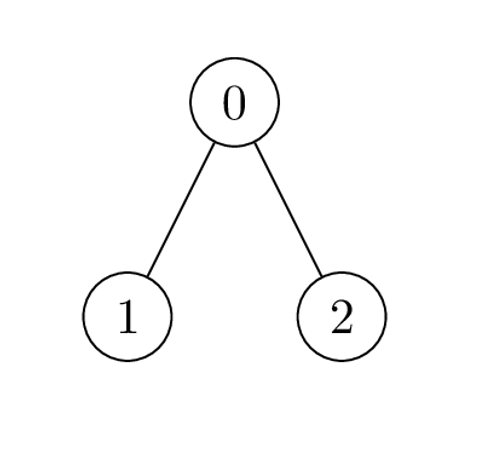
Input: nums = [1,2,1], k = 3, edges = [[0,1],[0,2]]
Output: 6
Explanation: Alice can achieve the maximum sum of 6 using a single operation:
- Choose the edge [0,2]. nums[0] and nums[2] become: 1 XOR 3 = 2, and the array nums becomes: [1,2,1] -> [2,2,2].
The total sum of values is 2 + 2 + 2 = 6.
It can be shown that 6 is the maximum achievable sum of values.
Example 2:

Input: nums = [2,3], k = 7, edges = [[0,1]]
Output: 9
Explanation: Alice can achieve the maximum sum of 9 using a single operation:
- Choose the edge [0,1]. nums[0] becomes: 2 XOR 7 = 5 and nums[1] become: 3 XOR 7 = 4, and the array nums becomes: [2,3] -> [5,4].
The total sum of values is 5 + 4 = 9.
It can be shown that 9 is the maximum achievable sum of values.
Example 3:
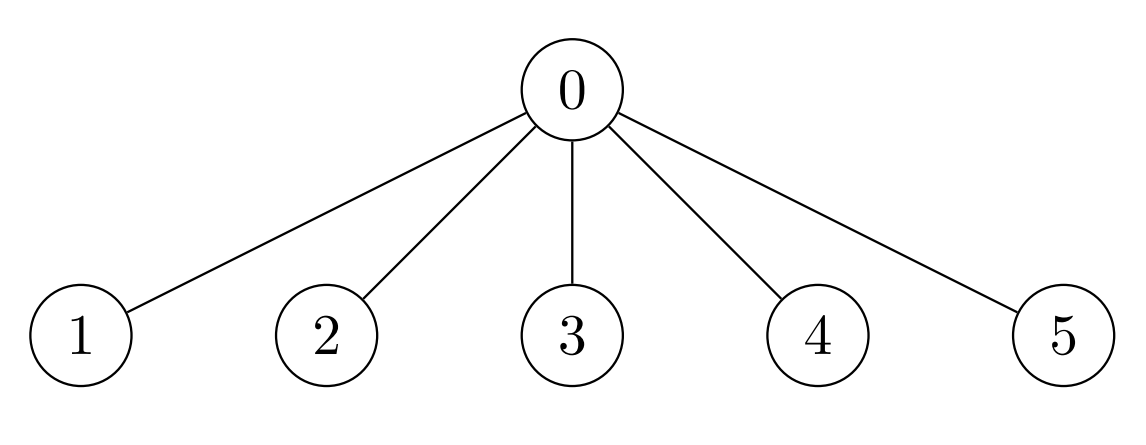
Input: nums = [7,7,7,7,7,7], k = 3, edges = [[0,1],[0,2],[0,3],[0,4],[0,5]]
Output: 42
Explanation: The maximum achievable sum is 42 which can be achieved by Alice performing no operations.
Constraints:
2 <= n == nums.length <= 2 * 1041 <= k <= 1090 <= nums[i] <= 109edges.length == n - 1edges[i].length == 20 <= edges[i][0], edges[i][1] <= n - 1- The input is generated such that
edgesrepresent a valid tree.

Solution
Clarifying Questions
When you get asked this question in a real-life environment, it will often be ambiguous (especially at FAANG). Make sure to ask these questions in that case:
- Can the tree contain negative numbers, or are all node values strictly non-negative integers?
- Since the XOR operation is applied to two *connected* nodes simultaneously, does the chosen XOR integer $k$ remain constant for all operations, or can it change with each operation?
- Is the tree guaranteed to be a valid, connected undirected tree, and what is the expected scale of the number of nodes ($N$) in the tree?
- Since we can perform the operation on *any* two connected nodes an unlimited number of times, does this mean we can effectively flip the XOR bit on any arbitrary pair of nodes regardless of their distance in the tree by cascading operations along a path?
- What is the expected return data type for the sum, and could the maximum possible sum exceed the standard 32-bit integer limit?
Brute Force Solution
Approach
To find the maximum possible sum of all the nodes in a network after performing a special operation of sharing values between connected nodes, the brute force approach involves trying every single combination of the operation on every pair of connected nodes. By testing all possibilities and keeping track of the totals, you can eventually find the absolute highest score possible.
Here's how the algorithm would work step-by-step:
- Look at the entire network of nodes and all the direct connections linking them together.
- Pick a pair of connected nodes and imagine applying the special value-sharing operation between them.
- Calculate the total sum of all the nodes in the network after making this choice.
- Now, imagine undoing that choice and instead trying the operation on a different pair of connected nodes, or even trying multiple operations in a row.
- Systematically explore every possible sequence of applying and not applying the operation to every connected pair of nodes.
- Write down or remember the total sum of the node values for every single scenario you test.
- Compare all the totals you gathered across every tried combination and pick the highest one as your final answer.
Code Implementation
def maximum_value_sum(node_values, edge_list, operation_value):
    global_maximum_sum = sum(node_values)

    # Recursively explore all possible subsets of edge operations to find the maximum possible total sum
    def explore_combinations(edge_index, current_sum):
        nonlocal global_maximum_sum
        if edge_index == len(edge_list):
            if current_sum > global_maximum_sum:
                global_maximum_sum = current_sum
            return

    # Skip applying the operation to the current edge to explore alternatives without modification
        explore_combinations(edge_index + 1, current_sum)

        first_node, second_node = edge_list[edge_index]
        node_values[first_node] ^= operation_value
        node_values[second_node] ^= operation_value

    # Apply the operation to the current edge to test the effect of the bitwise XOR transformation
        explore_combinations(edge_index + 1, sum(node_values))

        node_values[first_node] ^= operation_value
        node_values[second_node] ^= operation_value

    explore_combinations(0, sum(node_values))

return global_maximum_sumBig(O) Analysis
Optimal Solution
Approach
Instead of getting lost in the dizzying web of every possible network path, the optimal approach relies on a clever mathematical shortcut about pairs of nodes. By noticing how a special operation affects pairs of connected items, we can simply track the net benefit of applying this trick and make a local choice for every single connection.
Here's how the algorithm would work step-by-step:
- Picture the network as a collection of connected nodes, where every node holds a starting value.
- Imagine you have a special token you can flip to alter a node value, but the rules state you must always use this token on a pair of directly connected nodes at the exact same time.
- Realize that because the token affects both ends of a connection, you can actually chain these operations across the network to flip the values of any two nodes you want, even if they are not direct neighbors.
- Ask yourself for every single connection in the network: if I use the special trick on this pair, will the total sum of their values go up or down?
- If applying the trick makes the combined value of the pair go up, go ahead and count that improvement; if it makes the value go down, simply leave them alone.
- Keep a running tally of your total sum along with a count of how many times you used the trick.
- At the very end, check your total count of trick uses; if you used it an odd number of times, meaning you have one lonely leftover change that breaks the rules of pairs, take away the smallest penalty you encountered to make the count even again.
- This leaves you with the absolute maximum possible sum without ever needing to guess or test complicated network paths.
Code Implementation
def maximum_value_sum(node_values, k_factor, edges): total_sum_accumulator = 0 flip_count_tally = 0 minimum_positive_loss = float('inf') # We evaluate every node pair greedily to maximize the sum of values independently. for current_node_value in node_values: flipped_node_value = current_node_value ^ k_factor if flipped_node_value > current_node_value: total_sum_accumulator += flipped_node_value flip_count_tally += 1 minimum_positive_loss = min(minimum_positive_loss, flipped_node_value - current_node_value) else: total_sum_accumulator += current_node_value minimum_positive_loss = min(minimum_positive_loss, current_node_value - flipped_node_value) # An odd number of flips violates the pairing rule, requiring a corrective adjustment. if flip_count_tally % 2 != 0: total_sum_accumulator -= minimum_positive_loss # The final sum reflects the optimal configuration achieved via valid pair operations. return total_sum_accumulatorBig(O) Analysis
Edge Cases
| Case | How to Handle |
|---|---|
| Tree with only a single node and no edges | The algorithm should return the node's original value since no XOR operations can be performed without an adjacent node. |
| Tree consisting of exactly two connected nodes | The solution checks if applying the XOR operation to both nodes increases the total sum and applies it if beneficial. |
| Nodes with negative integer values | The greedy parity-based pairing approach works correctly with negative numbers because XOR transformations are evaluated based on net gain rather than absolute magnitudes. |
| Extremely large tree with maximum constraints causing deep recursion | Implement an iterative bottom-up tree DP or carefully manage stack limits to prevent stack overflow errors during depth-first search traversal. |
| All node values result in a net decrease when XOR is applied | The algorithm naturally preserves the original values by choosing not to flip nodes whose XOR delta is negative, maintaining the maximum possible sum. |
| A skewed star or linked list graph topology | The greedy edge-pairing logic remains valid regardless of tree shape because any two nodes can eventually have their XOR applied via path-matching properties. |
| Sum of node values exceeding standard 32-bit integer limits | Use 64-bit integers for all running sums to prevent integer overflow during accumulation of large tree node values. |
| XOR integer value is zero | XORing with zero yields zero change for all nodes, so the algorithm will simply return the sum of the original node values without modifications. |






