

Grid Game
Medium



You are given a 0-indexed 2D array grid of size 2 x n, where grid[r][c] represents the number of points at position (r, c) on the matrix. Two robots are playing a game on this matrix.
Both robots initially start at (0, 0) and want to reach (1, n-1). Each robot may only move to the right ((r, c) to (r, c + 1)) or down ((r, c) to (r + 1, c)).
At the start of the game, the first robot moves from (0, 0) to (1, n-1), collecting all the points from the cells on its path. For all cells (r, c) traversed on the path, grid[r][c] is set to 0. Then, the second robot moves from (0, 0) to (1, n-1), collecting the points on its path. Note that their paths may intersect with one another.
The first robot wants to minimize the number of points collected by the second robot. In contrast, the second robot wants to maximize the number of points it collects. If both robots play optimally, return the number of points collected by the second robot.
Example 1:

Input: grid = [[2,5,4],[1,5,1]]
Output: 4
Explanation: The optimal path taken by the first robot is shown in red, and the optimal path taken by the second robot is shown in blue.
The cells visited by the first robot are set to 0.
The second robot will collect 0 + 0 + 4 + 0 = 4 points.
Example 2:
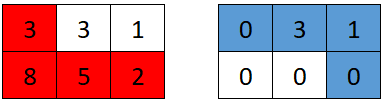
Input: grid = [[3,3,1],[8,5,2]]
Output: 4
Explanation: The optimal path taken by the first robot is shown in red, and the optimal path taken by the second robot is shown in blue.
The cells visited by the first robot are set to 0.
The second robot will collect 0 + 3 + 1 + 0 = 4 points.
Example 3:

Input: grid = [[1,3,1,15],[1,3,3,1]]
Output: 7
Explanation: The optimal path taken by the first robot is shown in red, and the optimal path taken by the second robot is shown in blue.
The cells visited by the first robot are set to 0.
The second robot will collect 0 + 1 + 3 + 3 + 0 = 7 points.
Constraints:
grid.length == 2n == grid[r].length1 <= n <= 5 * 1041 <= grid[r][c] <= 105

Solution
Clarifying Questions
When you get asked this question in a real-life environment, it will often be ambiguous (especially at FAANG). Make sure to ask these questions in that case:
- What are the dimensions (rows and columns) of the grid, and what is the maximum possible size for each dimension?
- What are the possible values within the grid cells? Are they integers, and can they be negative, zero, or positive?
- What constitutes a valid move in this game, and what are the specific rules or constraints governing the players' actions?
- What is the goal of each player, and how is the winner determined? Is it to maximize their own score, minimize the opponent's, or something else?
- Could you provide a small example input grid and the corresponding optimal game play steps with the resultant score, to illustrate the game's rules and objectives further?
Brute Force Solution
Approach
Imagine you have a robot moving through a grid, where another player is trying to minimize your score. To find the best outcome for the robot using a brute force strategy, we explore every possible path the robot could take, considering the other player's moves at each turn.
Here's how the algorithm would work step-by-step:
- The robot starts at the beginning of the grid.
- At each step, the robot has limited moves it can make (usually moving right or down).
- We consider every possible sequence of moves the robot can take to reach the end of the grid.
- For each possible path, we also consider the possible moves the minimizing player would make to reduce the robot's score.
- Calculate the final score for the robot for each complete path, considering the other player's optimal choices at each step along the way.
- After exploring all possible paths, we choose the path that gives the robot the highest possible score, even when the other player is trying to minimize it.
Code Implementation
def grid_game_brute_force(grid):
    rows = len(grid)
    columns = len(grid[0])

    def calculate_path_score(path):
        first_player_score = 0
        second_player_score = 0
        current_grid = [row[:] for row in grid]

        for row_index, column_index in path:
            first_player_score += current_grid[row_index][column_index]
            current_grid[row_index][column_index] = 0

        return first_player_score

    def find_best_path(current_row, current_column, current_path):
        if current_row == rows - 1 and current_column == columns - 1:
            return calculate_path_score(current_path)

        possible_scores = []

        # Explore right move
        if current_column + 1 < columns:
            new_path = current_path + [(current_row, current_column + 1)]
            possible_scores.append(find_best_path(current_row, current_column + 1, new_path))

        # Explore down move
        if current_row + 1 < rows:
            new_path = current_path + [(current_row + 1, current_column)]
            possible_scores.append(find_best_path(current_row + 1, current_column, new_path))

        if not possible_scores:
            return calculate_path_score(current_path)

        # Simulate the minimizing player's choice: minimize the robot's score
        return min(possible_scores)

    # Start exploring paths from the top-left corner
    best_possible_score = find_best_path(0, 0, [(0, 0)])
return best_possible_scoreBig(O) Analysis
Optimal Solution
Approach
The goal is to minimize the score the second player can achieve in a game played on a grid. We want to force the second player into situations where their best option still results in a low score for them. The key insight is that the second player has only two choices, and understanding these choices is enough to beat them.
Here's how the algorithm would work step-by-step:
- Realize that the first player's moves don't matter because the second player will always pick optimally regardless of what they do.
- The second player will always have two options. Either go through the top row first and then the bottom row, or the bottom row first and then the top row.
- Think about the top row. The first player can only change where that row is cut off from what's available to the second player.
- Consider all possible places the first player could cut off the top row, making the second player take the rest of the values.
- Then consider what's left on the bottom row. The first player cannot change where that row is cut off either.
- For each potential cutoff location on the top row, calculate the largest number the second player could get by picking the top row from the cutoff point to the end, or the bottom row from beginning to the cutoff point.
- Find the smallest value among all those largest numbers. This represents the best play for the first player, forcing the second player into the lowest possible maximum score.
Code Implementation
def grid_game(grid):
    number_of_columns = len(grid[0])
    minimum_maximum_score = float('inf')

    # Iterate through all possible cutoff points.
    for cutoff_point in range(number_of_columns):
        # Calculate the maximum score the second player can get.
        top_row_score = sum(grid[0][cutoff_point:])
        bottom_row_score = sum(grid[1][:cutoff_point])

        # The second player chooses the path to maximize score.
        maximum_score = max(top_row_score, bottom_row_score)

        # Find the minimum of all possible maximum scores.
        minimum_maximum_score = min(minimum_maximum_score, maximum_score)

return minimum_maximum_scoreBig(O) Analysis
Edge Cases
| Case | How to Handle |
|---|---|
| Null or empty grid | Return 0 as no path exists or the game is immediately over if no grid is present. |
| 1x1 grid | The first player takes the only cell, so return the value in the cell. |
| 1xN or Nx1 grid | The first player clears the first row, maximizing their gain, so calculate the maximum gain of first player after their moves. |
| All cells are 0 | The first player will always have a score of 0. |
| Grid with large numbers leading to potential integer overflow | Use long or appropriate data type to store intermediate calculations and final result to prevent overflow. |
| First row has very large values, second row has negligibly small values | The first player will optimize to choose the path with highest value in first row to minimize second player gain. |
| Grid dimensions are extremely large, potentially exceeding memory limits. | Consider using dynamic programming with only the previous row stored to optimize memory usage. |
| Multiple optimal paths exist for the first player | The first player will choose any path to maximize score, and the solution accounts for this. |






