

Insufficient Nodes in Root to Leaf Paths
Medium
Given the root of a binary tree and an integer limit, delete all insufficient nodes in the tree simultaneously, and return the root of the resulting binary tree.
A node is insufficient if every root to leaf path intersecting this node has a sum strictly less than limit.
A leaf is a node with no children.
Example 1:
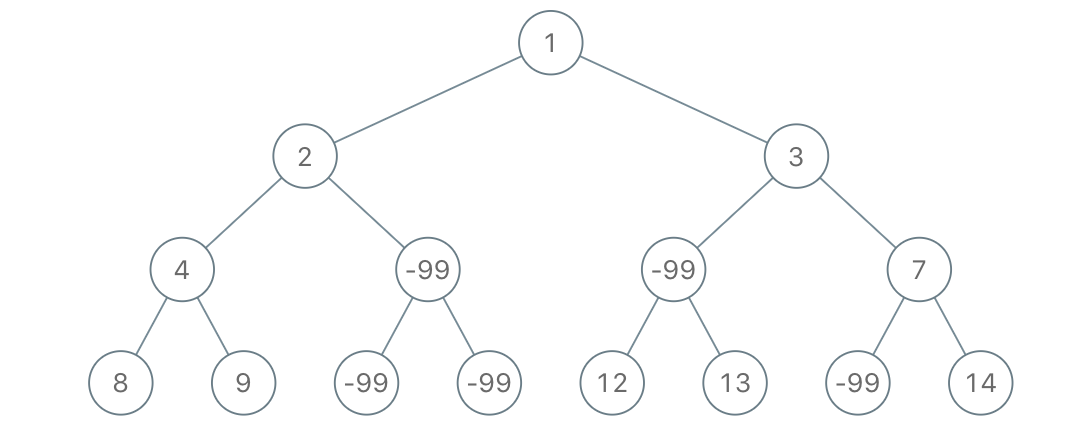
Input: root = [1,2,3,4,-99,-99,7,8,9,-99,-99,12,13,-99,14], limit = 1
Output: [1,2,3,4,null,null,7,8,9,null,14]
Example 2:

Input: root = [5,4,8,11,null,17,4,7,1,null,null,5,3], limit = 22
Output: [5,4,8,11,null,17,4,7,null,null,null,5]
Example 3:
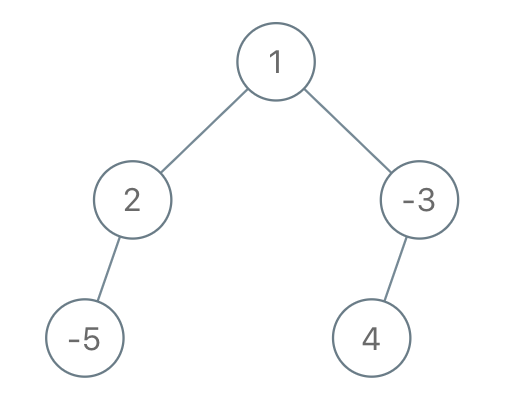
Input: root = [1,2,-3,-5,null,4,null], limit = -1
Output: [1,null,-3,4]
Constraints:
- The number of nodes in the tree is in the range
[1, 5000]. -105 <= Node.val <= 105-109 <= limit <= 109

Solution
Clarifying Questions
When you get asked this question in a real-life environment, it will often be ambiguous (especially at FAANG). Make sure to ask these questions in that case:
- What is the range of values for the nodes in the tree? Can they be negative, zero, or floating-point numbers?
- What constitutes 'insufficient'? Is the limit inclusive or exclusive?
- If a node has only one child and the path from the root to that child is insufficient, should that node be removed, or should the insufficient path be considered as going through that single child?
- If all nodes are removed, should I return null or an empty tree (a single null node)?
- Are we guaranteed that the root node is not null?
Brute Force Solution
Approach
The brute force method in this tree problem involves exploring every possible path from the root to a leaf. For each path, we check if it meets a certain requirement, and if it doesn't, we try to remove the nodes causing the failure.
Here's how the algorithm would work step-by-step:
- Start at the very top of the tree, the root.
- Trace every single path from the root all the way down to the very bottom leaves.
- For each of these paths, calculate a total value, like the sum of all the numbers along the path.
- Compare this total value to a given minimum value.
- If the total value is less than the minimum value, we need to cut out parts of the path to fix it.
- Try cutting out the very last node on the path (the leaf). See if that helps.
- If that doesn't help, try cutting out the node before the last one. See if that makes the total value big enough.
- Keep trying to cut out nodes, one at a time, working your way back up the path from the leaf towards the root, until either the total value is good enough, or you've removed too much of the path.
- If you have a choice of cutting either the left side or the right side of a branch, try both and see which one gives the best result according to the path's value in comparison to the limit.
- Once you've checked and possibly trimmed every single path, return the tree with all the insufficient nodes removed.
Code Implementation
def insufficient_nodes_brute_force(root, limit):
    def get_all_paths(node, current_path):
        if not node:
            return []

        current_path = current_path + [node]

        if not node.left and not node.right:
            return [current_path]

        all_paths = []
        all_paths.extend(get_all_paths(node.left, current_path))
        all_paths.extend(get_all_paths(node.right, current_path))
        return all_paths

    all_paths = get_all_paths(root, [])

    nodes_to_remove = set()

    for path in all_paths:
        path_sum = sum(node.val for node in path)

        if path_sum < limit:
            # If the path sum is insufficient, mark nodes for removal.
            for node in path:
                nodes_to_remove.add(node)

    def remove_insufficient_nodes(node):
        if not node:
            return None

        if node in nodes_to_remove:
            return None

        node.left = remove_insufficient_nodes(node.left)

        # Recursively remove insufficient right nodes
        node.right = remove_insufficient_nodes(node.right)

        return node

    root = remove_insufficient_nodes(root)

    # Return the modified tree
return rootBig(O) Analysis
Optimal Solution
Approach
The goal is to prune nodes from a tree where every path from the root to a leaf has a sum less than a given limit. We use a method that looks at each part of the tree and decides whether to keep it based on the sum of the path leading to it, working from the top down.
Here's how the algorithm would work step-by-step:
- Start at the very top of the tree (the root).
- As you go down each path, keep track of the running sum from the root to the current point.
- When you get to a leaf (the end of a path), check if the total sum of the path is at least the given limit.
- If the sum is less than the limit, that means this leaf and everything above it on this particular path are 'insufficient'.
- Go back up the tree. If a node only has 'insufficient' children (meaning all paths going through it are too small), then that node is also 'insufficient' and should be removed.
- Repeat this process, removing insufficient nodes, until you can't remove any more.
- If the root of the tree becomes 'insufficient' through this process, then the entire tree is insufficient and you return nothing, indicating that the original tree should be discarded; otherwise, you return the modified tree.
Code Implementation
def sufficient_node(root, current_sum, limit):
    if not root:
        return None

    current_sum += root.val

    # Check if the current node is a leaf.
    if not root.left and not root.right:
        return root if current_sum >= limit else None

    # Recursively process left and right subtrees.
    root.left = sufficient_node(root.left, current_sum, limit)
    root.right = sufficient_node(root.right, current_sum, limit)

    # Prune the current node if both children are insufficient.
    if not root.left and not root.right:
        return None

    return root

def prune_insufficient_nodes(root, limit):
    # Kick off the recursive pruning process.
    root = sufficient_node(root, 0, limit)

    # If the root is pruned, return None.
return rootBig(O) Analysis
Edge Cases
| Case | How to Handle |
|---|---|
| Null or empty tree | Return null immediately as there are no paths to evaluate. |
| Single node tree | Check if the node's value is less than the limit; if so, return null, otherwise return the node. |
| All node values are negative, and limit is positive | The entire tree will be pruned except for nodes close to the root which exceed limit. |
| All node values are zero, and limit is positive | The entire tree will be pruned as no path will sum up to equal or exceed the limit. |
| Tree with very deep branches | Ensure the recursive solution handles deep trees without causing a stack overflow; consider iterative solution. |
| Tree with a wide branching factor at each node | The algorithm should efficiently handle numerous child nodes without excessive memory usage. |
| Integer overflow in path sum | Use long data type, or check path sums to avoid overflow during calculation. |
| Limit is extremely large positive number | No nodes will be pruned unless they have negative values bringing the path below limit. |






