

Jump Game V
Hard
Given an array of integers arr and an integer d. In one step you can jump from index i to index:
i + xwhere:i + x < arr.lengthand0 < x <= d.i - xwhere:i - x >= 0and0 < x <= d.
In addition, you can only jump from index i to index j if arr[i] > arr[j] and arr[i] > arr[k] for all indices k between i and j (More formally min(i, j) < k < max(i, j)).
You can choose any index of the array and start jumping. Return the maximum number of indices you can visit.
Notice that you can not jump outside of the array at any time.
Example 1:
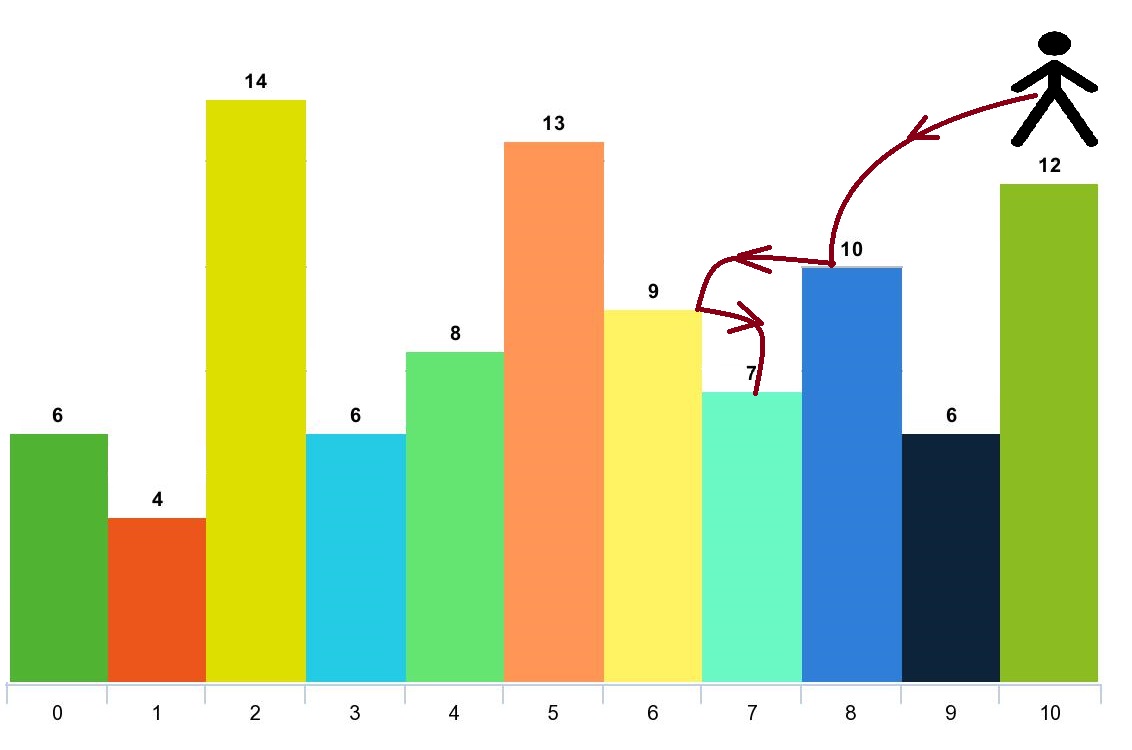
Input: arr = [6,4,14,6,8,13,9,7,10,6,12], d = 2
Output: 4
Explanation: You can start at index 10. You can jump 10 --> 8 --> 6 --> 7 as shown.
Note that if you start at index 6 you can only jump to index 7. You cannot jump to index 5 because 13 > 9. You cannot jump to index 4 because index 5 is between index 4 and 6 and 13 > 9.
Similarly You cannot jump from index 3 to index 2 or index 1.
Example 2:
Input: arr = [3,3,3,3,3], d = 3
Output: 1
Explanation: You can start at any index. You always cannot jump to any index.
Example 3:
Input: arr = [7,6,5,4,3,2,1], d = 1
Output: 7
Explanation: Start at index 0. You can visit all the indicies.
Constraints:
1 <= arr.length <= 10001 <= arr[i] <= 1051 <= d <= arr.length

Solution
Clarifying Questions
When you get asked this question in a real-life environment, it will often be ambiguous (especially at FAANG). Make sure to ask these questions in that case:
- What are the constraints on the size of the input array `arr` and the value of `d`?
- Can the elements in the input array `arr` be negative or non-integer values?
- If I cannot reach the end of the array, what value should I return?
- If there are multiple possible paths to reach a certain index, should I consider the path with the most jumps or any valid path?
- Is the condition 'arr[i] > arr[i + x]' a strict inequality, or is `arr[i] >= arr[i + x]` allowed?
Brute Force Solution
Approach
The goal is to find the longest sequence of jumps you can make through a series of platforms. The brute force approach involves trying every possible jump sequence and seeing which one is the longest.
Here's how the algorithm would work step-by-step:
- Start at the first platform.
- From that platform, try jumping to every platform within the allowed jump distance, both to the left and to the right, as long as the platform you're jumping to is lower than the current platform.
- For each of those possible jumps, treat the new platform as your starting point and repeat the process: try jumping to every platform within the allowed jump distance from this new location.
- Keep track of how many jumps you've made in each possible path.
- Continue exploring all possible jump combinations until you can't jump anymore from any platform in any path.
- After exploring all paths, pick the path with the most jumps. That path represents the longest sequence of valid jumps.
Code Implementation
def jump_game_v_brute_force(heights, jump_distance):
    number_of_platforms = len(heights)

    def longest_jump_path(current_position):
        max_jumps = 1

        # Iterate through possible jump positions.
        for next_position in range(current_position - jump_distance, current_position + jump_distance + 1):
            # Check for out-of-bounds or same position.
            if next_position < 0 or next_position >= number_of_platforms or next_position == current_position:
                continue

            # Ensure the jump is valid (height is lower).
            if heights[next_position] < heights[current_position]:
                # Recursively explore the next jump.
                jumps = 1 + longest_jump_path(next_position)
                max_jumps = max(max_jumps, jumps)

        return max_jumps

    max_overall_jumps = 0
    # Try starting from each position.
    for start_position in range(number_of_platforms):
        max_overall_jumps = max(max_overall_jumps, longest_jump_path(start_position))

return max_overall_jumpsBig(O) Analysis
Optimal Solution
Approach
The best way to solve this is by figuring out the furthest we can reach from each position, but in a smart way. We start from the easiest, highest value spots, and then use those results to solve the harder spots. This avoids re-doing work and quickly finds the maximum reach.
Here's how the algorithm would work step-by-step:
- First, think about how the values in the problem dictate how far you can jump. A position with a high value is likely better because it allows jumping from and to it.
- Then, sort the starting positions based on their values. Start solving the problem with the position having the largest value.
- Now, for each sorted position, look left and right within the given jump distance. See if we can jump to any valid spots within that range, respecting the value constraints (you can only jump to places with *smaller* values than the starting position)
- If you can jump to another position, and you haven't already calculated the maximum reach from *that* position, solve it too (using the same process from step 3).
- Remember the maximum reachable position from the current position. This prevents recalculating the same thing multiple times. If you already solved it, reuse the answer
- After calculating the maximum reach for all the positions in sorted order, the answer will be the largest reach found.
Code Implementation
def maxJumps(array, jump_distance):
    array_length = len(array)
    jump_lengths = [0] * array_length

    # Sort indices by array value to start with largest
    sorted_indices = sorted(range(array_length), key=lambda i: array[i], reverse=True)

    def calculate_max_jumps(current_index):
        if jump_lengths[current_index] > 0:
            return jump_lengths[current_index]

        max_reach = 1

        # Check left jumps
        for next_index in range(current_index - 1, max(current_index - jump_distance - 1, -1), -1):
            if array[next_index] < array[current_index]:
                max_reach = max(max_reach, 1 + calculate_max_jumps(next_index))
            else:
                break # Cannot jump further due to value constraint.

        # Check right jumps
        for next_index in range(current_index + 1, min(current_index + jump_distance + 1, array_length)):
            if array[next_index] < array[current_index]:
                max_reach = max(max_reach, 1 + calculate_max_jumps(next_index))
            else:
                break # Cannot jump further due to value constraint.

        jump_lengths[current_index] = max_reach
        return max_reach

    # Iterate through sorted indices and calc max jumps.
    for index in sorted_indices:
        calculate_max_jumps(index)

    # The answer will be the largest reach found
return max(jump_lengths)Big(O) Analysis
Edge Cases
| Case | How to Handle |
|---|---|
| Null or empty input array | Return 0 immediately as there are no jumps possible. |
| Array with only one element | Return 1 since the single element is the starting point itself. |
| All elements in the array are the same value. | If d > 0, it will only be possible to jump one step to the left and one step to the right within the d distance, or no steps at all if d=0, so the function needs to account for it. |
| Maximum size array with small d | Ensure the solution scales efficiently to avoid time limit exceeded errors; dynamic programming with memoization is suitable. |
| Maximum jump distance 'd' exceeds array bounds | The jump logic should handle out-of-bounds indices gracefully by checking the array length before attempting to access indices beyond the bounds. |
| Elements form a decreasing sequence | The dynamic programming approach should still work, properly calculating the possible number of jumps from each position. |
| Array elements cause integer overflow during calculations. | The heights of the array are bounded (1 <= arr[i] <= 10^5) so there is no risk of integer overflow with memoization. |
| A position is unreachable from any other position. | Memoization ensures that unreachable states are not recomputed, thus allowing for efficient processing of these isolated points. |






