

K-th Largest Perfect Subtree Size in Binary Tree
Medium
You are given the root of a binary tree and an integer k.
Return an integer denoting the size of the kth largest perfect binary subtree, or -1 if it doesn't exist.
A perfect binary tree is a tree where all leaves are on the same level, and every parent has two children.
Example 1:
Input: root = [5,3,6,5,2,5,7,1,8,null,null,6,8], k = 2
Output: 3
Explanation:

The roots of the perfect binary subtrees are highlighted in black. Their sizes, in non-increasing order are [3, 3, 1, 1, 1, 1, 1, 1].
The 2nd largest size is 3.
Example 2:
Input: root = [1,2,3,4,5,6,7], k = 1
Output: 7
Explanation:
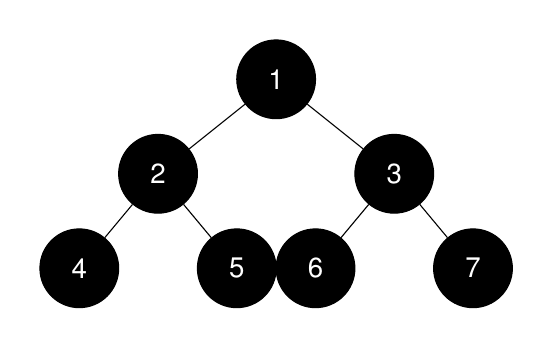
The sizes of the perfect binary subtrees in non-increasing order are [7, 3, 3, 1, 1, 1, 1]. The size of the largest perfect binary subtree is 7.
Example 3:
Input: root = [1,2,3,null,4], k = 3
Output: -1
Explanation:

The sizes of the perfect binary subtrees in non-increasing order are [1, 1]. There are fewer than 3 perfect binary subtrees.
Constraints:
- The number of nodes in the tree is in the range
[1, 2000]. 1 <= Node.val <= 20001 <= k <= 1024

Solution
Clarifying Questions
When you get asked this question in a real-life environment, it will often be ambiguous (especially at FAANG). Make sure to ask these questions in that case:
- What is the range of values for the node data in the binary tree, and are negative values possible?
- What should I return if there are fewer than K perfect subtrees? Should I return null, -1, or throw an exception?
- What defines the structure of the Binary Tree node, particularly how are children represented (e.g., left and right pointers)? Can a node have only one child?
- What is the maximum number of nodes that the binary tree can have?
- Can you define 'perfect subtree' more explicitly? Does it mean the subtree is a complete binary tree or a full binary tree, or something else (e.g., height-balanced)?
Brute Force Solution
Approach
The brute force approach to finding the K-th largest perfect subtree size involves checking every possible subtree within the given binary tree. For each subtree, we determine if it's a perfect binary tree and then calculate its size. Finally, we look through all the perfect subtree sizes and find the K-th largest one.
Here's how the algorithm would work step-by-step:
- Consider every node in the tree as the potential root of a subtree.
- For each of these nodes, check if the subtree rooted at that node is a perfect binary tree. A perfect binary tree is where all interior nodes have two children and all leaves are at the same level.
- To check if a subtree is perfect, look at all its levels. The subtree is perfect if all levels are completely filled.
- If a subtree is perfect, calculate the number of nodes in that subtree. This is the 'size' of the subtree.
- Keep a record of the sizes of all the perfect subtrees you find.
- Once you have gone through every node in the tree and checked every possible subtree, you will have a list of the sizes of all perfect subtrees.
- Finally, find the K-th largest size from this list. This means sorting the list of sizes and selecting the K-th element from the end. If K is 1, you want the largest; if K is 2, you want the second largest, and so on.
Code Implementation
class Node:
    def __init__(self, data):
        self.data = data
        self.left = None
        self.right = None

def kth_largest_perfect_subtree_size(root, k_value):
    perfect_subtree_sizes = []
    def is_perfect_binary_tree(node, depth=0, level=None):
        if node is None:
            return True, level

        if node.left is None and node.right is None:
            if level is None:
                level = depth
            return True, level

        if node.left is None or node.right is None:
            return False, level

        is_left_perfect, left_level = is_perfect_binary_tree(node.left, depth + 1, level)
        is_right_perfect, right_level = is_perfect_binary_tree(node.right, depth + 1, level)

        return is_left_perfect and is_right_perfect and left_level == right_level, left_level

    def subtree_size(node):
        if node is None:
            return 0
        return 1 + subtree_size(node.left) + subtree_size(node.right)

    def traverse(node):
        if node is None:
            return

        # Check if the subtree rooted at the current node is perfect
        is_perfect, _ = is_perfect_binary_tree(node)

        if is_perfect:
            # Calculate the size of the perfect subtree
            size = subtree_size(node)
            perfect_subtree_sizes.append(size)

        traverse(node.left)
        traverse(node.right)

    traverse(root)

    # Remove Duplicates and Sort in Descending Order
    unique_sizes = sorted(list(set(perfect_subtree_sizes)), reverse=True)

    # Return Kth largest size
    if k_value <= len(unique_sizes) and k_value > 0:
        return unique_sizes[k_value - 1]
    else:
return -1Big(O) Analysis
Optimal Solution
Approach
The most efficient way to find the k-th largest perfect subtree size involves a clever traversal of the binary tree. We want to figure out the size of each subtree and only keep track of the perfect ones, ultimately finding the k-th largest among those.
Here's how the algorithm would work step-by-step:
- Start by exploring the tree from the bottom up, meaning we'll start with the smallest subtrees at the leaves.
- For each subtree, check if it's a perfect binary tree. A perfect binary tree has all levels completely filled, with the same number of descendants on the left and right.
- If a subtree is perfect, calculate its size (the number of nodes it contains).
- Keep a running list of the sizes of all the perfect subtrees we encounter.
- Once we've explored the entire tree, find the k-th largest size from our list of perfect subtree sizes. If k is 1, you want the largest. If k is 2, you want the second largest and so on. There are established techniques to quickly select the k-th largest number in a list.
Code Implementation
class Node:
    def __init__(self, data):
        self.data = data
        self.left = None
        self.right = None

def kth_largest_perfect_subtree_size(root, k_value):
    perfect_subtree_sizes = []

    def is_perfect_binary_tree(node):
        if not node:
            return True, 0

        left_perfect, left_height = is_perfect_binary_tree(node.left)
        right_perfect, right_height = is_perfect_binary_tree(node.right)

        #Check if both subtrees are perfect and of equal height
        if left_perfect and right_perfect and left_height == right_height:
            return True, left_height + 1
        else:
            return False, -1

    def get_subtree_size(node):
        if not node:
            return 0
        return 1 + get_subtree_size(node.left) + get_subtree_size(node.right)

    def traverse_tree(node):
        if not node:
            return

        traverse_tree(node.left)
        traverse_tree(node.right)

        is_perfect, height = is_perfect_binary_tree(node)

        # Only process perfect subtrees
        if is_perfect:
            subtree_size = get_subtree_size(node)
            perfect_subtree_sizes.append(subtree_size)

    traverse_tree(root)

    #Remove duplicates and sort in descending order to find kth largest
    unique_sizes = sorted(list(set(perfect_subtree_sizes)), reverse=True)

    if k_value > 0 and k_value <= len(unique_sizes):
        return unique_sizes[k_value - 1]
    else:
return -1Big(O) Analysis
Edge Cases
| Case | How to Handle |
|---|---|
| Null or Empty Tree | Return an empty list if the root is null as there are no subtrees. |
| K is zero or negative | Return an empty list or throw an exception, as a non-positive k is not a valid input. |
| K is larger than the number of perfect subtrees | Return an empty list, indicating there are fewer than K perfect subtrees. |
| Single node tree | If the single node is a perfect binary tree (trivially true), its size is 1 and is added to the result if K is 1. |
| Skewed Tree (all nodes on one side) | Handle skewed trees correctly by recursively calculating subtree sizes, ensuring perfect subtrees are properly identified regardless of tree structure. |
| Tree with all identical node values | The algorithm determines subtree 'perfectness' based on structure, not values, so duplicate values will not impact the correctness. |
| Integer overflow when calculating subtree size | Use a data type that can accommodate large subtree sizes (e.g., long in Java or C++) or check for overflow during the size calculation. |
| Tree with very large depth, exceeding recursion limit | Consider converting the recursive solution to an iterative one with explicit stack management to avoid stack overflow errors for extremely deep trees. |






