

Kth Largest Sum in a Binary Tree
Medium



You are given the root of a binary tree and a positive integer k.
The level sum in the tree is the sum of the values of the nodes that are on the same level.
Return the kth largest level sum in the tree (not necessarily distinct). If there are fewer than k levels in the tree, return -1.
Note that two nodes are on the same level if they have the same distance from the root.
Example 1:
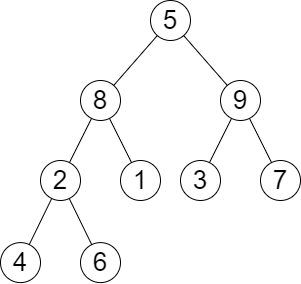
Input: root = [5,8,9,2,1,3,7,4,6], k = 2
Output: 13
Explanation: The level sums are the following:
- Level 1: 5.
- Level 2: 8 + 9 = 17.
- Level 3: 2 + 1 + 3 + 7 = 13.
- Level 4: 4 + 6 = 10.
The 2nd largest level sum is 13.
Example 2:

Input: root = [1,2,null,3], k = 1
Output: 3
Explanation: The largest level sum is 3.
Constraints:
- The number of nodes in the tree is
n. 2 <= n <= 1051 <= Node.val <= 1061 <= k <= n

Solution
Clarifying Questions
When you get asked this question in a real-life environment, it will often be ambiguous (especially at FAANG). Make sure to ask these questions in that case:
- What are the possible values for the node data in the binary tree; can they be negative, zero, or floating-point numbers?
- What happens if the value of 'k' is larger than the number of distinct sum values in the tree; should I return a specific value or throw an exception?
- How is the binary tree structured (e.g., is it a binary search tree, a complete binary tree, or a general binary tree)?
- By 'sum,' do you mean the sum of node values from the root to any node, or the sum of values from any path in the tree?
- Is 'k' 1-indexed or 0-indexed?
Brute Force Solution
Approach
The brute force method finds the kth largest sum by exhaustively calculating the sum of nodes at each level in the tree. We find the sum for every level, then determine the kth largest sum among all those level sums. This approach doesn't optimize; it simply tries everything.
Here's how the algorithm would work step-by-step:
- Go through the tree level by level, one level at a time.
- For each level, add up the values of all the nodes present in that level.
- After calculating the sum for every level in the tree, put all those level sums into a list.
- Sort this list of level sums from largest to smallest.
- Find the element at the kth position in the sorted list. This element represents the kth largest level sum.
Code Implementation
from collections import deque

def kth_largest_level_sum_brute_force(root, k_value):
    if not root:
        return -1

    level_sums = []
    queue = deque([root])

    while queue:
        level_size = len(queue)
        current_level_sum = 0

        # Iterate through all nodes at the current level
        for _ in range(level_size):
            node = queue.popleft()
            current_level_sum += node.val

            if node.left:
                queue.append(node.left)

            if node.right:
                queue.append(node.right)

        level_sums.append(current_level_sum)

    # Need to handle the edge case where k is larger than the number of levels
    if k_value > len(level_sums):
        return -1

    # Sort level sums to easily find the kth largest sum
    level_sums.sort(reverse=True)

return level_sums[k_value - 1]Big(O) Analysis
Optimal Solution
Approach
The key idea is to calculate the sum of values at each level of the binary tree and then find the kth largest among these sums. We can efficiently traverse the tree level by level and keep track of the sum at each level, and then find the kth largest sum.
Here's how the algorithm would work step-by-step:
- First, we traverse the binary tree level by level.
- As we visit each node, we identify its level in the tree.
- We keep track of the sum of the node values at each level.
- Once we have the sum for each level, we put those sums into a data structure that can efficiently give us the kth largest value.
- Finally, we return the kth largest sum we found.
Code Implementation
from collections import deque

class TreeNode:
    def __init__(self, val=0, left=None, right=None):
        self.val = val
        self.left = left
        self.right = right

def kth_largest_level_sum(root, k_value):
    if not root:
        return -1

    level_sums = []
    queue = deque([root])

    while queue:
        level_size = len(queue)
        current_level_sum = 0

        # Traverse all nodes at the current level
        for _ in range(level_size):
            node = queue.popleft()
            current_level_sum += node.val

            if node.left:
                queue.append(node.left)
            if node.right:
                queue.append(node.right)

        level_sums.append(current_level_sum)

    # Removing duplicates ensures correct Kth selection
    unique_level_sums = sorted(list(set(level_sums)), reverse=True)

    # Validate K value to avoid errors
    if k_value > len(unique_level_sums):
        return -1

    # Return kth largest sum
return unique_level_sums[k_value - 1]Big(O) Analysis
Edge Cases
| Case | How to Handle |
|---|---|
| Null or empty binary tree | Return an empty list immediately, as there are no sums to compute. |
| K is less than or equal to 0 | Return an empty list or throw an IllegalArgumentException, as requesting the kth largest with k <= 0 is invalid. |
| K is larger than the number of levels in the tree | Return the sums of all levels in descending order, as there aren't enough levels to return the Kth largest. |
| Binary tree with a single node | Return a list containing only the root's value if k is 1, otherwise return an empty list if k > 1. |
| Binary tree with all nodes having negative values | The solution should correctly handle negative sums, producing a list of sums that may all be negative. |
| Binary tree with large depth leading to potential integer overflow in sum | Use a data type with a larger range like `long` to store the sum of each level to prevent overflow. |
| Skewed binary tree (e.g., linked list) | The solution should still correctly calculate level sums, although performance might degrade to O(n) where n is the number of nodes due to the tree structure. |
| Binary tree with duplicate node values across multiple levels | The level-order traversal should correctly sum the values at each level regardless of duplicate node values. |






