

Largest Component Size by Common Factor
Hard
You are given an integer array of unique positive integers nums. Consider the following graph:
- There are
nums.lengthnodes, labelednums[0]tonums[nums.length - 1], - There is an undirected edge between
nums[i]andnums[j]ifnums[i]andnums[j]share a common factor greater than1.
Return the size of the largest connected component in the graph.
Example 1:

Input: nums = [4,6,15,35]
Output: 4
Example 2:

Input: nums = [20,50,9,63]
Output: 2
Example 3:
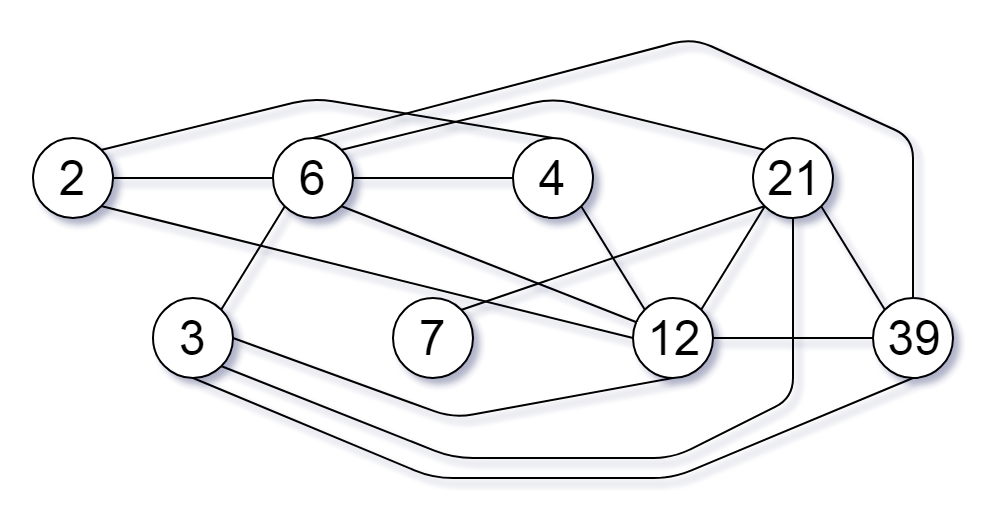
Input: nums = [2,3,6,7,4,12,21,39]
Output: 8
Constraints:
1 <= nums.length <= 2 * 1041 <= nums[i] <= 105- All the values of
numsare unique.

Solution
Clarifying Questions
When you get asked this question in a real-life environment, it will often be ambiguous (especially at FAANG). Make sure to ask these questions in that case:
- What are the bounds on the values within the input array A, and what is the maximum length of A?
- Are all elements of A positive integers? Can I assume there will be no negative numbers or zeros?
- If there are no common factors between any of the numbers in the array (i.e., all components have size 1), what should I return?
- Could you define more precisely what you mean by "component size" in this context? Does it refer to the number of elements sharing a common factor, or something else?
- If there are multiple components of the same largest size, can I return any one of them (represented by its size)?
Brute Force Solution
Approach
The brute force approach to finding the largest component size by common factor involves checking all possible combinations of numbers to see which ones share common factors. We essentially explore every possible grouping to find the biggest connected group. It's like trying every single team combination to find the biggest team where everyone has something in common.
Here's how the algorithm would work step-by-step:
- Start by considering each number individually. It forms a group of size one.
- Then, take the first number and compare it to every other number in the list.
- If any two numbers share a common factor greater than one, put them in the same group.
- Next, take the second number and compare it to every other number (that isn't already compared). If they share a common factor, put them in the same group as the second number.
- Continue doing this for every number in the list, building up groups based on common factors.
- At the end, you'll have a bunch of different groups. Some might overlap because of shared common factors across different numbers.
- Merge any overlapping groups into a single larger group.
- Once all groups are finalized and no longer overlapping, count the size of each group.
- The largest of these group sizes is your answer: the size of the largest component with common factors.
Code Implementation
def largest_component_size_by_common_factor_brute_force(numbers):
    number_count = len(numbers)
    groups = []

    for i in range(number_count):
        groups.append({numbers[i]})

    def find_greatest_common_divisor(first_number, second_number):
        while second_number:
            first_number, second_number = second_number, first_number % second_number
        return first_number

    def share_common_factor(first_number, second_number):
        return find_greatest_common_divisor(first_number, second_number) > 1

    # Iterate through all possible pairs to group numbers with common factors.
    for first_index in range(number_count):
        for second_index in range(first_index + 1, number_count):
            if share_common_factor(numbers[first_index], numbers[second_index]):
                group_one = None
                group_two = None
                for group in groups:
                    if numbers[first_index] in group:
                        group_one = group
                    if numbers[second_index] in group:
                        group_two = group

                # Merge groups if necessary to consolidate common factor relationships.
                if group_one and group_two and group_one != group_two:
                    group_one.update(group_two)
                    groups.remove(group_two)

    # After grouping, consolidate any remaining overlapping groups.
    final_groups = []
    for group in groups:
        is_merged = False
        for existing_group in final_groups:
            if group.intersection(existing_group):
                existing_group.update(group)
                is_merged = True
                break
        if not is_merged:
            final_groups.append(group)

    # Determine and return the largest group size.
    largest_size = 0
    for group in final_groups:
        largest_size = max(largest_size, len(group))

return largest_sizeBig(O) Analysis
Optimal Solution
Approach
The most efficient way to solve this involves grouping numbers based on their shared building blocks (prime factors). Then, we find the largest group, representing the biggest connected component.
Here's how the algorithm would work step-by-step:
- First, find the smallest building blocks (prime factors) of each number in the input.
- Next, imagine each number and each of its prime factors as separate people, and use a way to group them together where if two people share a common acquaintance (number or prime factor), they are in the same group.
- Once everyone is in their respective groups, simply find the group with the most people in it. That's your answer!
Code Implementation
def largestComponentSize(numbers: list[int]) -> int:
    def findPrimeFactors(number: int) -> list[int]:
        prime_factors = []
        divisor = 2
        while divisor * divisor <= number:
            if number % divisor == 0:
                prime_factors.append(divisor)
                while number % divisor == 0:
                    number //= divisor
            divisor += 1
        if number > 1:
            prime_factors.append(number)
        return prime_factors

    parent = list(range(len(numbers) + len(set(sum((findPrimeFactors(number) for number in numbers), [])))))
    size = [1] * len(parent)

    def find(node: int) -> int:
        if parent[node] != node:
            parent[node] = find(parent[node])
        return parent[node]

    def union(node1: int, node2: int) -> None:
        root1 = find(node1)
        root2 = find(node2)
        if root1 != root2:
            if size[root1] < size[root2]:
                root1, root2 = root2, root1
            parent[root2] = root1
            size[root1] += size[root2]

    prime_to_index = {}
    next_available_index = len(numbers)

    # Assign prime factors unique indices
    for i, number in enumerate(numbers):
        prime_factors = findPrimeFactors(number)
        for prime_factor in prime_factors:
            if prime_factor not in prime_to_index:
                prime_to_index[prime_factor] = next_available_index
                next_available_index += 1

            # Connect each number to its prime factors
            union(i, prime_to_index[prime_factor])

    component_size_counts = {}
    maximum_component_size = 0

    # Count the size of each component
    for i in range(len(numbers)):
        root = find(i)
        if root not in component_size_counts:
            component_size_counts[root] = 0
        component_size_counts[root] += 1
        maximum_component_size = max(maximum_component_size, component_size_counts[root])

    # Find and return the largest component size
return maximum_component_sizeBig(O) Analysis
Edge Cases
| Case | How to Handle |
|---|---|
| Empty input array | Return 0, as there are no components. |
| Array with a single element | Return 1, as a single element is a component of size 1. |
| Array with all elements equal to 1 | Return the array length, since each element is a separate component of size 1 and no common factors exist other than 1. |
| Array with large prime numbers | The union find should still function correctly; ensure that the prime factorization is handled efficiently to avoid performance issues. |
| Array with consecutive numbers (e.g., [2, 3, 4, 5]) | Ensure the prime factorization considers all possible factors in this range, connecting components correctly. |
| Array with elements exceeding integer limits during intermediate calculations (prime factorization) | Use long data type to avoid overflow during calculations in languages where integer overflow is not handled by default. |
| Large array size with limited memory | Optimize the memory footprint of the Union-Find data structure, possibly using path compression and union by rank. |
| Array contains duplicate composite numbers with shared factors | The Union-Find structure correctly merges components based on shared factors, even with duplicates. |






