

Largest Triangle Area
Easy

Given an array of points on the X-Y plane points where points[i] = [xi, yi], return the area of the largest triangle that can be formed by any three different points. Answers within 10-5 of the actual answer will be accepted.
Example 1:
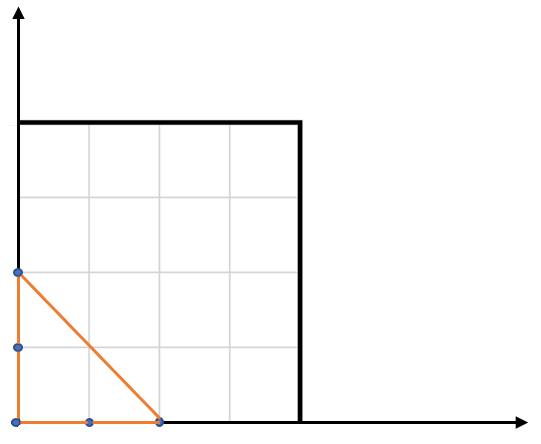
Input: points = [[0,0],[0,1],[1,0],[0,2],[2,0]]
Output: 2.00000
Explanation: The five points are shown in the above figure. The red triangle is the largest.
Example 2:
Input: points = [[1,0],[0,0],[0,1]]
Output: 0.50000
Constraints:
3 <= points.length <= 50-50 <= xi, yi <= 50- All the given points are unique.

Solution
Clarifying Questions
When you get asked this question in a real-life environment, it will often be ambiguous (especially at FAANG). Make sure to ask these questions in that case:
- What is the expected data type of the coordinates (integer, float), and what is the range of their values?
- Can the input list of points be empty or contain fewer than three points?
- Are the points guaranteed to be distinct, or might there be duplicate points?
- If the largest triangle area is zero (e.g., all points are collinear), what should I return: 0, or should I handle that as an error condition?
- Is the order of the points in the input list significant, or can I reorder them as needed to find the largest triangle?
Brute Force Solution
Approach
To find the largest triangle area, we'll consider every possible combination of three points. We'll calculate the area for each of these triangles and keep track of the largest area we've found so far.
Here's how the algorithm would work step-by-step:
- Take the first three points from the list and calculate the area of the triangle they form.
- Store this area as the largest area we've seen so far.
- Now, change the third point to the next point in the list and calculate the area again.
- If this new area is larger than the largest area we stored, update the stored largest area.
- Keep changing the third point until we've tried it with every other point in the list.
- Next, change the second point to the next point in the list, and repeat the process of trying all possible third points.
- Continue this process by changing the first point to the next point in the list and repeating all the steps above with the second and third points.
- Do this until you've considered every possible combination of three points.
- After checking all the combinations, the largest area you've stored is the answer.
Code Implementation
def largest_triangle_area(points):
    number_of_points = len(points)
    largest_area_so_far = 0

    for first_point_index in range(number_of_points):
        for second_point_index in range(first_point_index + 1, number_of_points):
            # Iterate through remaining points to form a triangle
            for third_point_index in range(second_point_index + 1, number_of_points):
                first_point = points[first_point_index]
                second_point = points[second_point_index]
                third_point = points[third_point_index]

                # Calculate area of triangle using determinant formula
                area = 0.5 * abs(
                    first_point[0] * (second_point[1] - third_point[1]) +
                    second_point[0] * (third_point[1] - first_point[1]) +
                    third_point[0] * (first_point[1] - second_point[1])
                )

                # Update largest triangle area if current is larger
                if area > largest_area_so_far:
                    largest_area_so_far = area

return largest_area_so_farBig(O) Analysis
Optimal Solution
Approach
The goal is to find the largest triangle area formed by any three points in a given set. Instead of checking every possible triangle, we use a formula to directly calculate the area of each triangle and keep track of the largest area found so far.
Here's how the algorithm would work step-by-step:
- Imagine you have a bunch of dots on a page.
- Pick any three dots. These three dots will form a triangle.
- Use a special formula (like the determinant method or Heron's formula) to figure out the area of that triangle using the coordinates of those three dots.
- Remember the area of the biggest triangle you've found so far.
- Now, pick a different set of three dots and find the area of that triangle.
- If the area of this new triangle is bigger than the biggest area you remembered, then update your 'biggest area'.
- Keep doing this, checking every possible group of three dots.
- When you've checked all possible groups of three dots, the 'biggest area' you have stored is the answer.
Code Implementation
def largest_triangle_area(points):
    number_of_points = len(points)
    largest_area = 0

    for i in range(number_of_points):
        for j in range(i + 1, number_of_points):
            for k in range(j + 1, number_of_points):
                # Calculate the area of the triangle formed by the three points
                area = 0.5 * abs(points[i][0] * (points[j][1] - points[k][1]) +
                                   points[j][0] * (points[k][1] - points[i][1]) +
                                   points[k][0] * (points[i][1] - points[j][1]))

                # Update largest_area if the current area is larger
                if area > largest_area:
                    largest_area = area

return largest_areaBig(O) Analysis
Edge Cases
| Case | How to Handle |
|---|---|
| Null or empty input array | Return 0 if the input is null or contains fewer than 3 points since a triangle cannot be formed. |
| Input array with only 3 points | The algorithm should correctly calculate the area of the single possible triangle. |
| All points are collinear (lie on the same line) | The area calculation will result in 0, which should be the correct output. |
| Duplicate points in the input array | The area calculation should still work correctly since the formula accounts for point coordinates. |
| Large coordinate values that could cause overflow during area calculation | Use double-precision floating-point numbers for intermediate calculations to avoid integer overflow. |
| Floating-point precision issues with very small triangle areas | Accept a small tolerance when comparing calculated area to zero for collinearity checks, such as using Math.abs(area) < 1e-9. |
| Input array with a very large number of points | The O(n^3) time complexity might become an issue; consider optimizations if performance is critical, but prioritize correctness first. |
| Points with negative and positive coordinates | The area calculation formula should work correctly with both positive and negative coordinate values. |






