

Longest Special Path II
Hard
You are given an undirected tree rooted at node 0, with n nodes numbered from 0 to n - 1. This is represented by a 2D array edges of length n - 1, where edges[i] = [ui, vi, lengthi] indicates an edge between nodes ui and vi with length lengthi. You are also given an integer array nums, where nums[i] represents the value at node i.
A special path is defined as a downward path from an ancestor node to a descendant node in which all node values are distinct, except for at most one value that may appear twice.
Return an array result of size 2, where result[0] is the length of the longest special path, and result[1] is the minimum number of nodes in all possible longest special paths.
Example 1:
Input: edges = [[0,1,1],[1,2,3],[1,3,1],[2,4,6],[4,7,2],[3,5,2],[3,6,5],[6,8,3]], nums = [1,1,0,3,1,2,1,1,0]
Output: [9,3]
Explanation:
In the image below, nodes are colored by their corresponding values in nums.
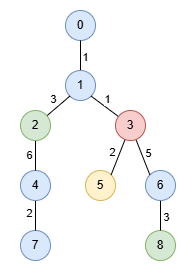
The longest special paths are 1 -> 2 -> 4 and 1 -> 3 -> 6 -> 8, both having a length of 9. The minimum number of nodes across all longest special paths is 3.
Example 2:
Input: edges = [[1,0,3],[0,2,4],[0,3,5]], nums = [1,1,0,2]
Output: [5,2]
Explanation:

The longest path is 0 -> 3 consisting of 2 nodes with a length of 5.
Constraints:
2 <= n <= 5 * 104edges.length == n - 1edges[i].length == 30 <= ui, vi < n1 <= lengthi <= 103nums.length == n0 <= nums[i] <= 5 * 104- The input is generated such that
edgesrepresents a valid tree.

Solution
Clarifying Questions
When you get asked this question in a real-life environment, it will often be ambiguous (especially at FAANG). Make sure to ask these questions in that case:
- What are the constraints on the number of nodes and edges in the graph? What is the maximum possible weight for an edge?
- Can edge weights be negative, zero, or non-integer values?
- What defines a 'special path'? Is it strictly based on edge weights, or are there other criteria to consider such as the number of nodes visited?
- If there are multiple longest special paths, is it acceptable to return any one of them, or is there a specific tie-breaking rule?
- If no special path exists, what should the function return? Should I return null/None, an empty path, or a specific error code?
Brute Force Solution
Approach
The goal is to find the longest path in a graph that satisfies a special condition. The brute force approach involves checking every possible path in the graph to see if it meets our criteria, and then selecting the longest one. It's like trying every route on a map and picking the longest valid one.
Here's how the algorithm would work step-by-step:
- Start from every possible starting point in the graph.
- From each starting point, explore every possible path by moving to neighboring locations.
- As you explore each path, check if it meets the 'special' condition we are looking for.
- If a path meets the condition, remember its length.
- Once you've explored all possible paths from every starting point, compare the lengths of all the 'special' paths you found.
- The longest of these special paths is your answer.
Code Implementation
def longest_special_path_brute_force(graph, is_special_node):
    longest_path_length = 0

    # Iterate through all possible starting nodes
    for start_node in range(len(graph)):
        # Explore all paths starting from the current node
        def explore_paths(current_node, current_path, current_path_length):
            nonlocal longest_path_length

            #Check if the current path is special
            is_current_path_special = all(is_special_node(node) for node in current_path)

            if is_current_path_special:
                longest_path_length = max(longest_path_length, current_path_length)

            #Explore neighboring nodes, create copies to avoid side effects
            for neighbor in graph[current_node]:
                if neighbor not in current_path:
                    explore_paths(neighbor, current_path + [neighbor], current_path_length + 1)

        explore_paths(start_node, [start_node], 0)

return longest_path_lengthBig(O) Analysis
Optimal Solution
Approach
To find the longest special path, we'll explore the graph using a smart strategy that remembers the best paths seen so far. This approach avoids redundant calculations by keeping track of the longest paths ending at each point and uses this information to efficiently discover the overall longest path.
Here's how the algorithm would work step-by-step:
- Think of the problem as exploring a network of connected points, where each connection has a color.
- Begin at the starting point and explore each possible path one step at a time.
- As you move from point to point, keep a record of the longest 'special' path you've found that ends at that point. A special path only includes a certain number of each color.
- Before exploring a new path, check if you've already found a longer special path to the current point. If so, there's no need to explore this new path further because it can't possibly be the longest.
- If the new path is longer or the same length, add it to your records for that point, and then continue exploring from that point.
- Keep going until you've explored all possible paths, remembering to update the longest path records along the way.
- The longest special path found during this process is your final answer.
Code Implementation
def longest_special_path(graph):
    number_of_nodes = len(graph)
    longest_paths = {node: 0 for node in range(number_of_nodes)}
    longest_path_found = 0

    def depth_first_search(current_node, current_path_length, visited_nodes):
        nonlocal longest_path_found

        # If we've been here before, no need to continue down path.
        if current_path_length <= longest_paths[current_node]:
            return

        longest_paths[current_node] = current_path_length
        longest_path_found = max(longest_path_found, current_path_length)

        for neighbor, edge_color in graph[current_node]:
            if neighbor not in visited_nodes:
                depth_first_search(neighbor, current_path_length + 1, visited_nodes | {neighbor})

    # Iterate through all possible starting nodes
    for start_node in range(number_of_nodes):
        depth_first_search(start_node, 1, {start_node})

return longest_path_foundBig(O) Analysis
Edge Cases
| Case | How to Handle |
|---|---|
| Empty graph (no nodes or edges) | Return 0, as there's no path at all. |
| Graph with a single node and no edges | Return 1 if the single node's value satisfies the 'special' criteria; otherwise, return 0. |
| Graph with a single edge and two nodes | Check if this single edge constitutes a special path, returning 2 if it does and if both node values meet 'special' criteria; otherwise analyze whether each individual node alone satisfies the conditions for length 1. |
| Graph with cycles | Use dynamic programming with memoization and visited set to avoid infinite loops and recalculations in cycles, ensuring the longest path is found. |
| Disconnected graph | Iterate through each connected component and find the longest special path within each, then return the maximum length among all components. |
| Very large graph (scalability) | Use dynamic programming to avoid recomputation of subproblems, and consider data structures (e.g., adjacency lists) for efficient graph representation and traversal. |
| Nodes with very large values that could lead to integer overflow | Use long data types for storing node values and intermediate path sums to avoid potential overflows during calculations, and consider modulo operations if applicable to the definition of 'special'. |
| Cases where no 'special' path exists at all | Return 0, indicating no path satisfying the problem's special criteria was found. |






