

Longest Subsequence Repeated k Times
Hard
You are given a string s of length n, and an integer k. You are tasked to find the longest subsequence repeated k times in string s.
A subsequence is a string that can be derived from another string by deleting some or no characters without changing the order of the remaining characters.
A subsequence seq is repeated k times in the string s if seq * k is a subsequence of s, where seq * k represents a string constructed by concatenating seq k times.
- For example,
"bba"is repeated2times in the string"bababcba", because the string"bbabba", constructed by concatenating"bba"2times, is a subsequence of the string"bababcba".
Return the longest subsequence repeated k times in string s. If multiple such subsequences are found, return the lexicographically largest one. If there is no such subsequence, return an empty string.
Example 1:
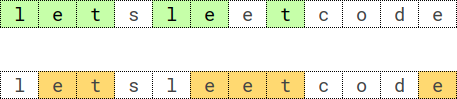
Input: s = "letsleetcode", k = 2
Output: "let"
Explanation: There are two longest subsequences repeated 2 times: "let" and "ete".
"let" is the lexicographically largest one.
Example 2:
Input: s = "bb", k = 2
Output: "b"
Explanation: The longest subsequence repeated 2 times is "b".
Example 3:
Input: s = "ab", k = 2
Output: ""
Explanation: There is no subsequence repeated 2 times. Empty string is returned.
Constraints:
n == s.length2 <= n, k <= 20002 <= n < k * 8sconsists of lowercase English letters.

Solution
Clarifying Questions
When you get asked this question in a real-life environment, it will often be ambiguous (especially at FAANG). Make sure to ask these questions in that case:
- What are the constraints on the length of the input string 's' and the value of 'k'? Can 'k' ever be zero or negative?
- If there are multiple longest subsequences repeated 'k' times, which one should I return? Is there a specific ordering or tie-breaking criteria?
- If no subsequence is repeated 'k' times, what should the function return? Should I return an empty string, null, or something else?
- Can the input string 's' contain characters other than lowercase English letters? Are there any restrictions on the character set?
- Is it possible for the length of the longest repeated subsequence to be zero? In other words, can an empty string be a valid subsequence that is repeated 'k' times?
Brute Force Solution
Approach
The brute force approach to finding the longest repeating subsequence involves checking every single possible subsequence. We generate all subsequences and verify if a given subsequence appears at least the required number of times. We keep track of the longest subsequence that meets the criteria.
Here's how the algorithm would work step-by-step:
- Start by generating all possible subsequences of the given text. A subsequence is a sequence that can be derived from another sequence by deleting some or no elements without changing the order of the remaining elements.
- For each generated subsequence, count how many times it appears in the original text without overlapping.
- If a subsequence appears at least the required number of times, we consider it a valid candidate.
- Keep track of the longest valid subsequence found so far.
- Compare the length of each new valid candidate with the length of the current longest valid subsequence.
- If a new valid subsequence is longer than the current longest, replace the current longest with the new subsequence.
- After checking all possible subsequences, return the longest valid subsequence that was found.
Code Implementation
def longest_subsequence_repeated_k_times_brute_force(text, k):
    longest_repeating_subsequence = ""

    def generate_subsequences(current_subsequence, index):
        if index == len(text):
            return [current_subsequence]

        # Option 1: Exclude the current character
        subsequences = generate_subsequences(current_subsequence, index + 1)

        # Option 2: Include the current character
        subsequences += generate_subsequences(current_subsequence + text[index], index + 1)
        return subsequences

    all_subsequences = generate_subsequences("", 0)

    for subsequence in all_subsequences:
        if not subsequence:
            continue

        # Count how many times the subsequence appears
        count = 0
        start_index = 0
        while start_index < len(text):
            index = find_subsequence(text, subsequence, start_index)
            if index == -1:
                break
            count += 1
            start_index = index + len(subsequence)

        # Check if the subsequence appears at least k times
        if count >= k:
            # Keep track of longest valid subsequence
            if len(subsequence) > len(longest_repeating_subsequence):
                longest_repeating_subsequence = subsequence

    return longest_repeating_subsequence

def find_subsequence(text, subsequence, start_index):
    text_index = start_index
    subsequence_index = 0

    while text_index < len(text) and subsequence_index < len(subsequence):
        if text[text_index] == subsequence[subsequence_index]:
            subsequence_index += 1
        text_index += 1

    # The subsequence was found
    if subsequence_index == len(subsequence):
        return text_index - len(subsequence)
    # The subsequence was not found
    else:
        return -1

# Helper method to remove duplicates from subsequence list (Optional optimization to avoid redundant operations)
#def remove_duplicates(subsequences):
# return list(dict.fromkeys(subsequences))Big(O) Analysis
Optimal Solution
Approach
The trick here is to build the longest repeated subsequence in reverse, starting from the longest possible subsequence. We iteratively try adding characters to the potential subsequence and check if it still appears enough times in the original string. This avoids exploring many unnecessary shorter subsequences.
Here's how the algorithm would work step-by-step:
- Start by identifying all the unique characters that appear in the original text.
- Create a list of possible subsequences to test, starting with the longest possible one formed by combining all unique characters.
- Iteratively shorten or modify subsequences and check if they appear at least 'k' times in the original text.
- To check the appearance, scan the original text and try to find matches for your subsequence; increase a counter each time you find a full subsequence.
- If any potential subsequence appears 'k' times or more, it is valid. Save that subsequence.
- Try shorter subsequences derived from saved subsequences by dropping various characters and running the appearance check again, maintaining the longest that still fulfills the frequency requirement.
- Repeat the process until you have tested all possibilities and identified the absolute longest repeated subsequence that satisfies the frequency requirement.
Code Implementation
def longest_subsequence_repeated_k_times(text, k):
    unique_characters = sorted(list(set(text)))
    longest_repeating_subsequence = ""

    # Start with the longest possible subsequence and work backwards
    for length in range(len(unique_characters), 0, -1):

        def find_all_subsequences(characters, current_subsequence="", index=0):
            if len(current_subsequence) == length:
                yield current_subsequence
                return
            if index >= len(characters):
                return
            yield from find_all_subsequences(characters, current_subsequence + characters[index], index + 1)
            yield from find_all_subsequences(characters, current_subsequence, index + 1)

        for potential_subsequence in find_all_subsequences(unique_characters):

            def check_subsequence_occurrence(subsequence, text, k):
                index_in_text = 0
                subsequence_count = 0
                index_in_subsequence = 0

                while index_in_text < len(text):
                    if text[index_in_text] == subsequence[index_in_subsequence]:
                        index_in_subsequence += 1
                        if index_in_subsequence == len(subsequence):
                            subsequence_count += 1
                            index_in_subsequence = 0
                    index_in_text += 1
                return subsequence_count >= k

            #Check if the subsequence occurs at least k times
            if check_subsequence_occurrence(potential_subsequence, text, k):
                longest_repeating_subsequence = potential_subsequence

                #If we found a valid subsequence, return it
                return longest_repeating_subsequence

    #If no subsequence is found, return an empty string.
return longest_repeating_subsequenceBig(O) Analysis
Edge Cases
| Case | How to Handle |
|---|---|
| Empty string s or k <= 0 | Return an empty string if the input string is empty or k is non-positive. |
| String length is less than k | Return an empty string because no subsequence of length at least 1 can be repeated k times if the string length is less than k. |
| k is very large such that len(s) / k < 1 | Return an empty string if the length of the input string divided by k is less than 1 as no subsequence will be possible. |
| String contains characters that are not useful for forming the subsequence | The algorithm should only consider characters present at least k times to be considered for subsequences. |
| The longest subsequence occurs at the beginning of the string | The algorithm should correctly identify the subsequence even if it starts from the beginning of the string. |
| The string 's' contains duplicate characters that can be part of multiple repeated subsequences | Ensure that the same characters used for forming a repeated subsequence are not used more than once within each repeating instance. |
| There is no valid subsequence that can be repeated k times. | Return an empty string when no repeated subsequence can be constructed as per the conditions. |
| Maximum input string size leading to potential memory overflow | Optimize the solution to minimize memory usage, potentially employing techniques like dynamic programming with memoization and pruning search space during the construction of the subsequence. |






