

Make Costs of Paths Equal in a Binary Tree
Make Costs of Paths Equal in a Binary Tree #375 Most Asked
Medium
You are given an integer n representing the number of nodes in a perfect binary tree consisting of nodes numbered from 1 to n. The root of the tree is node 1 and each node i in the tree has two children where the left child is the node 2 * i and the right child is 2 * i + 1.
Each node in the tree also has a cost represented by a given 0-indexed integer array cost of size n where cost[i] is the cost of node i + 1. You are allowed to increment the cost of any node by 1 any number of times.
Return the minimum number of increments you need to make the cost of paths from the root to each leaf node equal.
Note:
- A perfect binary tree is a tree where each node, except the leaf nodes, has exactly 2 children.
- The cost of a path is the sum of costs of nodes in the path.
Example 1:

Input: n = 7, cost = [1,5,2,2,3,3,1]
Output: 6
Explanation: We can do the following increments:
- Increase the cost of node 4 one time.
- Increase the cost of node 3 three times.
- Increase the cost of node 7 two times.
Each path from the root to a leaf will have a total cost of 9.
The total increments we did is 1 + 3 + 2 = 6.
It can be shown that this is the minimum answer we can achieve.
Example 2:
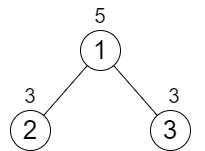
Input: n = 3, cost = [5,3,3]
Output: 0
Explanation: The two paths already have equal total costs, so no increments are needed.
Constraints:
3 <= n <= 105n + 1is a power of2cost.length == n1 <= cost[i] <= 104

Solution
Clarifying Questions
When you get asked this question in a real-life environment, it will often be ambiguous (especially at FAANG). Make sure to ask these questions in that case:
- What are the possible ranges for the node costs in the `costs` array? Could they be negative?
- What is the maximum size of the `costs` array? This will help me understand the potential depth of the binary tree.
- If the input `costs` array is empty, what should I return?
- Could you clarify the definition of 'root-to-leaf' path? Specifically, are we considering only paths from the absolute root (costs[0]) or is the root relative to subtrees?
- If there are multiple ways to minimize the total increment needed to make all root-to-leaf path costs equal, is any valid solution acceptable?
Brute Force Solution
Approach
The problem asks us to adjust the values within a tree so that all paths from the root to the leaves have the same total cost. A brute force approach explores all possible adjustments to find the one that works, without trying to be clever or efficient.
Here's how the algorithm would work step-by-step:
- Consider every possible value change for the very first node (the root).
- For each of those root changes, consider every possible value change for the next nodes down the tree.
- Continue this process, exploring every possible value change for every node in the tree.
- For each complete set of changes to all the nodes, calculate the cost of every path from the root to a leaf.
- Check if all the path costs are equal. If they are, then this set of changes is a potential solution.
- Keep track of all sets of changes that result in equal path costs.
- From all the sets of changes that give equal path costs, choose the one that requires the smallest total change to the node values. This is the best solution.
Code Implementation
class Node:
    def __init__(self, value, left=None, right=None):
        self.value = value
        self.left = left
        self.right = right

def make_costs_of_paths_equal_brute_force(root):
    minimum_cost = float('inf')
    best_tree = None

    def calculate_path_cost(node, current_cost):
        if not node:
            return [current_cost]

        current_cost += node.value

        if not node.left and not node.right:
            return [current_cost]

        path_costs = []
        path_costs.extend(calculate_path_cost(node.left, current_cost))
        path_costs.extend(calculate_path_cost(node.right, current_cost))
        return path_costs

    def calculate_cost_to_change(original_root, modified_root):
        if not original_root:
            return 0

        cost = abs(original_root.value - modified_root.value)

        if original_root.left and modified_root.left:
            cost += calculate_cost_to_change(original_root.left, modified_root.left)
        elif original_root.left or modified_root.left:
            cost = float('inf')
            return cost

        if original_root.right and modified_root.right:
            cost += calculate_cost_to_change(original_root.right, modified_root.right)
        elif original_root.right or modified_root.right:
            cost = float('inf')
            return cost

        return cost

    def explore_tree_configurations(current_root):
        nonlocal minimum_cost, best_tree

        # Need to explore many possible values
        for root_value in range(current_root.value - 5, current_root.value + 6):
            current_root.value = root_value

            if current_root.left:
                # Explore values for the left subtree
                for left_value in range(current_root.left.value - 5, current_root.left.value + 6):
                    current_root.left.value = left_value
                    if current_root.right:
                        # Explore values for the right subtree
                        for right_value in range(current_root.right.value - 5, current_root.right.value + 6):
                            current_root.right.value = right_value
                            path_costs = calculate_path_cost(root, 0)
                            if len(set(path_costs)) == 1:
                                cost_to_change = calculate_cost_to_change(root, root)

                                # We compare this configuration to other configurations
                                if cost_to_change < minimum_cost:
                                    minimum_cost = cost_to_change
                                    best_tree = root
                            # reset value
                            current_root.right.value = right_value - (right_value - current_root.right.value)

                    else:
                        path_costs = calculate_path_cost(root, 0)
                        if len(set(path_costs)) == 1:
                            cost_to_change = calculate_cost_to_change(root, root)
                            if cost_to_change < minimum_cost:
                                minimum_cost = cost_to_change
                                best_tree = root
                    # reset value
                    current_root.left.value = left_value - (left_value - current_root.left.value)
            else:
                path_costs = calculate_path_cost(root, 0)
                if len(set(path_costs)) == 1:
                    cost_to_change = calculate_cost_to_change(root, root)
                    if cost_to_change < minimum_cost:
                        minimum_cost = cost_to_change
                        best_tree = root

    explore_tree_configurations(root)

return minimum_costBig(O) Analysis
Optimal Solution
Approach
The best way to solve this is to work from the bottom up. We figure out the required cost increases needed at each step to make all paths from the root to the leaves have equal cost, ensuring we only increase costs and propagate information efficiently.
Here's how the algorithm would work step-by-step:
- Start by looking at the very bottom of the tree, the leaves. We don't need to do anything at the leaves because they are the end of each path.
- Move up to the parents of the leaves. For each parent, find the maximum cost of all paths from that parent down to the leaves.
- For each child of the parent, figure out how much we need to increase the cost along the path from the parent to that specific child so that all paths from the parent to the leaves have the same maximum cost.
- Add these required cost increases to the parent's cost. This ensures that all paths from this parent down to a leaf have equal cost.
- Repeat this process, moving up the tree one level at a time. Each time, we adjust the cost of a node based on the maximum costs of its children.
- Continue doing this until we reach the very top, the root of the tree.
- The total of all the increases we made as we moved upwards is the final answer: the minimum cost to make all paths from the root to any leaf have equal cost.
Code Implementation
class Node:
    def __init__(self, value):
        self.value = value
        self.left = None
        self.right = None

def min_cost_to_equalize_paths(root):
    total_cost = 0

    def dfs(node):
        nonlocal total_cost

        # Base case: leaf node
        if not node:
            return 0

        left_subtree_cost = dfs(node.left)
        right_subtree_cost = dfs(node.right)

        # Determine the maximum path cost from this node down.
        max_subtree_cost = max(left_subtree_cost, right_subtree_cost)

        # Calculate the cost to add to the current node.
        cost_to_add = max_subtree_cost - node.value

        # Accumulate the total cost.
        if cost_to_add > 0:
            total_cost += cost_to_add

        # Update the current node's value.
        node.value += cost_to_add

        # The path cost to this node's parent is its value plus the max cost from its subtrees.
        return node.value

    dfs(root)
return total_costBig(O) Analysis
Edge Cases
| Case | How to Handle |
|---|---|
| Empty input array (costs is null or has length 0) | Return 0 as there are no paths to adjust when the tree is empty. |
| Input array with only one element | Return 0, as a single-node tree already has equal path costs (only one path). |
| Input array with two elements | Return the absolute difference between the two node costs since they're children of a single root. |
| All costs are identical | Return 0, as all root-to-leaf paths already have equal costs. |
| Costs contain negative numbers | The solution should handle negative costs correctly; the differences are still calculated using absolute values. |
| Integer overflow when calculating differences between costs | Use long data type to store the path cost and total increment to prevent overflow. |
| Large input size impacting memory or stack usage if recursion is used | Use iterative approach to avoid stack overflow errors for very large trees or consider tail-recursive optimizations if recursion is absolutely required. |
| Skewed cost distribution (e.g., one path has very high costs compared to others) | The algorithm should correctly adjust the costs along the lower-cost paths to match the highest cost path, minimizing overall increment. |






