

Matrix Diagonal Sum
Easy





Given a square matrix mat, return the sum of the matrix diagonals.
Only include the sum of all the elements on the primary diagonal and all the elements on the secondary diagonal that are not part of the primary diagonal.
Example 1:
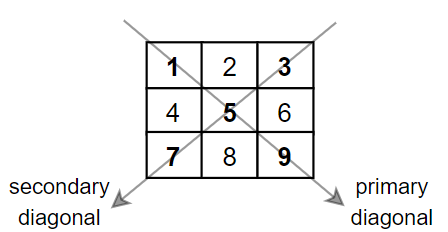
Input: mat = [[1,2,3],
              [4,5,6],
              [7,8,9]]
Output: 25
Explanation: Diagonals sum: 1 + 5 + 9 + 3 + 7 = 25
Notice that element mat[1][1] = 5 is counted only once.
Example 2:
Input: mat = [[1,1,1,1],
              [1,1,1,1],
              [1,1,1,1],
              [1,1,1,1]]
Output: 8
Example 3:
Input: mat = [[5]]
Output: 5
Constraints:
n == mat.length == mat[i].length1 <= n <= 1001 <= mat[i][j] <= 100

Solution
Clarifying Questions
When you get asked this question in a real-life environment, it will often be ambiguous (especially at FAANG). Make sure to ask these questions in that case:
- What is the maximum size (number of rows/columns) of the input matrix `mat`?
- Can the elements within the matrix `mat` be negative, zero, or non-integer values?
- Could you please clarify what should be returned if the input matrix `mat` is empty or null?
- Is the input matrix `mat` guaranteed to be a square matrix (number of rows equals the number of columns)?
- For the case where the matrix has an odd number of rows/columns, is it correct that the center element which lies on both diagonals should only be added to the sum once?
Brute Force Solution
Approach
The brute force method to find the sum of diagonals in a square grid means we'll go through the grid and check every possible cell that could be on either of the diagonals. We'll add the values of those cells together to get our final answer.
Here's how the algorithm would work step-by-step:
- Start at the top-left corner of the grid.
- See if this corner cell is part of the main diagonal (the one going from top-left to bottom-right). If it is, remember the number in that cell.
- Also, see if the top-left corner is part of the other diagonal (the one going from top-right to bottom-left). If it is, and it's a different cell than the one we already looked at, remember that number too.
- Move to the next cell in the grid, going row by row and column by column.
- For each cell, repeat the checks: is it on the main diagonal? Is it on the other diagonal (and not the same cell as one we've already counted)? If so, remember the number.
- Keep doing this until you've checked every single cell in the grid.
- Finally, add up all the numbers you remembered from the diagonal cells to find the total diagonal sum.
Code Implementation
def matrix_diagonal_sum_brute_force(matrix):
    grid_size = len(matrix)
    diagonal_sum = 0

    for row_index in range(grid_size):
        for column_index in range(grid_size):
            # Check for main diagonal (top-left to bottom-right)
            if row_index == column_index:
                diagonal_sum += matrix[row_index][column_index]

            # Check for anti-diagonal (top-right to bottom-left), avoid double counting
            if row_index + column_index == grid_size - 1 and row_index != column_index:
                diagonal_sum += matrix[row_index][column_index]

return diagonal_sumBig(O) Analysis
Optimal Solution
Approach
The goal is to sum the numbers found on the main and anti-diagonal of a square grid of numbers. The clever approach is to traverse the grid once and selectively add numbers to the running total. A simple adjustment avoids double-counting the center element if the grid's side length is odd.
Here's how the algorithm would work step-by-step:
- Begin by setting your running total to zero.
- Go through each position in the grid in a systematic way.
- If a position is on the main diagonal, add its number to the running total.
- If a position is on the anti-diagonal, add its number to the running total.
- If the grid has an odd number of rows and columns, you'll have counted the very center number twice. Reduce your total by the value of the center position to correct for the over-counting.
- The final result is the sum of all the numbers on the two diagonals without double counting.
Code Implementation
def matrix_diagonal_sum(matrix):
    grid_size = len(matrix)
    diagonal_sum = 0

    for row_index in range(grid_size):
        # Add the main diagonal element.
        diagonal_sum += matrix[row_index][row_index]

        # Add the anti-diagonal element.
        diagonal_sum += matrix[row_index][grid_size - 1 - row_index]

    # Correct for double counting if grid size is odd.
    if grid_size % 2 != 0:
        center_index = grid_size // 2
        diagonal_sum -= matrix[center_index][center_index]

return diagonal_sumBig(O) Analysis
Edge Cases
| Case | How to Handle |
|---|---|
| Null or undefined input matrix | Return 0 or throw an IllegalArgumentException to avoid NullPointerException. |
| Empty matrix (matrix with zero rows) | Return 0 as there are no diagonal elements to sum. |
| Matrix with only one element (1x1 matrix) | Return the value of the single element, as it's on both diagonals. |
| Matrix with negative numbers | The solution should handle negative numbers correctly as the problem statement allows integer values. |
| Large matrix (e.g., 1000x1000) to test for performance | The solution should have O(n) time complexity where n is the size of one dimension, making it scalable. |
| Matrix with all elements being zero | The sum should be 0, handled correctly by the summation logic. |
| Matrix with extremely large integer values close to Integer.MAX_VALUE | Consider using long data type for the sum to prevent integer overflow. |
| Non-square matrix | The problem states it receives a 'square matrix' so either throw an error, or adjust to consider diagonals until we reach either row or col end if they are different |






