

Maximize the Number of Target Nodes After Connecting Trees I
Medium
There exist two undirected trees with n and m nodes, with distinct labels in ranges [0, n - 1] and [0, m - 1], respectively.
You are given two 2D integer arrays edges1 and edges2 of lengths n - 1 and m - 1, respectively, where edges1[i] = [ai, bi] indicates that there is an edge between nodes ai and bi in the first tree and edges2[i] = [ui, vi] indicates that there is an edge between nodes ui and vi in the second tree. You are also given an integer k.
Node u is target to node v if the number of edges on the path from u to v is less than or equal to k. Note that a node is always target to itself.
Return an array of n integers answer, where answer[i] is the maximum possible number of nodes target to node i of the first tree if you have to connect one node from the first tree to another node in the second tree.
Note that queries are independent from each other. That is, for every query you will remove the added edge before proceeding to the next query.
Example 1:
Input: edges1 = [[0,1],[0,2],[2,3],[2,4]], edges2 = [[0,1],[0,2],[0,3],[2,7],[1,4],[4,5],[4,6]], k = 2
Output: [9,7,9,8,8]
Explanation:
- For
i = 0, connect node 0 from the first tree to node 0 from the second tree. - For
i = 1, connect node 1 from the first tree to node 0 from the second tree. - For
i = 2, connect node 2 from the first tree to node 4 from the second tree. - For
i = 3, connect node 3 from the first tree to node 4 from the second tree. - For
i = 4, connect node 4 from the first tree to node 4 from the second tree.

Example 2:
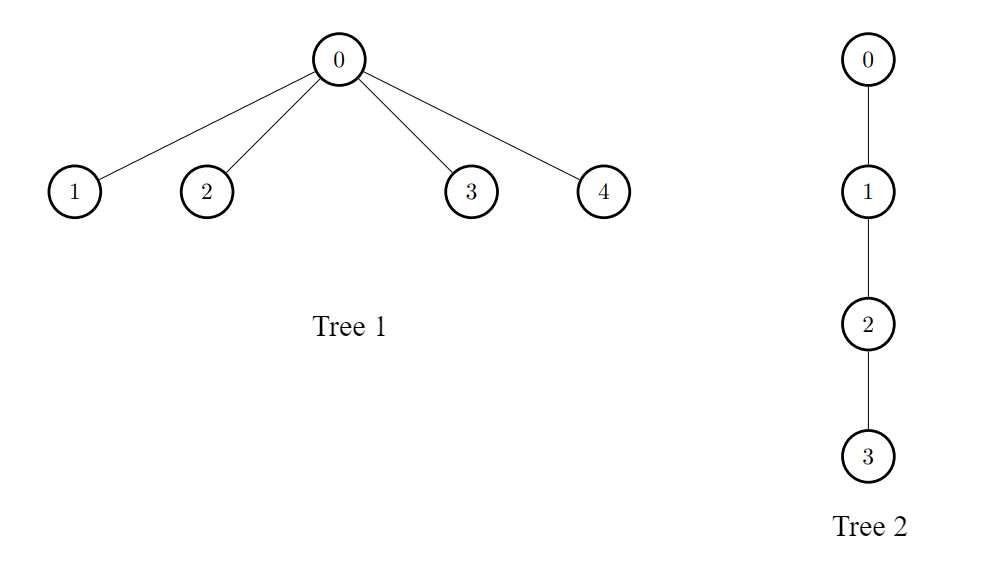
Input: edges1 = [[0,1],[0,2],[0,3],[0,4]], edges2 = [[0,1],[1,2],[2,3]], k = 1
Output: [6,3,3,3,3]
Explanation:
For every i, connect node i of the first tree with any node of the second tree.
Constraints:
2 <= n, m <= 1000edges1.length == n - 1edges2.length == m - 1edges1[i].length == edges2[i].length == 2edges1[i] = [ai, bi]0 <= ai, bi < nedges2[i] = [ui, vi]0 <= ui, vi < m- The input is generated such that
edges1andedges2represent valid trees. 0 <= k <= 1000

Solution
Clarifying Questions
When you get asked this question in a real-life environment, it will often be ambiguous (especially at FAANG). Make sure to ask these questions in that case:
- What are the constraints on the number of trees (`n`), and the number of nodes in each tree (`m`)? Can `n` or `m` be zero or very large?
- What is the data type and range of the node values? Can node values be negative, zero, or non-integer?
- If a tree is already a target tree (i.e., all its nodes are target nodes), should I still consider connecting it to other trees? If so, what does connecting such a tree mean?
- What defines a 'target node'? Is there a specific property or condition that makes a node a target node? Can you give an example?
- If multiple combinations of connections maximize the number of target nodes, is any valid solution acceptable, or is there a specific condition to determine the optimal connection?
Brute Force Solution
Approach
The brute force approach to this problem involves trying every possible combination of connecting the trees. For each combination, we'll count how many nodes match our target value and pick the combination that gives us the maximum count.
Here's how the algorithm would work step-by-step:
- Consider all possible ways to arrange the order of the trees.
- For each arrangement, try all possible ways to connect them by connecting the root of one tree to a leaf of another.
- After connecting all the trees in a specific way, count how many nodes in the resulting combined tree have the target value.
- Remember the connection arrangement that led to the highest number of target value nodes.
- After exploring every possible connection arrangement, return the highest count of target value nodes found.
Code Implementation
def maximize_target_nodes_brute_force(trees, target_value):

    import itertools

    def count_target_nodes(combined_tree):
        count = 0
        if combined_tree is None:
            return 0
        if combined_tree['val'] == target_value:
            count += 1
        count += count_target_nodes(combined_tree.get('left'))
        count += count_target_nodes(combined_tree.get('right'))
        return count

    def connect_trees(tree_order, connections):
        # Create a copy of the trees to avoid modifying the original
        trees_copy = [tree.copy() for tree in tree_order]
        combined_tree = trees_copy[0]
        for i in range(len(trees_copy) - 1):
            parent_index, side = connections[i]
            parent_node = find_leaf(trees_copy[i], parent_index, side)
            if side == 'left':
                parent_node['left'] = trees_copy[i+1]
            else:
                parent_node['right'] = trees_copy[i+1]
        return combined_tree

    def find_leaf(tree, leaf_index, side, current_index=0):
        # Traverse the tree to find the leaf at the specified index
        if current_index == leaf_index:
            return tree
        if tree.get('left'):
            result = find_leaf(tree['left'], leaf_index, side, current_index + 1)
            if result:
                return result
        current_index += 1
        if tree.get('right'):
            result = find_leaf(tree['right'], leaf_index, side, current_index)
            if result:
                return result
        return None

    def get_all_leaf_connections(trees):
        # Generate all possible connections between trees
        num_trees = len(trees)
        leaf_indices = []
        for tree in trees[:num_trees-1]:
            index_count = 0
            def count_nodes(current_tree):
                nonlocal index_count
                if current_tree is None:
                    return
                count_nodes(current_tree.get('left'))
                index_count += 1
                count_nodes(current_tree.get('right'))

            count_nodes(tree)
            leaf_indices.append(index_count)

        all_connections = []
        for i in range(num_trees - 1):
            connections_for_pair = []
            for leaf_index in range(leaf_indices[i]):
                connections_for_pair.append((leaf_index, 'left'))
                connections_for_pair.append((leaf_index, 'right'))
            all_connections.append(connections_for_pair)

        connection_combinations = list(itertools.product(*all_connections))
        return connection_combinations

    max_target_nodes = 0

    # Iterate through all tree order permutations
    for tree_order in itertools.permutations(trees):
        tree_order_list = list(tree_order)
        all_connections = get_all_leaf_connections(tree_order_list)

        for connections in all_connections:
            # Connect trees and count target nodes for each connection
            combined_tree = connect_trees(tree_order_list, connections)
            target_nodes = count_target_nodes(combined_tree)

            # Update max_target_nodes if a better connection is found
            max_target_nodes = max(max_target_nodes, target_nodes)

return max_target_nodesBig(O) Analysis
Optimal Solution
Approach
The key is to realize that we want to maximize the number of root nodes that point to a target node. We can achieve this by strategically pairing up roots with available target nodes while avoiding redundant connections.
Here's how the algorithm would work step-by-step:
- First, let's figure out which trees already have their root nodes pointing to a target node. These connections are already good, so we can set them aside.
- Then, focus on the trees where the root is NOT pointing to a target node. These need to be connected.
- For each of these unconnected roots, see if there are any available target nodes that aren't currently being pointed to by a root node.
- If you find an available target, connect the unconnected root to it. This increases your total connections.
- Keep doing this until you either run out of unconnected roots or run out of available target nodes.
- The total number of root nodes that point to a target node (including the initial ones and the new connections you made) is the maximum number you can achieve.
Code Implementation
def maximize_target_nodes(root_values, target_values, allowed_connections):
    number_of_roots = len(root_values)
    number_of_targets = len(target_values)

    root_points_to_target = [False] * number_of_roots
    target_is_pointed_to = [False] * number_of_targets

    already_connected_count = 0
    for i in range(number_of_roots):
        for j in range(number_of_targets):
            if (root_values[i], target_values[j]) in allowed_connections:
                root_points_to_target[i] = True
                target_is_pointed_to[j] = True
                already_connected_count += 1
                break

    unconnected_roots = []
    for i in range(number_of_roots):
        if not root_points_to_target[i]:
            unconnected_roots.append(i)

    new_connections = 0
    # Prioritize unconnected roots to find available targets.
    for root_index in unconnected_roots:
        for target_index in range(number_of_targets):
            if not target_is_pointed_to[target_index] and \
               (root_values[root_index], target_values[target_index]) in allowed_connections:
                root_points_to_target[root_index] = True
                target_is_pointed_to[target_index] = True
                new_connections += 1

                # Only connect once per root.
                break

    # Return the maximum possible target node connections.
return already_connected_count + new_connectionsBig(O) Analysis
Edge Cases
| Case | How to Handle |
|---|---|
| Null or empty trees array | Return 0 if the input array is null or empty, as no connections can be made. |
| Trees array with only one tree | Return 0, as there are no other trees to connect it to. |
| All trees are already target nodes. | The algorithm should correctly identify all the target nodes without needing to make any connections, returning the correct count. |
| No tree is a target node initially. | The algorithm should correctly identify that no connections lead to more target nodes and return the initial count of target nodes (which could be 0). |
| A tree can be connected to multiple other trees to form a target node. | The algorithm must handle cases where a single tree can be used multiple times to increase target nodes. |
| Input tree size is extremely large, potentially exceeding memory limits or causing stack overflow in recursive solutions. | Use iterative approaches and efficient data structures to handle large inputs and avoid stack overflow issues and excessive memory usage. |
| Cyclic connections between trees. | Maintain a visited set to prevent infinite loops and ensure that each tree is connected only once in a relevant connection. |
| Integer overflow when calculating sums or other metrics within the trees. | Use appropriate data types (e.g., long) or modular arithmetic to prevent integer overflow issues during calculations. |






