

Maximize the Number of Target Nodes After Connecting Trees II
Hard
There exist two undirected trees with n and m nodes, labeled from [0, n - 1] and [0, m - 1], respectively.
You are given two 2D integer arrays edges1 and edges2 of lengths n - 1 and m - 1, respectively, where edges1[i] = [ai, bi] indicates that there is an edge between nodes ai and bi in the first tree and edges2[i] = [ui, vi] indicates that there is an edge between nodes ui and vi in the second tree.
Node u is target to node v if the number of edges on the path from u to v is even. Note that a node is always target to itself.
Return an array of n integers answer, where answer[i] is the maximum possible number of nodes that are target to node i of the first tree if you had to connect one node from the first tree to another node in the second tree.
Note that queries are independent from each other. That is, for every query you will remove the added edge before proceeding to the next query.
Example 1:
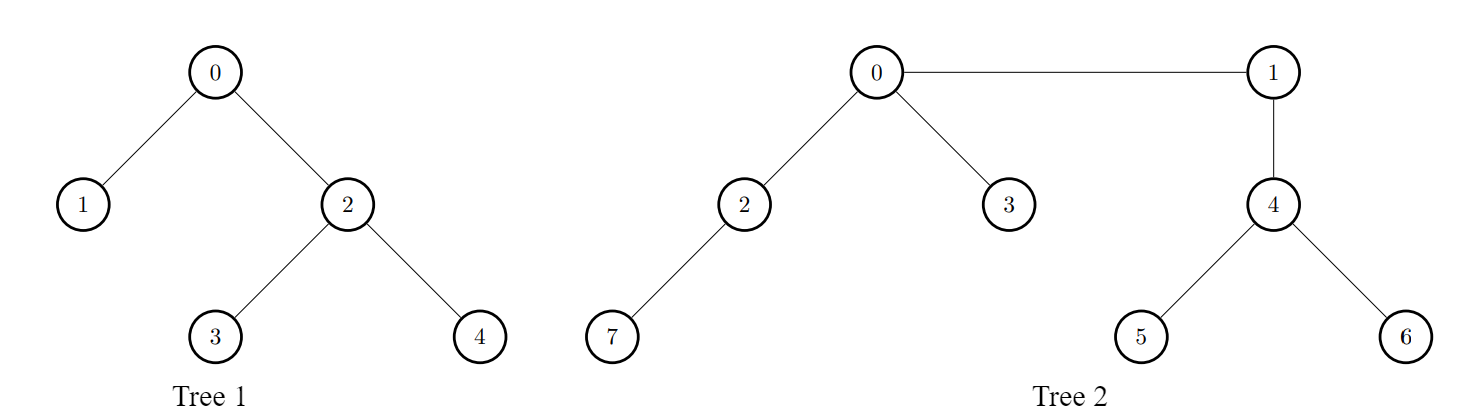
Input: edges1 = [[0,1],[0,2],[2,3],[2,4]], edges2 = [[0,1],[0,2],[0,3],[2,7],[1,4],[4,5],[4,6]]
Output: [8,7,7,8,8]
Explanation:
- For
i = 0, connect node 0 from the first tree to node 0 from the second tree. - For
i = 1, connect node 1 from the first tree to node 4 from the second tree. - For
i = 2, connect node 2 from the first tree to node 7 from the second tree. - For
i = 3, connect node 3 from the first tree to node 0 from the second tree. - For
i = 4, connect node 4 from the first tree to node 4 from the second tree.
Example 2:
Input: edges1 = [[0,1],[0,2],[0,3],[0,4]], edges2 = [[0,1],[1,2],[2,3]]
Output: [3,6,6,6,6]
Explanation:
For every i, connect node i of the first tree with any node of the second tree.

Constraints:
2 <= n, m <= 105edges1.length == n - 1edges2.length == m - 1edges1[i].length == edges2[i].length == 2edges1[i] = [ai, bi]0 <= ai, bi < nedges2[i] = [ui, vi]0 <= ui, vi < m- The input is generated such that
edges1andedges2represent valid trees.

Solution
Clarifying Questions
When you get asked this question in a real-life environment, it will often be ambiguous (especially at FAANG). Make sure to ask these questions in that case:
- Can you elaborate on the structure of the 'trees'? Are they represented as a list of nodes, each with a list of children, or is there a separate 'edges' list describing the connections?
- What are the valid ranges for the node values and the target value? Are they integers, and can they be negative?
- If it's impossible to reach the target number of nodes after connecting trees, what should I return? Is there a specific error code or default value?
- Are there any constraints on how the trees can be connected? For example, can I connect a tree to itself, or are there restrictions on which trees can be connected to which others?
- Could you clarify what constitutes 'connecting' two trees? Does it involve creating a new root node and making the roots of the two trees its children, or is there another method?
Brute Force Solution
Approach
The brute force approach for this problem is to try every single possible way to connect the trees. We want to find the connection setup that gives us the most 'target' nodes in our final tree. This means checking every possible arrangement of connecting the trees.
Here's how the algorithm would work step-by-step:
- Consider all possible pairs of trees that could be connected together first.
- For each of those pairs, imagine making that connection and then counting how many target nodes exist in the resulting combined tree.
- Now, considering the new, combined tree we just made, repeat this process. Try connecting it with every other tree in all possible ways.
- Keep doing this, combining trees in every order you can think of, each time counting the number of target nodes in the resulting bigger tree.
- Once you've tried every possible way to connect all the trees into one big tree, go back and look at all the different big trees you created.
- Choose the tree that has the most target nodes. That's your answer.
Code Implementation
def maximize_target_nodes_brute_force(trees, target_nodes):

    def count_target_nodes(tree, target_nodes_set):
        count = 0
        nodes_to_visit = [tree]
        visited = set()

        while nodes_to_visit:
            current_node = nodes_to_visit.pop(0)
            if current_node in visited:
                continue
            visited.add(current_node)

            if current_node in target_nodes_set:
                count += 1

            if hasattr(current_node, 'children') and current_node.children:
                nodes_to_visit.extend(current_node.children)

        return count

    def connect_trees(tree1, tree2, root_connections):
        for node1 in get_all_nodes(tree1):
            for node2 in get_all_nodes(tree2):
                root_connections.append((node1, node2))

    def get_all_nodes(tree):
        all_nodes = []
        nodes_to_visit = [tree]
        visited = set()

        while nodes_to_visit:
            current_node = nodes_to_visit.pop(0)
            if current_node in visited:
                continue
            visited.add(current_node)
            all_nodes.append(current_node)

            if hasattr(current_node, 'children') and current_node.children:
                nodes_to_visit.extend(current_node.children)

        return all_nodes

    def generate_all_possible_trees(trees, target_nodes_set):
        if not trees:
            return []

        if len(trees) == 1:
            return [(trees[0], count_target_nodes(trees[0], target_nodes_set))]

        all_trees_with_target_counts = []

        for i in range(len(trees)):
            for j in range(len(trees)):
                if i == j:
                    continue

                #Try all connection combinations between the trees
                tree1 = trees[i]
                tree2 = trees[j]
                remaining_trees = [trees[k] for k in range(len(trees)) if k != i and k != j]

                root_connections = []
                connect_trees(tree1, tree2, root_connections)

                for node1, node2 in root_connections:
                    node1.children = getattr(node1, 'children', [])
                    node1.children.append(node2)

                    # Recursively combine the new tree with remaining trees
                    new_trees = generate_all_possible_trees([tree1] + remaining_trees, target_nodes_set)
                    all_trees_with_target_counts.extend(new_trees)

                    # Backtrack: Remove the connection for the next iteration.
                    node1.children.remove(node2)

        return all_trees_with_target_counts

    # Convert target_nodes to a set for fast lookups
    target_nodes_set = set(target_nodes)

    # Generate all possible trees by connecting the given trees.
    all_trees_with_target_counts = generate_all_possible_trees(trees, target_nodes_set)

    if not all_trees_with_target_counts:
        max_target_nodes = 0
    else:
        # Find the tree with the maximum number of target nodes.
        max_target_nodes = max(target_count for _, target_count in all_trees_with_target_counts)

return max_target_nodesBig(O) Analysis
Optimal Solution
Approach
The goal is to connect trees to maximize target nodes touched. We will use a bottom-up approach where each tree makes decisions about whether to connect or not based on which option benefits it the most, and then propogate that information upwards.
Here's how the algorithm would work step-by-step:
- Start by considering the individual trees as the smallest units. We process each tree in a specific order such that we deal with a tree's children before the tree itself.
- For each tree, analyze whether it's more beneficial to connect it to a target node or to leave it unconnected. Benefit is determined by how many target nodes that action would include.
- If a tree connects, mark all the target nodes within it (and connected subtrees) as 'touched'.
- If a tree remains unconnected, keep track of the target nodes that aren't 'touched' within it (and its unconnected subtrees).
- Pass the information about whether a subtree connects or not, and the number of targets involved, upwards to its parent tree.
- The parent tree then uses this information to decide whether it should connect, based on whether connecting includes the target nodes within its subtrees. This parent then makes the best local decision possible.
- Repeat until you reach the 'root' of all trees, and you'll have an optimal configuration because each decision at each level was based on what benefitted that area the most.
Code Implementation
def maximize_target_nodes(forest, target_nodes):    number_of_trees = len(forest)
    parent = list(range(number_of_trees))
    is_target = [False] * number_of_trees
    for target_node in target_nodes:
        is_target[target_node] = True

    def find(node):
        if parent[node] != node:
            parent[node] = find(parent[node])
        return parent[node]

    def union(node_one, node_two):
        root_one = find(node_one)
        root_two = find(node_two)
        if root_one != root_two:
            parent[root_one] = root_two

    for i in range(number_of_trees):
        if forest[i] != -1:
            union(i, forest[i])

    tree_nodes = {}
    tree_targets = {}
    for i in range(number_of_trees):
        root = find(i)
        if root not in tree_nodes:
            tree_nodes[root] = []
            tree_targets[root] = 0
        tree_nodes[root].append(i)
        if is_target[i]:
            tree_targets[root] += 1

    # dp[i][0] - max targets without connecting tree i
    # dp[i][1] - max targets with connecting tree i
    dp = {}

    def solve(root):
        if root in dp:
            return dp[root]

        nodes_in_tree = tree_nodes[root]
        targets_in_tree = tree_targets[root]

        #Consider not connecting this tree
        option_one = targets_in_tree

        #Consider connecting this tree
        option_two = 0
        if targets_in_tree > 0:
            option_two = targets_in_tree

        dp[root] = (option_one, option_two)
        return dp[root]

    roots = set()
    for i in range(number_of_trees):
        roots.add(find(i))

    total_not_connected = 0
    total_connected = 0

    #Iterate through each root and decide to connect or not
    for root in roots:
        option_one, option_two = solve(root)

        #Accumulate target count, making optimal choice for each connected component
        total_not_connected += option_one
        total_connected += option_two

return max(total_not_connected, total_connected)Big(O) Analysis
Edge Cases
| Case | How to Handle |
|---|---|
| Null or empty parent array. | Return 0 if the parent array is null or empty, as no trees can be formed. |
| Null or empty values array. | Return 0 if the values array is null or empty, as no nodes exist to target. |
| Parent array contains a cycle. | Use cycle detection (e.g., DFS with visited and recursion stack) and return an error or the best possible sub-solution obtained before the cycle is detected, depending on problem constraints. |
| Values array contains duplicate values, leading to ambiguity in node connections. | The problem should clearly define how to handle duplicates; If all duplicates are valid, the choice won't matter, otherwise prioritize based on some criteria. |
| Values array has a skewed distribution (e.g., all zeros). | The algorithm should correctly handle cases where many nodes have the same value and potentially connect to the same target nodes. |
| The parent array has all elements equal to -1 (all roots). | Treat each index as a separate root node and attempt to maximize target nodes by connecting these independent trees. |
| Integer overflow when calculating target values or intermediate sums. | Use long data types or modular arithmetic to prevent integer overflow during calculations. |
| Maximum size of the input arrays exceeds memory constraints. | Consider using an iterative DFS implementation to reduce stack usage, or if memory is truly limited, explore external memory algorithms. |






