

Maximum Number of K-Divisible Components
Hard

There is an undirected tree with n nodes labeled from 0 to n - 1. You are given the integer n and a 2D integer array edges of length n - 1, where edges[i] = [ai, bi] indicates that there is an edge between nodes ai and bi in the tree.
You are also given a 0-indexed integer array values of length n, where values[i] is the value associated with the ith node, and an integer k.
A valid split of the tree is obtained by removing any set of edges, possibly empty, from the tree such that the resulting components all have values that are divisible by k, where the value of a connected component is the sum of the values of its nodes.
Return the maximum number of components in any valid split.
Example 1:

Input: n = 5, edges = [[0,2],[1,2],[1,3],[2,4]], values = [1,8,1,4,4], k = 6
Output: 2
Explanation: We remove the edge connecting node 1 with 2. The resulting split is valid because:
- The value of the component containing nodes 1 and 3 is values[1] + values[3] = 12.
- The value of the component containing nodes 0, 2, and 4 is values[0] + values[2] + values[4] = 6.
It can be shown that no other valid split has more than 2 connected components.
Example 2:
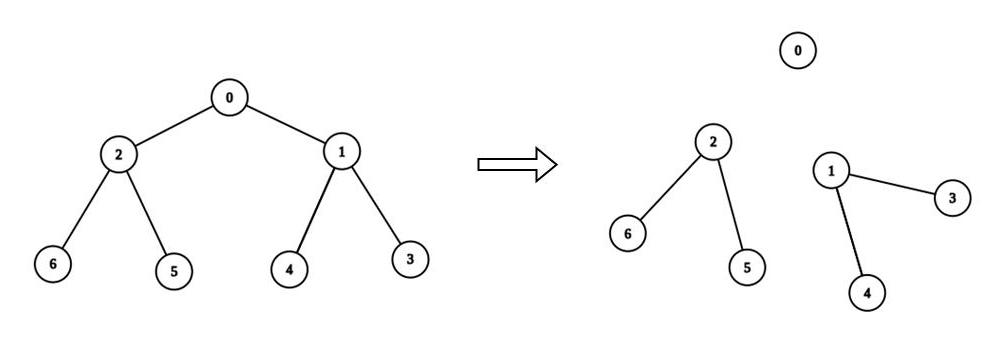
Input: n = 7, edges = [[0,1],[0,2],[1,3],[1,4],[2,5],[2,6]], values = [3,0,6,1,5,2,1], k = 3
Output: 3
Explanation: We remove the edge connecting node 0 with 2, and the edge connecting node 0 with 1. The resulting split is valid because:
- The value of the component containing node 0 is values[0] = 3.
- The value of the component containing nodes 2, 5, and 6 is values[2] + values[5] + values[6] = 9.
- The value of the component containing nodes 1, 3, and 4 is values[1] + values[3] + values[4] = 6.
It can be shown that no other valid split has more than 3 connected components.
Constraints:
1 <= n <= 3 * 104edges.length == n - 1edges[i].length == 20 <= ai, bi < nvalues.length == n0 <= values[i] <= 1091 <= k <= 109- Sum of
valuesis divisible byk. - The input is generated such that
edgesrepresents a valid tree.

Solution
Clarifying Questions
When you get asked this question in a real-life environment, it will often be ambiguous (especially at FAANG). Make sure to ask these questions in that case:
- What are the constraints on the size of the tree (number of nodes)? What are the possible values for the node values and 'k'?
- Can node values or 'k' be negative, zero, or floating-point numbers?
- If a subtree's sum is 0, should I consider it K-divisible (assuming k != 0)?
- Is the input guaranteed to be a valid tree, or should I handle cases where the input might be malformed (e.g., disconnected graph, cycles)?
- If no component is K-divisible, what should I return? Should I return 0, -1, or throw an exception?
Brute Force Solution
Approach
The brute force approach to this problem involves exploring all possible ways to break down the connections between items into separate groups. We systematically try every combination to find the one that gives us the most groups that meet our divisibility requirement. This is like trying every possible team combination in a class and checking if the total score of each team is divisible by a certain number.
Here's how the algorithm would work step-by-step:
- Consider each connection between items one at a time.
- For each connection, we have a choice: either keep the items connected as part of the same group, or break the connection, creating two separate groups.
- We explore every single possible combination of keeping or breaking each connection.
- For each complete scenario (where we've decided whether to keep or break every connection), we end up with a certain number of separate groups.
- For each group in each scenario, calculate the total value of the items in that group.
- Check if this total value is divisible by our special number 'K'.
- Count how many groups in the current scenario have a total value divisible by 'K'.
- Compare this count with the highest count we've seen so far. If it's higher, remember this new highest count.
- After trying every possible scenario of keeping or breaking connections, the highest count we remembered is the answer.
Code Implementation
def maximum_k_divisible_components_brute_force(values, edges, k_value):

    number_of_nodes = len(values)
    maximum_divisible_components = 0

    # Iterate through all possible edge combinations
    for i in range(2**len(edges)):
        edge_set_to_remove = []

        # Determine which edges to remove based on the binary representation of i
        for edge_index in range(len(edges)):
            if (i >> edge_index) & 1:
                edge_set_to_remove.append(edges[edge_index])

        # Create adjacency list based on remaining edges
        adjacency_list = [[] for _ in range(number_of_nodes)]
        for node_one, node_two in edges:
            if (node_one, node_two) not in edge_set_to_remove and \
               (node_two, node_one) not in edge_set_to_remove:
                adjacency_list[node_one].append(node_two)
                adjacency_list[node_two].append(node_one)

        visited = [False] * number_of_nodes
        divisible_components_count = 0

        # Iterate through each node to find connected components
        for node in range(number_of_nodes):
            if not visited[node]:
                component_sum = 0
                component_nodes = []
                stack = [node]
                visited[node] = True

                # Depth-first search to explore the connected component
                while stack:
                    current_node = stack.pop()
                    component_nodes.append(current_node)
                    component_sum += values[current_node]

                    for neighbor in adjacency_list[current_node]:
                        if not visited[neighbor]:
                            visited[neighbor] = True
                            stack.append(neighbor)

                # Check if the component sum is divisible by k
                if component_sum % k_value == 0:
                    divisible_components_count += 1

        # Update the maximum count if necessary
        maximum_divisible_components = max(maximum_divisible_components, divisible_components_count)

return maximum_divisible_componentsBig(O) Analysis
Optimal Solution
Approach
The goal is to divide a connected structure into the maximum number of independent groups, where the sum of values within each group is divisible by a given number K. We achieve this by traversing the structure and strategically breaking it apart whenever a group satisfying the divisibility condition is found.
Here's how the algorithm would work step-by-step:
- Think of the structure as a set of interconnected nodes, each having a value.
- Start at any node and explore its connections, adding the values of connected nodes to a running total.
- At each step, check if the current running total is divisible by K. If it is, we've found a valid group.
- If a valid group is found, disconnect this group from the rest of the structure, increasing our count of valid groups.
- Begin exploring the remaining structure (if any) from a new starting node, repeating the process.
- Continue until all nodes have been assigned to a group or are no longer connected to any other node.
- The final count of valid groups represents the maximum number of K-divisible components.
Code Implementation
def maximum_k_divisible_components(number_of_nodes, edges, node_values, divisor):

    adjacency_list = [[] for _ in range(number_of_nodes)]
    for edge_start, edge_end in edges:
        adjacency_list[edge_start].append(edge_end)
        adjacency_list[edge_end].append(edge_start)

    visited_nodes = [False] * number_of_nodes
    divisible_components_count = 0

    def depth_first_search(current_node):
        visited_nodes[current_node] = True
        current_sum = node_values[current_node]
        nodes_in_component = [current_node]

        for neighbor in adjacency_list[current_node]:
            if not visited_nodes[neighbor]:
                neighbor_sum, neighbor_nodes = depth_first_search(neighbor)
                current_sum += neighbor_sum
                nodes_in_component.extend(neighbor_nodes)

        return current_sum, nodes_in_component

    for node in range(number_of_nodes):
        if not visited_nodes[node]:
            # Initiate DFS to find a connected component
            component_sum, component_nodes = depth_first_search(node)

            if component_sum % divisor == 0:
                # Increment the count because the sum is divisible
                divisible_components_count += 1

return divisible_components_countBig(O) Analysis
Edge Cases
| Case | How to Handle |
|---|---|
| Null or empty graph (no nodes or edges) | Return 0 as there are no components. |
| K is zero | Handle this case by returning the number of nodes if the sum of node values equals 0, otherwise 0. |
| Graph with a single node | Return 1 if the node's value is divisible by K, otherwise 0. |
| All node values are zero | The number of connected components will be the result. |
| Maximum number of nodes (scalability) | Ensure DFS or Union-Find doesn't exceed time or memory limits. |
| Graph is a single connected component, but the sum is not divisible by K | Return 0, as no valid K-divisible component exists. |
| Node values can be negative | Handle negative values correctly when calculating component sums. |
| Integer overflow when summing node values in a component | Use long data type for accumulating sums to prevent overflow. |






