

Maximum Number of Moves in a Grid
Medium

You are given a 0-indexed m x n matrix grid consisting of positive integers.
You can start at any cell in the first column of the matrix, and traverse the grid in the following way:
- From a cell
(row, col), you can move to any of the cells:(row - 1, col + 1),(row, col + 1)and(row + 1, col + 1)such that the value of the cell you move to, should be strictly bigger than the value of the current cell.
Return the maximum number of moves that you can perform.
Example 1:
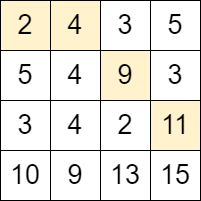
Input: grid = [[2,4,3,5],[5,4,9,3],[3,4,2,11],[10,9,13,15]]
Output: 3
Explanation: We can start at the cell (0, 0) and make the following moves:
- (0, 0) -> (0, 1).
- (0, 1) -> (1, 2).
- (1, 2) -> (2, 3).
It can be shown that it is the maximum number of moves that can be made.
Example 2:
Input: grid = [[3,2,4],[2,1,9],[1,1,7]]
Output: 0
Explanation: Starting from any cell in the first column we cannot perform any moves.
Constraints:
m == grid.lengthn == grid[i].length2 <= m, n <= 10004 <= m * n <= 1051 <= grid[i][j] <= 106

Solution
Clarifying Questions
When you get asked this question in a real-life environment, it will often be ambiguous (especially at FAANG). Make sure to ask these questions in that case:
- What are the dimensions of the grid (number of rows and columns), and what are the constraints on these dimensions?
- What is the range of possible values for the numbers within the grid, and can they be negative, zero, or floating-point numbers?
- What should I return if no valid path exists from the first column to any other column?
- Are diagonal moves allowed, or can I only move right, up-right, or down-right?
- If there are multiple possible paths yielding the same maximum number of moves, is any one of them acceptable, or is there a specific criterion for selecting one?
Brute Force Solution
Approach
We want to find the most steps we can take moving through the grid. The brute force method involves exploring every single possible path to find the longest one.
Here's how the algorithm would work step-by-step:
- Start at each possible starting point in the leftmost column.
- From each starting point, explore every possible move to a neighboring cell in the next column to the right, if such a move is valid based on the given rules.
- Continue exploring possible moves column by column, always moving to the right, until you can't move anymore (you hit the edge of the grid or no valid moves are available).
- Keep track of the length of each path you explore.
- After exploring all possible paths from all starting points, compare the lengths of all the paths you found.
- The longest path you found is the maximum number of moves you can make.
Code Implementation
def maximum_moves_brute_force(grid):
    rows = len(grid)
    cols = len(grid[0])
    maximum_moves = 0

    def explore_path(row, col, current_path_length):
        nonlocal maximum_moves
        maximum_moves = max(maximum_moves, current_path_length)

        # Explore possible moves to the next column.

        for row_direction in [-1, 0, 1]:
            new_row = row + row_direction
            new_col = col + 1

            if 0 <= new_row < rows and new_col < cols and grid[new_row][new_col] > grid[row][col]:

                explore_path(new_row, new_col, current_path_length + 1)

    # Iterate through all possible starting points

    for starting_row in range(rows):
        explore_path(starting_row, 0, 0)

return maximum_movesBig(O) Analysis
Optimal Solution
Approach
We want to find the longest path through a grid, where each step must move to the right and to a larger number. The key is to build the solution step-by-step, reusing previous calculations to avoid redundant work.
Here's how the algorithm would work step-by-step:
- Imagine starting from each cell in the rightmost column, and working backwards towards the left.
- For each cell, find the maximum number of moves you can make starting from that cell.
- You can only move to the right, so you can only move to the cells in the next column to the right.
- You can only move to a cell if its value is greater than the current cell's value.
- When calculating the maximum moves for a cell, look at the maximum moves already computed for the cells to its right that you are allowed to move to. This avoids recomputing the same paths over and over.
- The maximum number of moves for the whole grid is the largest of the maximum moves found for each starting cell in the leftmost column.
Code Implementation
def maximum_moves_in_grid(grid):
    number_of_rows = len(grid)
    number_of_columns = len(grid[0])

    # DP table to store maximum moves from each cell
    maximum_moves = [[0] * number_of_columns for _ in range(number_of_rows)]

    # Iterate over the grid from right to left
    for column_index in range(number_of_columns - 1, -1, -1):
        for row_index in range(number_of_rows):

            # For rightmost column, moves are 0
            if column_index == number_of_columns - 1:
                maximum_moves[row_index][column_index] = 0
            else:
                # Initialize moves from current cell to 0
                current_max_moves = 0
                # Check possible moves to the right
                for next_row_index in [row_index - 1, row_index, row_index + 1]:
                    if 0 <= next_row_index < number_of_rows and grid[next_row_index][column_index + 1] > grid[row_index][column_index]:

                        # Update max moves using already calculated values
                        current_max_moves = max(current_max_moves, maximum_moves[next_row_index][column_index + 1] + 1)

                maximum_moves[row_index][column_index] = current_max_moves

    # Find the maximum moves starting from the leftmost column
    maximum_grid_moves = 0

    # Iterate through all possible start cells in the first column.
    for row_index in range(number_of_rows):
        maximum_grid_moves = max(maximum_grid_moves, maximum_moves[row_index][0])

    # Need to return the maximum possible moves.
return maximum_grid_movesBig(O) Analysis
Edge Cases
| Case | How to Handle |
|---|---|
| Null or empty grid | Return 0 immediately as no moves are possible. |
| Grid with only one row or one column | Return 0 if no moves are possible given the single row or column, otherwise calculate the longest path from the first column. |
| Grid with all identical values | Return 0 immediately, as no move will satisfy the increasing cell value constraint. |
| Negative values in the grid | The solution should handle negative values without issues as the increasing cell value constraint still applies. |
| Grid with a path that circles back on itself (if using a DP solution) | A DP based approach inherently avoids cycles because we only move to the right, avoiding revisits to previous columns. |
| Integer overflow potential when calculating the maximum number of moves (very large grid dimensions or extremely high cell values) | Use a data type that can handle large numbers, like long, to store the maximum number of moves. |
| No valid path exists in the grid | Return 0 if there are no moves possible from any starting cell in the first column, indicating no valid path. |
| Large grid dimensions impacting memory usage if using a DP table | Optimize space complexity by potentially using a single 1D array to store DP values for the current column if previous column values are no longer needed. |






