

Maximum White Tiles Covered by a Carpet
Maximum White Tiles Covered by a Carpet #534 Most Asked
Medium
You are given a 2D integer array tiles where tiles[i] = [li, ri] represents that every tile j in the range li <= j <= ri is colored white.
You are also given an integer carpetLen, the length of a single carpet that can be placed anywhere.
Return the maximum number of white tiles that can be covered by the carpet.
Example 1:

Input: tiles = [[1,5],[10,11],[12,18],[20,25],[30,32]], carpetLen = 10
Output: 9
Explanation: Place the carpet starting on tile 10.
It covers 9 white tiles, so we return 9.
Note that there may be other places where the carpet covers 9 white tiles.
It can be shown that the carpet cannot cover more than 9 white tiles.
Example 2:
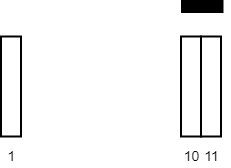
Input: tiles = [[10,11],[1,1]], carpetLen = 2
Output: 2
Explanation: Place the carpet starting on tile 10.
It covers 2 white tiles, so we return 2.
Constraints:
1 <= tiles.length <= 5 * 104tiles[i].length == 21 <= li <= ri <= 1091 <= carpetLen <= 109- The
tilesare non-overlapping.

Solution
Clarifying Questions
When you get asked this question in a real-life environment, it will often be ambiguous (especially at FAANG). Make sure to ask these questions in that case:
- What are the constraints on the size of the `tiles` array and the `carpetLen`? Also, what are the maximum and minimum values for `tiles[i][0]` and `tiles[i][1]`?
- Can the `tiles` array be empty? What should I return in that case?
- Are the tiles guaranteed to be sorted by their starting position `tiles[i][0]`? If not, should I sort them first?
- Can the tile ranges overlap? If so, how should I handle overlapping tiles when calculating the covered area?
- If no tiles are covered by the carpet (e.g., carpetLen is zero or all tiles start after where the carpet can reach), what should I return?
Brute Force Solution
Approach
The brute force approach to this problem is all about trying every single possible placement of the carpet. We will check the number of white tiles covered for each of these placements. Then, we simply pick the carpet placement that covers the most white tiles.
Here's how the algorithm would work step-by-step:
- Imagine placing the left edge of the carpet at the very beginning of the first tile.
- Calculate how many white tiles are covered by the carpet in this position.
- Now, shift the carpet slightly to the right, placing the left edge just after the beginning of the first tile.
- Again, calculate the number of white tiles covered in this new position.
- Continue shifting the carpet to the right, incrementing the position little by little and calculating the covered tiles each time.
- Eventually, you'll have the carpet's left edge at the beginning of the second tile, then just after it, and so on.
- Keep doing this until the right edge of the carpet reaches the end of the last tile.
- Compare the number of tiles covered for all of these different carpet positions.
- The position that gives you the maximum number of covered white tiles is your answer.
Code Implementation
def maximum_white_tiles_covered_brute_force(tiles, carpet_length):
    maximum_covered_tiles = 0
    number_of_tiles = len(tiles)

    # Iterate through all possible starting positions of the carpet.
    for carpet_start_index in range(number_of_tiles):
        carpet_start_position = tiles[carpet_start_index][0]

        # Consider all possible start positions between tiles.
        while carpet_start_position <= tiles[-1][1]:
            covered_tiles = 0

            # Iterate through all tiles and check how many are covered.
            for tile_start, tile_end in tiles:

                # Calculate the overlap between the carpet and the current tile.
                overlap_start = max(carpet_start_position, tile_start)
                overlap_end = min(carpet_start_position + carpet_length, tile_end)

                # If there is a positive overlap, add it to the count.
                overlap = max(0, overlap_end - overlap_start)
                covered_tiles += overlap

            # Update the maximum number of covered tiles.
            maximum_covered_tiles = max(maximum_covered_tiles, covered_tiles)

            # Move carpet one position to the right
            carpet_start_position += 1

return maximum_covered_tilesBig(O) Analysis
Optimal Solution
Approach
The core idea is to efficiently determine the maximum tiles covered by the carpet by sliding it across the tiles. Instead of exhaustively checking every possible placement, we leverage a sliding window technique combined with precomputed sums to find the optimal position.
Here's how the algorithm would work step-by-step:
- First, sort the tile segments by their start positions to make processing easier.
- Create a list of numbers where each number is how long each tile segment is; this will let you quickly find totals for any set of tiles.
- Imagine the carpet starting at the beginning of the first tile; keep track of the total tiles covered by the carpet as you move.
- Slide the carpet to the right, considering each tile's start position as a potential starting point for the carpet.
- While sliding the carpet, calculate how many white tiles are covered by the carpet in its current position by considering the start and end of current tile segment.
- Keep track of the maximum number of white tiles covered seen so far as the carpet moves.
- After considering all possible carpet starting positions, the maximum number of white tiles covered that you've tracked is the answer.
Code Implementation
def maximum_white_tiles(tiles, carpet_length):
    tiles.sort()

tile_lengths = [tile[1] - tile[0] + 1 for tile in tiles]

    max_covered = 0
    window_start = 0
    current_covered = 0

    for window_end in range(len(tiles)):
        current_covered += tile_lengths[window_end]

        # This loop maintains the sliding window within carpet_length.
        while tiles[window_end][1] - tiles[window_start][0] + 1 > carpet_length:
            current_covered -= tile_lengths[window_start]
            window_start += 1

        # Need to recalc the covered tiles within the carpet length
        covered_by_carpet = current_covered
        left_over_space = carpet_length - (tiles[window_end][1] - tiles[window_start][0] + 1)

        if left_over_space < 0:
            covered_by_carpet = current_covered + left_over_space

        #Keep track of maximum tiles covered
        max_covered = max(max_covered, covered_by_carpet)

return max_coveredBig(O) Analysis
Edge Cases
| Case | How to Handle |
|---|---|
| Empty tiles array | Return 0 immediately as there are no tiles to cover. |
| Carpet length is 0 | Return 0 immediately as no tiles can be covered with a carpet of length 0. |
| Carpet length is larger than the range of all tiles | Return the sum of the lengths of all tiles, since the carpet can cover everything. |
| Tiles array has only one tile | Return the length of the single tile, or the carpet length if it's smaller. |
| Tiles are very sparse (large gaps between them) | Sliding window approach will handle large gaps correctly, potentially skipping many iterations. |
| Tiles are clustered together (minimal gaps) | Sliding window will still work efficiently as the covered tiles will increase mostly linearly with the carpet length. |
| Large tile start and end values leading to integer overflow in calculations | Use long data type to store tile start and end values, and intermediate calculations, preventing overflow issues. |
| Tiles are not sorted by starting position | Sort the tiles array based on their starting positions before applying the sliding window algorithm. |






