

Merge BSTs to Create Single BST
Hard
You are given n BST (binary search tree) root nodes for n separate BSTs stored in an array trees (0-indexed). Each BST in trees has at most 3 nodes, and no two roots have the same value. In one operation, you can:
- Select two distinct indices
iandjsuch that the value stored at one of the leaves oftrees[i]is equal to the root value oftrees[j]. - Replace the leaf node in
trees[i]withtrees[j]. - Remove
trees[j]fromtrees.
Return the root of the resulting BST if it is possible to form a valid BST after performing n - 1 operations, or null if it is impossible to create a valid BST.
A BST (binary search tree) is a binary tree where each node satisfies the following property:
- Every node in the node's left subtree has a value strictly less than the node's value.
- Every node in the node's right subtree has a value strictly greater than the node's value.
A leaf is a node that has no children.
Example 1:
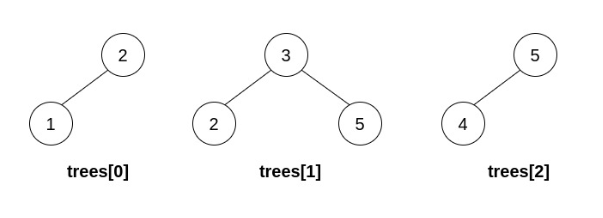
Input: trees = [[2,1],[3,2,5],[5,4]] Output: [3,2,5,1,null,4] Explanation: In the first operation, pick i=1 and j=0, and merge trees[0] into trees[1]. Delete trees[0], so trees = [[3,2,5,1],[5,4]].In the second operation, pick i=0 and j=1, and merge trees[1] into trees[0]. Delete trees[1], so trees = [[3,2,5,1,null,4]].
The resulting tree, shown above, is a valid BST, so return its root.
Example 2:
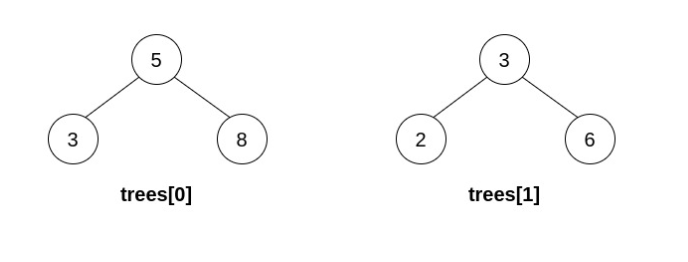
Input: trees = [[5,3,8],[3,2,6]] Output: [] Explanation: Pick i=0 and j=1 and merge trees[1] into trees[0]. Delete trees[1], so trees = [[5,3,8,2,6]].The resulting tree is shown above. This is the only valid operation that can be performed, but the resulting tree is not a valid BST, so return null.
Example 3:
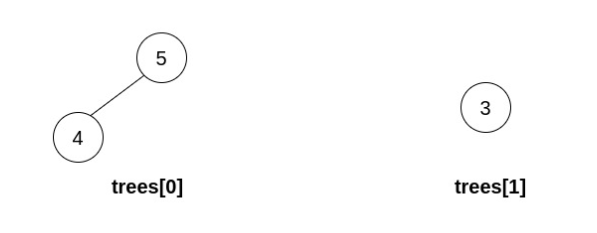
Input: trees = [[5,4],[3]]
Output: []
Explanation: It is impossible to perform any operations.
Constraints:
n == trees.length1 <= n <= 5 * 104- The number of nodes in each tree is in the range
[1, 3]. - Each node in the input may have children but no grandchildren.
- No two roots of
treeshave the same value. - All the trees in the input are valid BSTs.
1 <= TreeNode.val <= 5 * 104.

Solution
Clarifying Questions
When you get asked this question in a real-life environment, it will often be ambiguous (especially at FAANG). Make sure to ask these questions in that case:
- What are the constraints on the number of BSTs in the input list, and the number of nodes in each BST?
- What are the data types of the node values in the BSTs, and what are the min/max values of the allowed range?
- If it's impossible to merge the BSTs into a valid BST within the given range, should I return null, or is there a specific error code or exception I should raise?
- Is the given range inclusive or exclusive?
- Are the BSTs guaranteed to be valid binary search trees initially, or do I need to validate them before merging?
Brute Force Solution
Approach
The brute force method merges BSTs by trying every possible combination of nodes. It involves extracting all nodes from the given BSTs, shuffling them in every possible way, and then attempting to construct a single valid BST from each shuffled order.
Here's how the algorithm would work step-by-step:
- First, gather all the individual pieces (nodes) from all of the binary search trees.
- Next, imagine these pieces are like cards, and we need to arrange them in every single possible order. This means trying every combination imaginable.
- For each of these possible orders, try to build a new binary search tree using those pieces.
- As we're building each tree, check that it follows the rules of a binary search tree: smaller values on the left, larger values on the right. If it breaks these rules at any point, discard that particular order and move on.
- If, after putting all the pieces together in a specific order, we successfully create a valid binary search tree, remember that tree.
- Once we've tried all possible orders, we'll have a collection of potentially valid binary search trees. We then pick the 'best' one. In this scenario we'd stop after the first valid BST is found.
Code Implementation
class Node:
    def __init__(self, value):
        self.value = value
        self.left = None
        self.right = None

def merge_bsts_brute_force(root1, root2):

    all_values = []

    def inorder_traversal(root):
        if root:
            inorder_traversal(root.left)
            all_values.append(root.value)
            inorder_traversal(root.right)

    inorder_traversal(root1)
    inorder_traversal(root2)

    import itertools
    for permutation in itertools.permutations(all_values):

        # Attempt to construct BST from each permutation.
        root = construct_bst(permutation)

        if is_valid_bst(root):
            return root

    return None

def construct_bst(values):
    if not values:
        return None

    root = Node(values[0])

    for value in values[1:]:
        insert_node(root, value)

    return root

def insert_node(root, value):
    if value < root.value:
        if root.left is None:
            root.left = Node(value)
        else:
            insert_node(root.left, value)
    else:
        if root.right is None:
            root.right = Node(value)
        else:
            insert_node(root.right, value)

def is_valid_bst(root):
    def is_bst_helper(node, minimum_value, maximum_value):
        if not node:
            return True

        if node.value <= minimum_value or node.value >= maximum_value:
            return False

        return (is_bst_helper(node.left, minimum_value, node.value) and \
                is_bst_helper(node.right, node.value, maximum_value))

    # Use helper to define initial min/max boundaries.
return is_bst_helper(root, float('-inf'), float('inf'))Big(O) Analysis
Optimal Solution
Approach
The best way to merge Binary Search Trees (BSTs) into a single BST is to leverage their ordered property. First, we extract all the node values from the BSTs, then we rebuild a balanced BST using those values. This is faster than directly merging the tree structures.
Here's how the algorithm would work step-by-step:
- Gather all the values stored in each individual BST into a single, sorted list. Because the nodes of a BST are already in order, getting a sorted list is relatively simple.
- Sort the combined list of values to ensure everything is in ascending order. This is crucial for creating a valid BST.
- Use this sorted list to construct a new, balanced BST. A balanced BST ensures the fastest possible search times.
- The key is to pick the middle element of the sorted list as the root of your BST. Then, recursively build the left subtree with the values before the middle element and the right subtree with the values after the middle element.
- Keep dividing the sorted list in half and making the middle element the root of a (sub)tree until you run out of elements. This guarantees the new BST is properly structured and balanced.
Code Implementation
class Node:
    def __init__(self, data):
        self.data = data
        self.left = None
        self.right = None

def inorder_traversal(root, sorted_list):
    if root:
        inorder_traversal(root.left, sorted_list)
        sorted_list.append(root.data)
        inorder_traversal(root.right, sorted_list)

def sorted_list_to_bst(sorted_list):
    if not sorted_list:
        return None

    middle_index = len(sorted_list) // 2
    root = Node(sorted_list[middle_index])

    # Recursively construct left and right subtrees
    root.left = sorted_list_to_bst(sorted_list[:middle_index])

    root.right = sorted_list_to_bst(sorted_list[middle_index + 1:])

    return root

def merge_bsts(root1, root2):
    # Extract inorder traversal, resulting in sorted lists
    sorted_list_one = []
    inorder_traversal(root1, sorted_list_one)

    sorted_list_two = []
    inorder_traversal(root2, sorted_list_two)

    # Merge the two sorted lists into a single sorted list
    merged_sorted_list = sorted(sorted_list_one + sorted_list_two)

    # Build a balanced BST from the merged sorted list
return sorted_list_to_bst(merged_sorted_list)Big(O) Analysis
Edge Cases
| Case | How to Handle |
|---|---|
| Null or empty list of BSTs | Return null immediately, as no BST can be created without input trees. |
| A single BST is provided, and it falls within the given range | Return the root of that single BST directly if its values fall within the range. |
| The given range is invalid (min > max) | Return null, as no BST can possibly fall within an invalid range. |
| The combined range of values in all BSTs is outside the given range | Return null, as it is impossible to create a BST with values falling in the required range. |
| BSTs with overlapping ranges of values but no duplicates (e.g., [1, 5] and [3, 7]) | The in-order traversal and merge operation should handle overlapping ranges correctly, but validity checks must ensure proper BST structure. |
| Extreme boundary values for node data (Integer.MAX_VALUE, Integer.MIN_VALUE) | Ensure that comparisons and tree construction do not result in integer overflows or other unexpected behavior; use long data type when required. |
| No valid solution exists (BSTs are incompatible and cannot be merged into a single valid BST within range) | After merging, if the resulting tree is not a valid BST or if it falls outside the specified range, return null. |
| Very large number of BSTs leading to potential memory issues during merging | Consider a divide-and-conquer approach, merging BSTs in batches to manage memory efficiently. |






