

Minimize the Maximum Edge Weight of Graph
Medium
You are given two integers, n and threshold, as well as a directed weighted graph of n nodes numbered from 0 to n - 1. The graph is represented by a 2D integer array edges, where edges[i] = [Ai, Bi, Wi] indicates that there is an edge going from node Ai to node Bi with weight Wi.
You have to remove some edges from this graph (possibly none), so that it satisfies the following conditions:
- Node 0 must be reachable from all other nodes.
- The maximum edge weight in the resulting graph is minimized.
- Each node has at most
thresholdoutgoing edges.
Return the minimum possible value of the maximum edge weight after removing the necessary edges. If it is impossible for all conditions to be satisfied, return -1.
Example 1:
Input: n = 5, edges = [[1,0,1],[2,0,2],[3,0,1],[4,3,1],[2,1,1]], threshold = 2
Output: 1
Explanation:
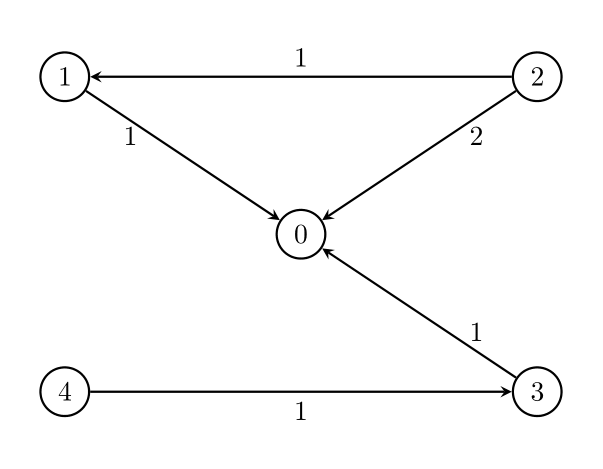
Remove the edge 2 -> 0. The maximum weight among the remaining edges is 1.
Example 2:
Input: n = 5, edges = [[0,1,1],[0,2,2],[0,3,1],[0,4,1],[1,2,1],[1,4,1]], threshold = 1
Output: -1
Explanation:
It is impossible to reach node 0 from node 2.
Example 3:
Input: n = 5, edges = [[1,2,1],[1,3,3],[1,4,5],[2,3,2],[3,4,2],[4,0,1]], threshold = 1
Output: 2
Explanation:
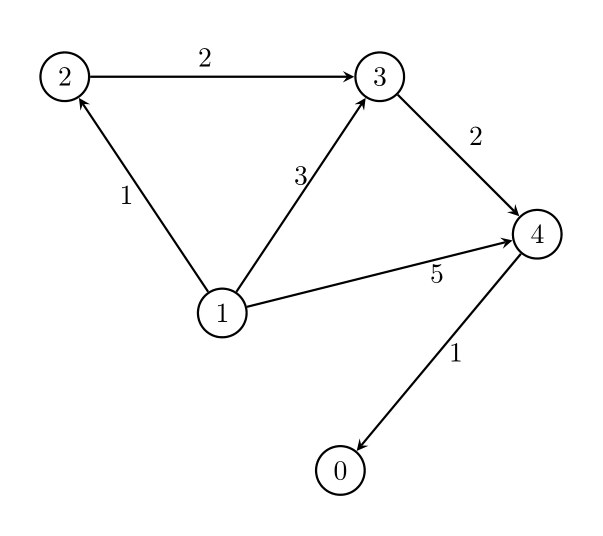
Remove the edges 1 -> 3 and 1 -> 4. The maximum weight among the remaining edges is 2.
Example 4:
Input: n = 5, edges = [[1,2,1],[1,3,3],[1,4,5],[2,3,2],[4,0,1]], threshold = 1
Output: -1
Constraints:
2 <= n <= 1051 <= threshold <= n - 11 <= edges.length <= min(105, n * (n - 1) / 2).edges[i].length == 30 <= Ai, Bi < nAi != Bi1 <= Wi <= 106- There may be multiple edges between a pair of nodes, but they must have unique weights.

Solution
Clarifying Questions
When you get asked this question in a real-life environment, it will often be ambiguous (especially at FAANG). Make sure to ask these questions in that case:
- What are the possible ranges for the number of nodes and edges in the graph, and what is the maximum weight an edge can have?
- Is the graph guaranteed to be connected? If not, what should the algorithm return if there's no path connecting all nodes within the specified weight limit?
- Are edge weights integers? Can edge weights be negative or zero?
- If there are multiple possible solutions (i.e., multiple minimum maximum edge weights), is any one of them acceptable?
- Is the graph directed or undirected?
Brute Force Solution
Approach
The goal is to find the smallest possible heaviest edge we can allow while still being able to connect all the locations. To do this the brute force strategy tries every possible weight limit until one works. For each limit, we check if it's possible to travel between all the locations using only roads with that weight or less.
Here's how the algorithm would work step-by-step:
- Start by guessing a really small weight as the maximum allowed weight for any road.
- Then, only consider the roads that have a weight less than or equal to our guess.
- Check if you can travel from any location to any other location using only these roads.
- If you cannot connect all locations using only those roads, then the guess was too small, and we need to guess a bigger weight.
- Repeat the process with increasingly larger weight guesses until you find the smallest weight that allows you to connect all the locations.
Code Implementation
def minimize_maximum_edge_weight_brute_force(number_of_locations, roads):

    # Sort the edges by weight to make the guessing process easier.
    roads.sort(key=lambda road: road[2])

    for maximum_allowed_weight in range(1, 101): # Iterate through possible weights
        accessible_roads = []
        for start_location, end_location, road_weight in roads:
            if road_weight <= maximum_allowed_weight:
                accessible_roads.append((start_location, end_location))

        # Check if all locations are connected with the current weight limit.
        if is_graph_connected(number_of_locations, accessible_roads):
            return maximum_allowed_weight

def is_graph_connected(number_of_locations, accessible_roads):
    if number_of_locations == 0:
        return True
    if not accessible_roads and number_of_locations > 1:
        return False

    visited_locations = set()
    queue = [1] # Start BFS from location 1
    visited_locations.add(1)

    while queue:
        current_location = queue.pop(0)

        for start_location, end_location in accessible_roads:
            if start_location == current_location and end_location not in visited_locations:
                queue.append(end_location)
                visited_locations.add(end_location)
            elif end_location == current_location and start_location not in visited_locations:
                queue.append(start_location)
                visited_locations.add(start_location)

    # Ensure every location was visited.
return len(visited_locations) == number_of_locationsBig(O) Analysis
Optimal Solution
Approach
The goal is to find the smallest possible maximum weight of an edge in a graph that can still connect all the nodes as specified. We use a binary search approach: we guess a maximum edge weight and see if we can build a connected graph with only edges of that weight or less. If so, we try a smaller weight; otherwise, we try a larger one.
Here's how the algorithm would work step-by-step:
- Think of this as a search problem: what's the smallest maximum edge weight we can get away with and still have a connected graph?
- Use binary search to guess a possible maximum edge weight. This drastically narrows down the possibilities.
- For the weight you guessed, try to build a graph where all the nodes are connected, but only use edges that have a weight less than or equal to your guess.
- If you can successfully build such a connected graph, it means your guess was too high, and you should try a lower weight in the binary search.
- If you can't build a connected graph with the current weight limit, it means your guess was too low, and you need to try a higher weight.
- Keep adjusting your guess (using binary search) until you find the smallest possible maximum edge weight that still allows you to connect all the nodes in the graph.
- Report this value as the answer.
Code Implementation
def minimize_maximum_edge_weight(number_of_nodes, edges):
    left = 0
    right = max(edge[2] for edge in edges)
    minimum_maximum_weight = right

    while left <= right:
        mid = (left + right) // 2

        # Check if the graph is connected with the current maximum weight.
        if is_connected(number_of_nodes, edges, mid):
            minimum_maximum_weight = mid
            right = mid - 1
        else:
            left = mid + 1

    return minimum_maximum_weight

def is_connected(number_of_nodes, edges, max_weight):
    adj = [[] for _ in range(number_of_nodes)]
    for source, destination, weight in edges:
        if weight <= max_weight:
            adj[source - 1].append(destination - 1)
            adj[destination - 1].append(source - 1)

    visited = [False] * number_of_nodes

    # Start DFS from node 0
    dfs(0, adj, visited)

    #If all nodes were visited, the graph is connected
    return all(visited)

def dfs(node, adj, visited):
    visited[node] = True
    for neighbor in adj[node]:
        if not visited[neighbor]:
            dfs(neighbor, adj, visited)

# Example usage (This part is NOT part of the solution, just for testing)
if __name__ == '__main__':
    number_of_nodes = 4
    edges = [[1, 2, 3], [2, 3, 5], [3, 4, 7], [1, 4, 9]]
    result = minimize_maximum_edge_weight(number_of_nodes, edges)
print(f"Minimum maximum edge weight: {result}")Big(O) Analysis
Edge Cases
| Case | How to Handle |
|---|---|
| Empty graph (no edges) | Return 0 or infinity (depending on the problem's definition of 'minimum maximum weight') because there are no edges to consider. |
| Graph with a single node | Return 0 or infinity (depending on the problem's definition) because there are no edges. |
| Graph with two nodes and a single edge of weight 0 | Return 0 because the minimum maximum edge weight is 0 in this case. |
| Graph with many nodes and edges, all with the same weight | The minimum maximum edge weight will be that single weight. |
| Graph with edges that have extremely large weights, potentially leading to integer overflow | Use a data type (e.g., long) that can accommodate large values to avoid overflow during calculations, and be mindful of potential overflow in any weight comparisons. |
| Graph that is not connected | The behavior depends on the problem requirements; either return an error or consider only the connected component containing the start/end nodes, if those are specified. |
| Graph that contains a cycle | Algorithms such as binary search with Disjoint Set Union (DSU) work correctly with cycles because they consider all edges regardless of cycle presence. |
| No path exists between start and end nodes (if the problem asks for a path between nodes) | Return an appropriate error value (e.g., infinity or -1) to indicate that no valid path exists. |






