

Minimum Absolute Difference in BST
Easy

Given the root of a Binary Search Tree (BST), return the minimum absolute difference between the values of any two different nodes in the tree.
Example 1:

Input: root = [4,2,6,1,3]
Output: 1
Example 2:
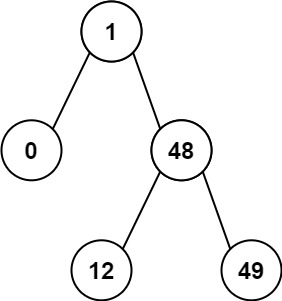
Input: root = [1,0,48,null,null,12,49]
Output: 1
Constraints:
- The number of nodes in the tree is in the range
[2, 104]. 0 <= Node.val <= 105
Note: This question is the same as 783: https://leetcode.com/problems/minimum-distance-between-bst-nodes/

Solution
Clarifying Questions
When you get asked this question in a real-life environment, it will often be ambiguous (especially at FAANG). Make sure to ask these questions in that case:
- What is the range of values that the nodes in the BST can have?
- Can the BST be empty or contain only one node?
- Are duplicate values allowed in the BST, and if so, how should they be handled?
- Is the given tree guaranteed to be a valid Binary Search Tree?
- In the case of an empty tree or a single-node tree, what value should I return?
Brute Force Solution
Approach
The brute force method for finding the minimum absolute difference in a binary search tree involves checking every possible pair of node values. It's like comparing each person in a room with every other person to find the two closest in age, without any clever shortcuts.
Here's how the algorithm would work step-by-step:
- First, gather all the values stored in each of the nodes of the tree into a simple list.
- Then, take the first value in the list and calculate the difference between it and every other value in the list.
- Remember the smallest difference you find.
- Repeat this process for the second value in the list, comparing it to every other value, and update the smallest difference if you find an even smaller one.
- Continue doing this for each value in the list, one by one, always comparing it to all the other values and keeping track of the smallest difference.
- Once you've gone through all the values and compared them with all the others, the smallest difference you've kept track of is the answer.
Code Implementation
def minimum_absolute_difference_bst_brute_force(root):
    node_values = []

    def inorder_traversal(node):
        if node:
            inorder_traversal(node.left)
            node_values.append(node.val)
            inorder_traversal(node.right)

    inorder_traversal(root)
    minimum_difference = float('inf')

    # Iterate through all node values to calculate difference
    for first_index in range(len(node_values)):

        # Compare the first value with all others.
        for second_index in range(len(node_values)):
            if first_index != second_index:

                # Ensure we're only computing absolute differences.
                current_difference = abs(node_values[first_index] - node_values[second_index])

                # Update min difference if smaller value is found
                if current_difference < minimum_difference:
                    minimum_difference = current_difference

return minimum_differenceBig(O) Analysis
Optimal Solution
Approach
The key to solving this problem efficiently lies in understanding the properties of a Binary Search Tree (BST). Since a BST is ordered, we can traverse the tree in a way that allows us to compare adjacent nodes and efficiently find the minimum difference.
Here's how the algorithm would work step-by-step:
- Traverse the tree in an inorder fashion. Inorder traversal visits the left subtree, then the current node, and finally the right subtree. This guarantees we visit nodes in ascending order.
- Keep track of the previously visited node. This allows us to compute the difference between the current node and its immediate predecessor.
- Calculate the absolute difference between the current node's value and the value of the previous node.
- Maintain a running minimum of these absolute differences. Whenever a smaller difference is found, update the minimum.
- Continue the inorder traversal, updating the minimum difference along the way, until all nodes have been visited.
- The final minimum difference is the smallest absolute difference between any two nodes in the BST.
Code Implementation
class TreeNode:
    def __init__(self, val=0, left=None, right=None):
        self.val = val
        self.left = left
        self.right = right

def get_minimum_difference(root):
    minimum_absolute_difference = float('inf')
    previous_node_value = None

    def inorder_traversal(node):
        nonlocal minimum_absolute_difference
        nonlocal previous_node_value

        if not node:
            return

        inorder_traversal(node.left)

        # Only calculate diff after first node
        if previous_node_value is not None:

            difference = abs(node.val - previous_node_value)

            # Update the minimum difference found
            minimum_absolute_difference = min(minimum_absolute_difference, difference)

        # Store current node value for next comp
        previous_node_value = node.val

        inorder_traversal(node.right)

    inorder_traversal(root)
return minimum_absolute_differenceBig(O) Analysis
Edge Cases
| Case | How to Handle |
|---|---|
| Null or empty tree | Return a large value like Integer.MAX_VALUE since no difference can be computed, or handle separately by returning a special value or throwing an exception if appropriate. |
| Tree with only one node | Return a large value like Integer.MAX_VALUE since no difference can be computed. |
| Tree with only two nodes | Directly compute the absolute difference between the two node values. |
| BST with all nodes having the same value | The minimum absolute difference will be 0, which the inorder traversal approach will find when comparing adjacent identical values. |
| Highly skewed BST (e.g., linked list) | Inorder traversal will still correctly find the minimum difference between adjacent nodes, but recursion depth could be a concern, suggesting iterative inorder traversal. |
| BST with negative node values | Absolute difference calculation handles negative numbers correctly. |
| Large range of node values (potential integer overflow) | Ensure that the absolute difference calculation uses long to prevent integer overflow issues. |
| Very large BST | The inorder traversal approach has O(N) time complexity and O(H) space complexity where H is height of the tree, which scales reasonably; however, for extremely deep trees, consider iterative inorder to reduce stack usage. |






