

Minimum Cost for Cutting Cake I
Medium
There is an m x n cake that needs to be cut into 1 x 1 pieces.
You are given integers m, n, and two arrays:
horizontalCutof sizem - 1, wherehorizontalCut[i]represents the cost to cut along the horizontal linei.verticalCutof sizen - 1, whereverticalCut[j]represents the cost to cut along the vertical linej.
In one operation, you can choose any piece of cake that is not yet a 1 x 1 square and perform one of the following cuts:
- Cut along a horizontal line
iat a cost ofhorizontalCut[i]. - Cut along a vertical line
jat a cost ofverticalCut[j].
After the cut, the piece of cake is divided into two distinct pieces.
The cost of a cut depends only on the initial cost of the line and does not change.
Return the minimum total cost to cut the entire cake into 1 x 1 pieces.
Example 1:
Input: m = 3, n = 2, horizontalCut = [1,3], verticalCut = [5]
Output: 13
Explanation:
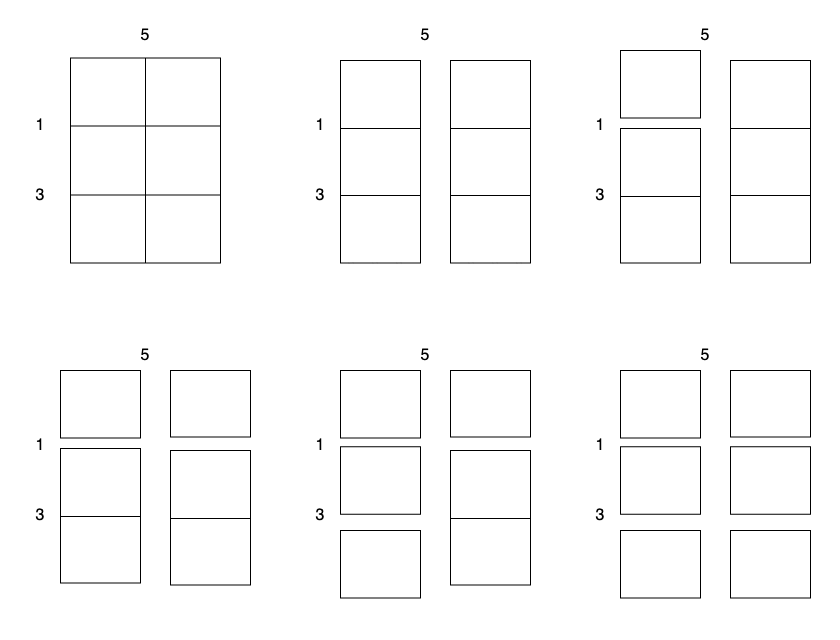
- Perform a cut on the vertical line 0 with cost 5, current total cost is 5.
- Perform a cut on the horizontal line 0 on
3 x 1subgrid with cost 1. - Perform a cut on the horizontal line 0 on
3 x 1subgrid with cost 1. - Perform a cut on the horizontal line 1 on
2 x 1subgrid with cost 3. - Perform a cut on the horizontal line 1 on
2 x 1subgrid with cost 3.
The total cost is 5 + 1 + 1 + 3 + 3 = 13.
Example 2:
Input: m = 2, n = 2, horizontalCut = [7], verticalCut = [4]
Output: 15
Explanation:
- Perform a cut on the horizontal line 0 with cost 7.
- Perform a cut on the vertical line 0 on
1 x 2subgrid with cost 4. - Perform a cut on the vertical line 0 on
1 x 2subgrid with cost 4.
The total cost is 7 + 4 + 4 = 15.
Constraints:
1 <= m, n <= 20horizontalCut.length == m - 1verticalCut.length == n - 11 <= horizontalCut[i], verticalCut[i] <= 103

Solution
Clarifying Questions
When you get asked this question in a real-life environment, it will often be ambiguous (especially at FAANG). Make sure to ask these questions in that case:
- What are the possible ranges for the cut positions and the cake size?
- Are the cut positions guaranteed to be within the bounds of the cake (i.e., between 0 and the cake size)?
- If there are no cuts to be made, should I return 0?
- Are the cut positions provided in any particular order, or can they be unsorted?
- What data type represents the cost of a cut, and can it be negative?
Brute Force Solution
Approach
The brute force method for cutting the cake explores every possible combination of cuts to find the cheapest one. It's like trying every single way to slice the cake and calculating the cost for each, then picking the cheapest option. This guarantees finding the minimum cost, but it can take a very long time.
Here's how the algorithm would work step-by-step:
- Consider every possible place you could make the first cut in the cake.
- For each of those first cut options, consider all the possible places to make the second cut.
- Keep doing this until you've made all the required cuts.
- For each complete set of cuts, calculate the total cost of those cuts.
- Compare the total cost of each set of cuts.
- Choose the set of cuts that has the smallest total cost. That's the minimum cost.
Code Implementation
def minimum_cost_cake_cutting_brute_force(cake_length, cuts):
    cuts.sort()
    number_of_cuts = len(cuts)

    def calculate_cost(current_cuts):
        total_cost = 0
        previous_cut = 0
        for cut in current_cuts:
            total_cost += cut - previous_cut
            previous_cut = cut

        total_cost += cake_length - previous_cut
        return total_cost

    def find_minimum_cost(index, current_cuts):
        # Base case: all cuts have been made
        if len(current_cuts) == number_of_cuts:
            return calculate_cost(current_cuts)

        minimum_cost = float('inf')

        # Explore all possible cut positions
        for cut_position in range(index, cake_length + 1):
            if cut_position not in current_cuts and cut_position in cuts:

                # Recursively explore the remaining cuts
                cost = find_minimum_cost(index + 1, current_cuts + [cut_position])
                minimum_cost = min(minimum_cost, cost)

        return minimum_cost

    # Start the recursion with no cuts made
return find_minimum_cost(0, [])Big(O) Analysis
Optimal Solution
Approach
The problem involves finding the cheapest way to cut a cake given a set of cut locations. The key idea is to realize that the order in which you make the cuts affects the overall cost, and we can find the optimal order by thinking recursively.
Here's how the algorithm would work step-by-step:
- First, imagine you've already made some cuts and are considering where to make the next one.
- Realize that each cut divides a piece of cake into two smaller pieces.
- The cost of a cut is equal to the length of the cake piece you are cutting.
- To find the minimum cost, you need to explore all possible cut locations and figure out the cost for each of the cut location.
- For each of the locations you considered, you now have 2 smaller pieces of cake and need to figure out the optimal way to cut each of them recursively.
- Since you are using recursion, you will start by considering smaller pieces of cake and then working your way upwards.
- Use a way to remember the smallest costs you find as you are exploring so you do not do the same calculation twice. This is a common strategy called 'memorization' that avoids repeating work, which is essential for making the process efficient.
Code Implementation
def min_cost_cut(cake_length, cuts):
    cuts = [0] + sorted(cuts) + [cake_length]
    number_of_cuts = len(cuts)

    memo = {}

    def calculate_cost(left_index, right_index):
        if right_index - left_index <= 1:
            return 0

        if (left_index, right_index) in memo:
            return memo[(left_index, right_index)]

        minimum_cost = float('inf')

        # Iterate through each possible cut location
        for i in range(left_index + 1, right_index):

            # Cost equals length of the current piece
            cost = cuts[right_index] - cuts[left_index]

            # Recursively calculate the cost of cutting the two pieces
            cost += calculate_cost(left_index, i) + calculate_cost(i, right_index)
            minimum_cost = min(minimum_cost, cost)

        # Store the calculated minimum cost
        memo[(left_index, right_index)] = minimum_cost

        return minimum_cost

    # Start the recursive calculation
return calculate_cost(0, number_of_cuts - 1)Big(O) Analysis
Edge Cases
| Case | How to Handle |
|---|---|
| Empty horizontal cuts or vertical cuts array | Return 0 as there are no cuts to be made and thus no cost. |
| Single horizontal or vertical cut | The algorithm should correctly calculate the cost based on the cake size and the single cut location. |
| Horizontal and vertical cuts at the same location (potentially multiple) | The cost calculation should correctly account for potentially overlapping regions. |
| Large number of cuts resulting in integer overflow in cost calculation | Use a data type with a larger range (e.g., long long in C++, long in Java) to prevent integer overflow. |
| Cuts that are out of bounds (negative or larger than cake dimensions) | Filter out invalid cuts before processing to avoid incorrect calculations. |
| Cake of size 1x1 | Handle the case where width and height are one correctly, with a cost of 0 when there are no horizontal or vertical cuts. |
| Duplicate cut values within the horizontal or vertical cuts array | Handle duplicates correctly, as they represent cuts at the same location and should not be double-counted in the cost calculation. |
| Cuts provided already sorted | Ensure the algorithm still functions correctly even if horizontalCuts and verticalCuts are already sorted. |






