

Minimum Cost Homecoming of a Robot in a Grid
Medium
There is an m x n grid, where (0, 0) is the top-left cell and (m - 1, n - 1) is the bottom-right cell. You are given an integer array startPos where startPos = [startrow, startcol] indicates that initially, a robot is at the cell (startrow, startcol). You are also given an integer array homePos where homePos = [homerow, homecol] indicates that its home is at the cell (homerow, homecol).
The robot needs to go to its home. It can move one cell in four directions: left, right, up, or down, and it can not move outside the boundary. Every move incurs some cost. You are further given two 0-indexed integer arrays: rowCosts of length m and colCosts of length n.
- If the robot moves up or down into a cell whose row is
r, then this move costsrowCosts[r]. - If the robot moves left or right into a cell whose column is
c, then this move costscolCosts[c].
Return the minimum total cost for this robot to return home.
Example 1:
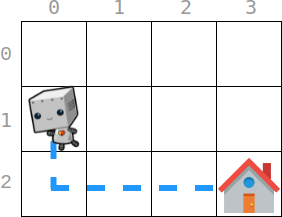
Input: startPos = [1, 0], homePos = [2, 3], rowCosts = [5, 4, 3], colCosts = [8, 2, 6, 7]
Output: 18
Explanation: One optimal path is that:
Starting from (1, 0)
-> It goes down to (2, 0). This move costs rowCosts[2] = 3.
-> It goes right to (2, 1). This move costs colCosts[1] = 2.
-> It goes right to (2, 2). This move costs colCosts[2] = 6.
-> It goes right to (2, 3). This move costs colCosts[3] = 7.
The total cost is 3 + 2 + 6 + 7 = 18
Example 2:
Input: startPos = [0, 0], homePos = [0, 0], rowCosts = [5], colCosts = [26]
Output: 0
Explanation: The robot is already at its home. Since no moves occur, the total cost is 0.
Constraints:
m == rowCosts.lengthn == colCosts.length1 <= m, n <= 1050 <= rowCosts[r], colCosts[c] <= 104startPos.length == 2homePos.length == 20 <= startrow, homerow < m0 <= startcol, homecol < n

Solution
Clarifying Questions
When you get asked this question in a real-life environment, it will often be ambiguous (especially at FAANG). Make sure to ask these questions in that case:
- Are the startPos and homePos guaranteed to be within the bounds of the grid defined by rowCosts and colCosts? If not, what should I return?
- Can the rowCosts and colCosts arrays contain negative costs, zero costs, or only positive costs?
- Is it possible for the startPos to be the same as the homePos? If so, what should I return?
- What are the maximum possible sizes of the rowCosts and colCosts arrays?
- Could you provide an example where the starting row index is greater than the home row index, and the starting column index is greater than the home column index, to make sure I understand the direction of movement costs?
Brute Force Solution
Approach
The problem asks for the cheapest path for a robot to get home in a grid. The brute force approach tries every possible path the robot could take, checking the cost of each path until it finds the cheapest one.
Here's how the algorithm would work step-by-step:
- Start by listing all possible moves the robot can make from its starting location: it can move right or down.
- For each of those moves, list all the possible next moves. Keep going until the robot reaches home.
- Each time the robot takes a step, add the cost of that move to the total cost of the path.
- Once the robot is home, remember the total cost of that particular path.
- Do this for every single possible path the robot can take from start to home.
- Finally, compare the total cost of all the paths you found and choose the path with the lowest cost. That's the cheapest way home!
Code Implementation
def min_cost_homecoming_brute_force(start_row_position, start_column_position,
                                home_row_position, home_column_position,
                                row_costs, column_costs):
    minimum_cost = float('inf')

    def calculate_cost(current_row, current_column, current_cost):
        nonlocal minimum_cost

        # If we reach the home, compare the cost and return
        if current_row == home_row_position and current_column == home_column_position:
            minimum_cost = min(minimum_cost, current_cost)
            return

        # Explore the path moving down
        if current_row < home_row_position:
            new_cost = current_cost + row_costs[current_row]
            calculate_cost(current_row + 1, current_column, new_cost)

        # Explore the path moving up
        if current_row > home_row_position:
            new_cost = current_cost + row_costs[current_row - 1]

            calculate_cost(current_row - 1, current_column, new_cost)

        # Explore the path moving right
        if current_column < home_column_position:
            new_cost = current_cost + column_costs[current_column]
            calculate_cost(current_row, current_column + 1, new_cost)

        # Explore the path moving left
        if current_column > home_column_position:
            new_cost = current_cost + column_costs[current_column - 1]

            calculate_cost(current_row, current_column - 1, new_cost)

    # Initiate the recursion with starting positions
    calculate_cost(start_row_position, start_column_position, 0)

return minimum_costBig(O) Analysis
Optimal Solution
Approach
The robot needs to get home with the least cost. Instead of exploring every possible route, we'll guide it directly by making simple, cost-effective moves either horizontally or vertically until it reaches its destination.
Here's how the algorithm would work step-by-step:
- Figure out the robot's current location and where it needs to go (its home).
- Determine the horizontal distance the robot needs to travel to reach its home's column.
- Calculate the total cost of moving the robot horizontally by adding the cost of each move along that path.
- Determine the vertical distance the robot needs to travel to reach its home's row.
- Calculate the total cost of moving the robot vertically by adding the cost of each move along that path.
- Add the horizontal and vertical costs together. The result is the minimum cost for the robot to get home.
Code Implementation
def min_cost_homecoming(start_pos, home_pos, row_costs, col_costs):
    start_row = start_pos[0]
    start_col = start_pos[1]
    home_row = home_pos[0]
    home_col = home_pos[1]

    row_movement_cost = 0
    # Calculate cost of moving up/down rows
    if start_row < home_row:

        for row_index in range(start_row + 1, home_row + 1):
            row_movement_cost += row_costs[row_index]
    elif start_row > home_row:

        for row_index in range(start_row - 1, home_row - 1, -1):
            row_movement_cost += row_costs[row_index]

    column_movement_cost = 0
    # Calculate cost of moving left/right columns
    if start_col < home_col:

        for col_index in range(start_col + 1, home_col + 1):
            column_movement_cost += col_costs[col_index]
    elif start_col > home_col:

        for col_index in range(start_col - 1, home_col - 1, -1):
            column_movement_cost += col_costs[col_index]

    # Summing the cost for row and column
    total_cost = row_movement_cost + column_movement_cost
return total_costBig(O) Analysis
Edge Cases
| Case | How to Handle |
|---|---|
| startPos equals homePos | Return 0 immediately as no movement is required. |
| Null or empty rowCosts or colCosts arrays | Throw an IllegalArgumentException or return -1 indicating invalid input. |
| rowCosts or colCosts have length 0 | This is also considered an illegal argument, throw exception or return -1. |
| startPos or homePos coordinates are out of bounds for rowCosts or colCosts lengths | Throw an IllegalArgumentException or return -1 indicating out of bounds access. |
| rowCosts or colCosts contain negative costs | Costs are assumed positive, and negative cost is illegal; throw an exception or return -1 to indicate invalid input. |
| Large grid size (large rowCosts and colCosts lengths) | Use int instead of short (or other smaller types) to hold indices/costs to avoid integer overflow issues, and test that it won't cause memory issues. |
| Only moving horizontally or vertically (one of startPos[0] == homePos[0] OR startPos[1] == homePos[1]) | Correctly calculates cost moving only in the appropriate direction (row or column). |
| Integer overflow of accumulated costs | Use long to store accumulated costs to prevent integer overflow during cost calculations. |






