

Minimum Domino Rotations For Equal Row
Minimum Domino Rotations For Equal Row #492 Most Asked
Medium
In a row of dominoes, tops[i] and bottoms[i] represent the top and bottom halves of the ith domino. (A domino is a tile with two numbers from 1 to 6 - one on each half of the tile.)
We may rotate the ith domino, so that tops[i] and bottoms[i] swap values.
Return the minimum number of rotations so that all the values in tops are the same, or all the values in bottoms are the same.
If it cannot be done, return -1.
Example 1:
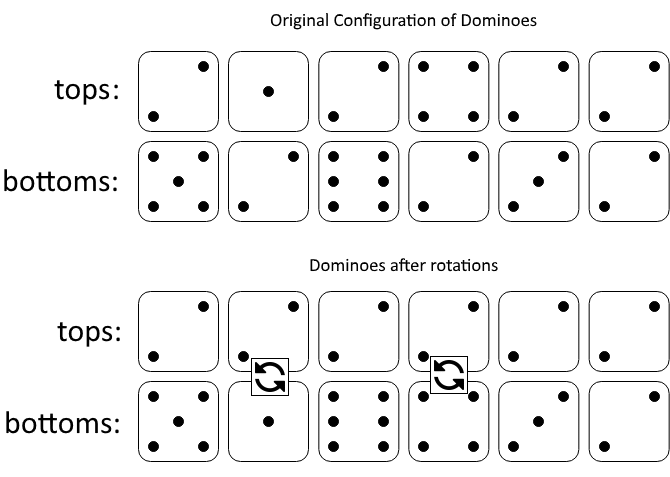
Input: tops = [2,1,2,4,2,2], bottoms = [5,2,6,2,3,2]
Output: 2
Explanation:
The first figure represents the dominoes as given by tops and bottoms: before we do any rotations.
If we rotate the second and fourth dominoes, we can make every value in the top row equal to 2, as indicated by the second figure.
Example 2:
Input: tops = [3,5,1,2,3], bottoms = [3,6,3,3,4]
Output: -1
Explanation:
In this case, it is not possible to rotate the dominoes to make one row of values equal.
Constraints:
2 <= tops.length <= 2 * 104bottoms.length == tops.length1 <= tops[i], bottoms[i] <= 6

Solution
Clarifying Questions
When you get asked this question in a real-life environment, it will often be ambiguous (especially at FAANG). Make sure to ask these questions in that case:
- What is the range of values for the integers in the dominoes arrays A and B? Can they be negative or zero?
- If it's impossible to make all values in either row equal, what should I return?
- Can the input arrays A and B be empty or null? If so, what should I return?
- Are the lengths of arrays A and B guaranteed to be the same?
- If multiple domino values could lead to a minimum number of rotations, is any of those minimums acceptable?
Brute Force Solution
Approach
The brute force way to solve this domino problem is to check every possible value from 1 to 6 and see if we can make either the top or bottom row have all the same value. We'll count how many flips it takes for each possibility and pick the smallest one.
Here's how the algorithm would work step-by-step:
- First, pick a target number between 1 and 6 (inclusive). This is the number we want to make all the domino faces match.
- Next, try to make the top row have all of the target number. Go through the dominoes one by one.
- If the top face of a domino doesn't match the target number, check if the bottom face does.
- If the bottom face does match, we need to 'flip' the domino so the target number is on top. Count this flip.
- If neither the top nor the bottom face matches the target number, it's impossible to make the top row all the target number. Stop and mark this attempt as a failure.
- If we make it through all the dominoes, count the total number of flips we did.
- Now, repeat the process, but this time try to make the bottom row have all the target numbers. Count the flips needed, just like before.
- Do steps 2 through 7 for each number from 1 to 6.
- Finally, after checking all numbers for both the top and bottom rows, pick the solution that required the fewest flips. If we never found a solution, it's impossible to make either row the same, so we'll say it can't be done.
Code Implementation
def minimum_domino_rotations(tops, bottoms):    number_of_dominoes = len(tops)
    minimum_rotations = float('inf')

    for target_number in range(1, 7):
        # Attempt to make the top row all the target number
        rotations_to_top = 0
        possible = True
        for index in range(number_of_dominoes):
            if tops[index] != target_number:
                if bottoms[index] == target_number:
                    rotations_to_top += 1
                else:
                    possible = False
                    break

        # Update minimum rotations if a solution was found
        if possible:
            minimum_rotations = min(minimum_rotations, rotations_to_top)

        # Attempt to make the bottom row all the target number
        rotations_to_bottom = 0
        possible = True
        for index in range(number_of_dominoes):
            if bottoms[index] != target_number:
                if tops[index] == target_number:
                    rotations_to_bottom += 1
                else:
                    possible = False
                    break

        # Update minimum rotations if a solution was found
        if possible:
            minimum_rotations = min(minimum_rotations, rotations_to_bottom)

    # If no solution was found, return -1
    if minimum_rotations == float('inf'):
        return -1
    else:
return minimum_rotationsBig(O) Analysis
Optimal Solution
Approach
The fastest way to solve this is to realize we only care if one of the numbers from the first domino can potentially make an entire row the same. We count how many rotations it takes to make either of those numbers fill a row, and the smaller rotation count is the answer.
Here's how the algorithm would work step-by-step:
- Look at the numbers on the first domino.
- For the first number, count how many dominoes need to be rotated to make the top row all that number.
- If it's impossible to make the top row all that number, mark it as impossible.
- For the first number, count how many dominoes need to be rotated to make the bottom row all that number.
- If it's impossible to make the bottom row all that number, mark it as impossible.
- Repeat the counting process for the second number on the first domino, checking rotations for both the top and bottom rows.
- Compare the four rotation counts (top/bottom for each number). The smallest non-impossible count is the answer.
Code Implementation
def minDominoRotations(tops, bottoms):
    first_domino_top_value = tops[0]
    first_domino_bottom_value = bottoms[0]
    number_of_dominoes = len(tops)

    def calculate_rotations(target_value, target_row):
        rotations_needed = 0
        for i in range(number_of_dominoes):
            if target_row == 'tops':
                if tops[i] != target_value:
                    if bottoms[i] == target_value:
                        rotations_needed += 1
                    else:
                        return float('inf')
            else:
                if bottoms[i] != target_value:
                    if tops[i] == target_value:
                        rotations_needed += 1
                    else:
                        return float('inf')
        return rotations_needed

    #Calculate rotations needed for the top row to match first domino top value
    top_rotations_for_first_top = calculate_rotations(first_domino_top_value, 'tops')

    #Calculate rotations needed for the bottom row to match first domino top value
    bottom_rotations_for_first_top = calculate_rotations(first_domino_top_value, 'bottoms')

    #Calculate rotations needed for the top row to match first domino bottom value
    top_rotations_for_first_bottom = calculate_rotations(first_domino_bottom_value, 'tops')

    #Calculate rotations needed for the bottom row to match first domino bottom value
    bottom_rotations_for_first_bottom = calculate_rotations(first_domino_bottom_value, 'bottoms')

    minimum_rotations = min(top_rotations_for_first_top,
                            bottom_rotations_for_first_top,
                            top_rotations_for_first_bottom,
                            bottom_rotations_for_first_bottom)

    # If it's impossible return -1
    if minimum_rotations == float('inf'):
        return -1

return minimum_rotationsBig(O) Analysis
Edge Cases
| Case | How to Handle |
|---|---|
| Empty input arrays A or B | Return -1 immediately since no rotations are possible. |
| Arrays A and B have different lengths | Return -1 since a common row cannot be achieved. |
| Arrays A and B have a single element | Return 0 if the single elements are equal, and -1 otherwise. |
| All elements in both A and B are the same | Return 0 since no rotations are needed. |
| No number appears in all of A or all of B | Return -1, indicating no solution is possible. |
| Arrays A and B are identical, but no number is the same throughout | This should correctly result in -1 being returned. |
| Arrays A and B have very large size (performance consideration) | Ensure the algorithm iterates the array only a constant number of times (O(n) time complexity). |
| Integer overflow if counting rotations with very large array sizes | The number of rotations will never exceed the array size; thus, integer overflow is not a concern. |






