

Minimum Garden Perimeter to Collect Enough Apples
Minimum Garden Perimeter to Collect Enough Apples #1102 Most Asked
Medium
In a garden represented as an infinite 2D grid, there is an apple tree planted at every integer coordinate. The apple tree planted at an integer coordinate (i, j) has |i| + |j| apples growing on it.
You will buy an axis-aligned square plot of land that is centered at (0, 0).
Given an integer neededApples, return the minimum perimeter of a plot such that at least neededApples apples are inside or on the perimeter of that plot.
The value of |x| is defined as:
xifx >= 0-xifx < 0
Example 1:
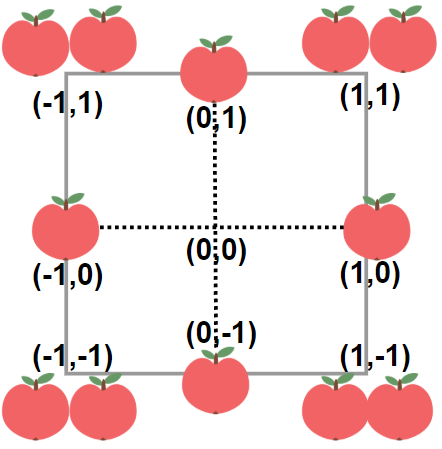
Input: neededApples = 1
Output: 8
Explanation: A square plot of side length 1 does not contain any apples.
However, a square plot of side length 2 has 12 apples inside (as depicted in the image above).
The perimeter is 2 * 4 = 8.
Example 2:
Input: neededApples = 13
Output: 16
Example 3:
Input: neededApples = 1000000000
Output: 5040
Constraints:
1 <= neededApples <= 1015

Solution
Clarifying Questions
When you get asked this question in a real-life environment, it will often be ambiguous (especially at FAANG). Make sure to ask these questions in that case:
- What is the range of the number of apples required (neededApples), and can it be zero?
- Are we dealing with integer apples only? (Can neededApples be a floating-point number?)
- If no garden perimeter can produce enough apples, what should I return?
- Is there an expected output format (e.g., positive integer only)?
- To clarify, each side of the square garden extends equally in all four directions from the origin?
Brute Force Solution
Approach
We need to find the smallest square garden that can hold a certain number of apples. The brute force approach involves trying out different sizes of squares and checking if they can hold enough apples.
Here's how the algorithm would work step-by-step:
- Start with a small square garden.
- Calculate how many apples can grow inside and along the edges of this square.
- Compare the number of apples the garden can hold to the required number of apples.
- If the garden holds enough apples, we've found a potential solution.
- If not, make the square garden bigger.
- Repeat the process of calculating apples and comparing to the requirement for the bigger square.
- Continue increasing the size of the square until we find a garden size that holds enough apples.
- Because we started with small squares and worked our way up, the first garden we find that holds enough apples will be the smallest one that works. The size (perimeter) of this garden is our answer.
Code Implementation
def minimum_perimeter(needed_apples):
    garden_side = 1
    while True:
        # Calculate total apples based on garden size
        total_apples = 2 * garden_side * (garden_side + 1) * (2 * garden_side + 1)

        # Compare apples in garden with needed apples
        if total_apples >= needed_apples:
            # Once total apples are enough, return the perimeter
            return 8 * garden_side

        # Increment to check the next size garden
garden_side += 1Big(O) Analysis
Optimal Solution
Approach
The problem asks us to find the smallest square-shaped fence needed to enclose a certain number of apples planted in a diamond pattern. The key idea is to observe how the number of apples within a square grows as the square gets bigger, and use this to find the smallest square that contains enough apples.
Here's how the algorithm would work step-by-step:
- Imagine the apples arranged in layers forming bigger and bigger diamond shapes.
- Realize that each layer adds a predictable number of apples to the total.
- Start with a small square and gradually increase its size, layer by layer.
- For each square size, quickly calculate the total number of apples inside it, using the pattern of how apples are added with each layer.
- Stop increasing the square size when the total number of apples inside is at least the required number.
- The size of that square's perimeter is the answer.
Code Implementation
def minimum_garden_perimeter(needed_apples):
    layer_index = 0
    total_apples = 0

    while True:
        # Calculate apples added in the current layer.
        apples_in_layer = 12 * (layer_index**2)

        total_apples += apples_in_layer

        # We found a perimeter that collects enough apples.
        if total_apples >= needed_apples:
            break

        layer_index += 1

    # The perimeter is 8 times the layer index.
    perimeter = 8 * layer_index

return perimeterBig(O) Analysis
Edge Cases
| Case | How to Handle |
|---|---|
| n is zero or negative | Return 0 immediately, as no apples are required and thus no perimeter is needed, or throw an IllegalArgumentException if negative. |
| n is a very large number, causing integer overflow during calculation of total apples | Use long data type for intermediate calculations and return value to prevent integer overflow. |
| The minimum possible value for n is 1 | The algorithm should correctly calculate the perimeter for n=1 (perimeter = 8). |
| Very large values of 'n' which would result in very large perimeters exceeding reasonable limits | Check for possible overflow during perimeter calculation (e.g., result > Long.MAX_VALUE) and return appropriate error value or throw an exception. |
| n is close to the maximum representable integer value | Ensure the solution doesn't run into integer overflow when calculating the number of apples and perimeter in the loop. |
| Corner size increments in a way that leads to an infinite loop without reaching n | Ensure termination condition is met eventually, likely by using a well-defined upper bound based on properties of the problem. |
| Apples exceed long MAX, but the perimeter doesn't. | The logic needs to calculate and track the 'apples' count, so that you break out of the loop when the needed number of apples is reached - do not try to calculate the full amount that the final perimeter could possibly yield. |
| Floating point errors resulting in the wrong perimeter size | Ensure all calculations are performed with integer arithmetic to avoid potential floating-point precision issues. |






