

Minimum Number of Food Buckets to Feed the Hamsters
Minimum Number of Food Buckets to Feed the Hamsters #1 Most Asked
Medium
You are given a 0-indexed string hamsters where hamsters[i] is either:
'H'indicating that there is a hamster at indexi, or'.'indicating that indexiis empty.
You will add some number of food buckets at the empty indices in order to feed the hamsters. A hamster can be fed if there is at least one food bucket to its left or to its right. More formally, a hamster at index i can be fed if you place a food bucket at index i - 1 and/or at index i + 1.
Return the minimum number of food buckets you should place at empty indices to feed all the hamsters or -1 if it is impossible to feed all of them.
Example 1:
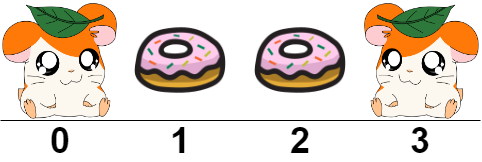
Input: hamsters = "H..H"
Output: 2
Explanation: We place two food buckets at indices 1 and 2.
It can be shown that if we place only one food bucket, one of the hamsters will not be fed.
Example 2:
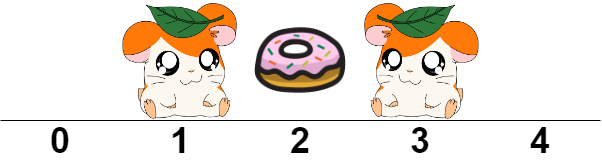
Input: hamsters = ".H.H."
Output: 1
Explanation: We place one food bucket at index 2.
Example 3:
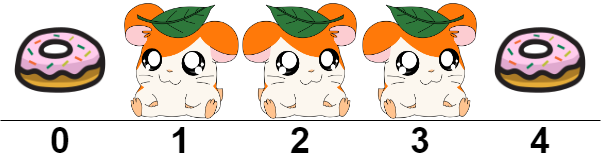
Input: hamsters = ".HHH."
Output: -1
Explanation: If we place a food bucket at every empty index as shown, the hamster at index 2 will not be able to eat.
Constraints:
1 <= hamsters.length <= 105hamsters[i]is either'H'or'.'.

Solution
Clarifying Questions
When you get asked this question in a real-life environment, it will often be ambiguous (especially at FAANG). Make sure to ask these questions in that case:
- What characters are guaranteed to be present in the string, and how are empty spaces versus hamsters represented?
- What exact value should be returned if it is impossible to feed all the hamsters?
- Can a single food bucket feed two hamsters at the same time (e.g., if a bucket is placed between two hamsters like 'H.H'), and does that count as using one bucket?
- Are there any constraints on the maximum length of the street string?
- What should be the expected output for trivial or edge-case inputs, such as an empty string or a street containing no hamsters?
Brute Force Solution
Approach
Imagine you have a street where some spots have hungry hamsters waiting for food and other spots are empty. The brute force approach is like testing every single combination of placing food buckets to see which setup feeds everyone using the fewest buckets.
Here's how the algorithm would work step-by-step:
- Look at the entire row of spots from the very beginning to the very end.
- List out every possible way you could place food buckets in the empty spots.
- For each of your possible setups, walk down the street to check if every single hamster has at least one food bucket sitting right next to them on either their immediate left or their immediate right.
- If a setup misses even a single hamster, cross that setup off your list because it fails the requirement.
- If a setup successfully feeds every hamster, count how many food buckets you used.
- Compare all the successful setups to find the one that used the smallest number of food buckets.
- If it is impossible to feed all the hamsters no matter how you place the buckets, recognize that no valid setup exists.
Code Implementation
def minimumBuckets(street_string):
    from itertools import combinations

    street_length = len(street_string)
    empty_spot_indices = [index for index, character in enumerate(street_string) if character == '.']
    minimum_buckets_needed = float('inf')

    # Iterate through all possible bucket counts to find the minimum valid placement
    for bucket_count in range(len(empty_spot_indices) + 1):
        for current_combination in combinations(empty_spot_indices, bucket_count):
            bucket_positions = set(current_combination)
            all_hamsters_fed = True

            for street_index in range(street_length):
                if street_string[street_index] == 'H':
                    has_bucket_left = (street_index - 1 in bucket_positions)
                    has_bucket_right = (street_index + 1 in bucket_positions)
                    if not has_bucket_left and not has_bucket_right:
                        all_hamsters_fed = False
                        break

            # Track the smallest number of buckets that successfully feeds every hamster
            if all_hamsters_fed:
                minimum_buckets_needed = min(minimum_buckets_needed, bucket_count)

        if minimum_buckets_needed != float('inf'):
            return minimum_buckets_needed

    # Return negative one if no valid bucket combination can feed all hamsters
return -1Big(O) Analysis
Optimal Solution
Approach
To feed the hamsters efficiently, we use a greedy strategy that always prioritizes placing food in the most advantageous spot possible. By scanning through the row from left to right and making local decisions, we ensure that every hungry hamster gets fed using the fewest food buckets overall.
Here's how the algorithm would work step-by-step:
- Walk along the row from left to right, inspecting each spot one by one.
- Whenever you encounter a hamster, check if it has already been fed by a food bucket placed previously.
- If the hamster is not yet fed, look to its immediate right spot to see if it is empty.
- If the right spot is empty, place a food bucket there because it can also help feed the next hamster if needed.
- If the right spot is not empty, look to the immediate left spot of the current hamster.
- If the left spot is empty, place a food bucket there to feed the current hamster.
- If neither neighboring spot is available to place a food bucket, conclude that it is impossible to feed all the hamsters and report failure.
- Continue this process until the end of the row, ensuring each hamster is accounted for with the minimum necessary buckets.
Code Implementation
def minimum_buckets(street_layout):
    street_chars = list(street_layout)
    total_buckets = 0
    index = 0

    while index < len(street_chars):
        if street_chars[index] == 'H':
            if index + 1 < len(street_chars) and street_chars[index + 1] == 'B':
                index += 1

            elif index + 1 < len(street_chars) and street_chars[index + 1] == '.':
                street_chars[index + 1] = 'B'
                total_buckets += 1

            elif index - 1 >= 0 and street_chars[index - 1] == '.':
                street_chars[index - 1] = 'B'
                total_buckets += 1

            else:
                return -1

        index += 1

return total_bucketsBig(O) Analysis
Edge Cases
| Case | How to Handle |
|---|---|
| String with no hamsters present | Return zero buckets since no food is needed. |
| String containing only a single hamster and no empty spaces | Return minus one because a bucket requires an adjacent empty space. |
| Hamsters trapped between two obstacles or at boundaries with no adjacent empty spaces | Return minus one since it is impossible to place a bucket adjacent to them. |
| Hamsters that can share a single bucket placed between them | Greedily place the bucket to the right of the first hamster to maximize coverage for subsequent hamsters. |
| Maximum length street string up to constraints limit | Use a linear scan greedy approach to run in O(n) time complexity and scale efficiently. |
| Multiple consecutive hamsters requiring careful bucket placement | Prioritize placing buckets on the right side of hamsters to service both current and upcoming neighbors. |






